A CORSIA budget built as "tonnes times price" will be wrong in both terms and will omit most of the cost. Building it properly is not difficult, but it requires modelling rather than extrapolating.
The Lines
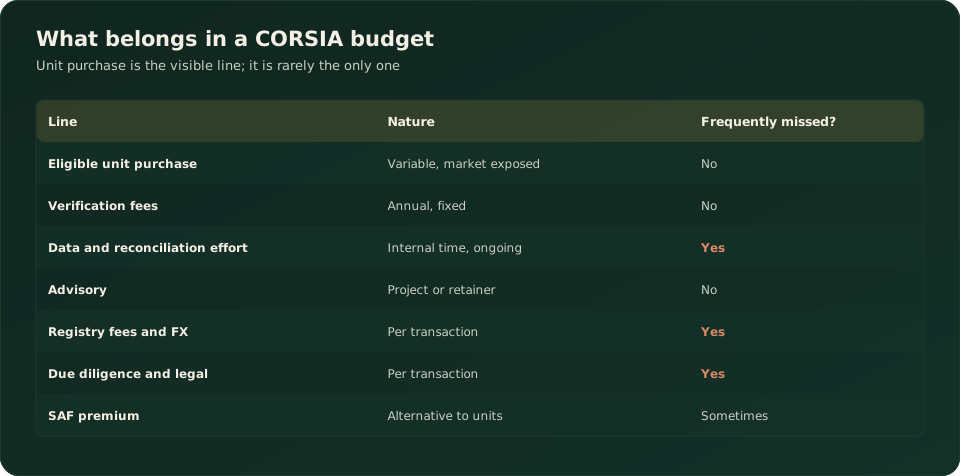
| Line | Nature | Frequently missed |
|---|---|---|
| Eligible unit purchase | Variable, market exposed | No |
| Verification fees | Annual, fixed floor | No |
| Data and reconciliation effort | Internal time, ongoing | Yes |
| Advisory | Project or retainer | No |
| Registry fees and foreign exchange | Per transaction | Yes |
| Due diligence and legal | Per transaction | Yes |
| SAF premium | Alternative to units | Sometimes |
The three marked are where budgets go wrong, and they are all real cash or real capacity.
Data and reconciliation effort is the largest hidden line. Building a defensible pipeline in year one and maintaining it afterwards is genuine work across flight operations, finance and whoever owns the process. Costing it at zero because it is internal produces a budget that understates the commitment and a project that is under-resourced.
Registry fees and foreign exchange appear per transaction and are small individually. Cross-border payment costs on unit purchases are not always trivial.
Due diligence and legal on a first purchase can be a meaningful proportion of a small transaction. At scale it amortises; on a first small tranche it does not.
Forecasting the Requirement
The volume side dominates. A requirement estimate that is 30% wrong swamps a price estimate that is 15% wrong.
Start from covered emissions, not total. International flights, aircraft above 5,700 kg, excluding exempt types, on route pairs where both States participate. For a carrier with a large domestic network this removes most of total emissions immediately, and budgeting from the total overstates the obligation several times over.
Estimate the growth factor as a range. Published industry traffic and emissions data supports a reasonable estimate ahead of ICAO confirmation. Produce low, central and high cases with the assumptions written down.
Layer in individual growth from 2030. Weighting is 15% from 2030 and 30% from 2033. A carrier expanding faster than the sector carries proportionally more.
Model the fuels reduction realistically. Based on fuel you can actually obtain, with certification and chain of custody you can actually produce — not on a sustainability target. An aspirational SAF assumption understates both the obligation and the budget.
The Two Step Changes
These are the parts that cannot be extrapolated.
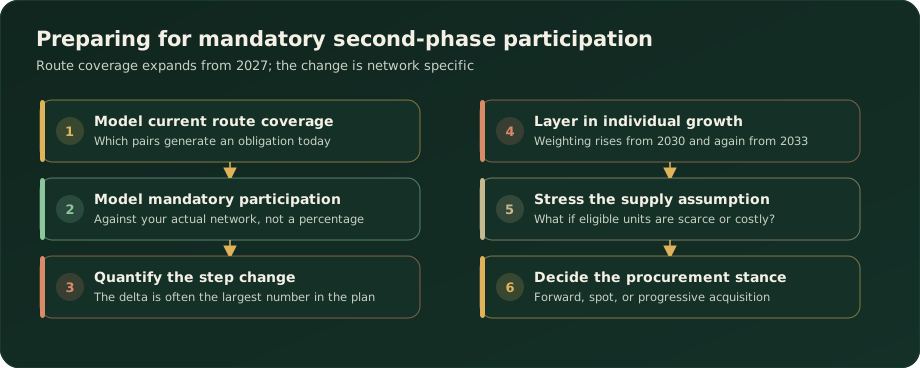
2027 — mandatory participation. Route coverage expands for States above the activity thresholds. Routes generating no obligation today begin to count.
The change is entirely network specific. A carrier flying predominantly to already-participating States sees little difference; one with significant traffic to currently non-participating States can see covered emissions rise substantially. Applying a generic percentage uplift will be wrong in one direction or the other, quite possibly badly.
Model it by re-running your covered-emissions calculation against your actual route network under mandatory participation. The delta is frequently the largest single number in the forecast.
2030 — individual growth factor. Ties the obligation to your own growth. For a growing Indian carrier this is not a marginal effect, and it connects fleet and network planning directly to a compliance cost.
Building the Forecast
- Establish covered emissions for the current year from verified data
- Project covered emissions forward from the fleet and network plan
- Re-run coverage under second-phase mandatory participation from 2027
- Apply growth factor scenarios — low, central, high
- Apply the individual growth weighting from 2030
- Subtract a realistic fuels reduction
- Apply a unit price range anchored in actual quotes, not published averages
- Add the non-unit lines
- State the assumptions and the sensitivities
Anchoring the Price
Do not use published voluntary market averages. They blend incompatible products across an enormous range and describe nothing you can buy.
Anchor instead in actual quotes for actual authorised units, of the vintage and type you would buy, in the volume you would buy. Obtaining those quotes is itself work, and it is what makes the budget defensible when it is questioned.
Present a range with the assumptions stated. A single number in a board paper will be treated as a forecast and will be wrong.
Sensitivities Worth Running
| Scenario | Why it is not remote |
|---|---|
| Unit price doubles | Supply is constrained by government authorisation decisions |
| Requirement 30% above central case | Growth factor and coverage uncertainty compound |
| A programme loses ICAO approval | Approvals have lapsed before |
| Vintage window shifts | Windows have been adjusted before |
| SAF unavailable at planned stations | Availability is regional and thin |
Two of those have close precedents in the scheme's own history. Presenting them as remote possibilities understates the position.
Timing and Cash
Obligations are calculated annually and settled per three-year compliance period, which creates a cash timing question.
Buying progressively spreads cash across the period and averages price exposure. Deferring to the deadline concentrates both, in the window when the entire sector is buying.
There is also no carry-forward — cancelling more than you owe does not bank credit against a future period. Over-cancelling by 5% on a large obligation is simply spent money, which is why forecast accuracy has direct financial value rather than being merely tidy.
Common Budgeting Errors
| Error | Effect |
|---|---|
| Budgeting from total rather than covered emissions | Obligation overstated, often several times |
| Extrapolating a trend through 2027 | Misses the step change entirely |
| Applying a generic percentage uplift for the second phase | Wrong for almost every network |
| Costing internal data effort at zero | Project under-resourced, cost reappears elsewhere |
| Anchoring price on voluntary market averages | Wrong benchmark, usually low |
| Assuming SAF availability at target volumes | Understates obligation and budget together |
| Omitting transaction and FX costs | Small individually, meaningful on a first cycle |
| Presenting a single point estimate | Variance later read as a forecasting failure |
| Ignoring that surplus cancellation is not banked | Over-purchase becomes spent money |
The first and the second are the largest in magnitude. Budgeting from total emissions can overstate the obligation by a multiple; missing the 2027 step can understate it substantially for a network exposed to currently non-participating States.
Both are avoided by the same discipline: model covered emissions against the actual route network, twice — once under current participation and once under mandatory second-phase participation — rather than working from a headline emissions figure and a growth assumption.
Presenting It
For a board or audit committee, four things:
The number, as a range with the central case identified. The trajectory, showing 2027 and 2030 explicitly rather than as a smooth line. The risks, named — supply, price, participation, programme approval. The levers, quantified — fuel efficiency, SAF, procurement timing, requirement accuracy.
Avoid presenting a single point estimate. It will be quoted back later, and the variance will be read as a forecasting failure rather than as the uncertainty you actually described.
Reforecasting Through the Year
A CORSIA budget set once and left alone will drift, because several of its inputs firm up during the year.
After verified emissions are available, replace the estimated covered emissions with the actual figure. This is usually the largest single reduction in uncertainty.
After ICAO publishes growth factors, replace the estimated factor with the confirmed one. The obligation becomes a firm number at this point rather than a range.
When the participation list changes, re-run covered emissions. A State joining or leaving moves route coverage without any change to your operation.
When quotes are obtained, replace the assumed price with observed pricing for the vintage and type you would actually buy.
When network plans change, re-run the forward projection. A route addition to a participating State adds obligation from day one.
A practical cadence is quarterly, with an out-of-cycle update when growth factors are published. Each revision should record what changed and why, so the movement between forecasts is explainable rather than appearing as instability.
The reason this matters beyond tidiness: an obligation understated through the year removes the option of progressive purchasing, because the shortfall is discovered when the only remaining route is a late purchase in a thin market.
Frequently Asked Questions
What is the biggest budget line? Unit purchase once obligations are material. In a first year, the build and verification usually dominate.
How accurate can a forecast be? Reasonably accurate on covered emissions, much less so on the growth factor and price. A range with stated assumptions is the honest output.
Should we budget for the second phase now? Model it now. The step change is known in timing and network-specific in size, and discovering it late removes your procurement options.
How do we cost internal effort? At the loaded cost of the people involved. Treating it as free produces an under-resourced project.
Is SAF cheaper than units? Increasingly often, and the crossover moves as unit prices rise and growth factors increase. Run the comparison on current numbers rather than a remembered conclusion.
What if our forecast is wrong? Under-forecasting is the dangerous direction — it leaves an unmet obligation in a market where replacement may be scarce. Build headroom rather than optimism.
Who should own the forecast? Whoever owns the obligation, with finance validating the assumptions. See board reporting and governance.
Sourcing or cancelling CORSIA units? DSTechnoverse handles registry setup, pre-transaction due diligence, procurement support and cancellation reporting for Indian operators. See our CORSIA carbon credit services. We are based in Indore, Madhya Pradesh and work across India.
Apply as a CORSIA buyer or seller
Talk to our carbon markets team about your position.