Most disappointing CORSIA advisory engagements are not the result of a poor consultant. They are the result of buying the wrong shape of work, usually in the wrong order.
The Four Models
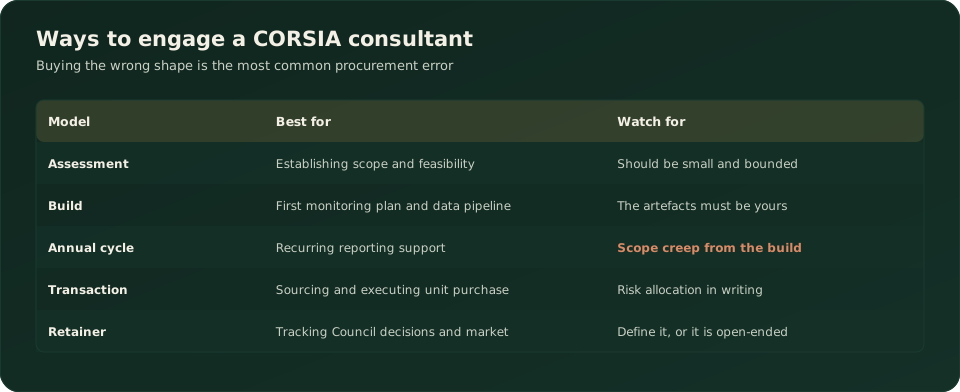
| Model | Answers | Typical duration |
|---|---|---|
| Assessment | Are we in scope, and what state are we in? | 1-4 weeks |
| Build | Establishing the machinery that then runs | 2-4 months |
| Annual cycle | Recurring reporting and verification support | Ongoing, seasonal |
| Transaction | Sourcing and executing a unit purchase | Episodic |
They are sequential more often than parallel, and the sequence matters.
1. Assessment
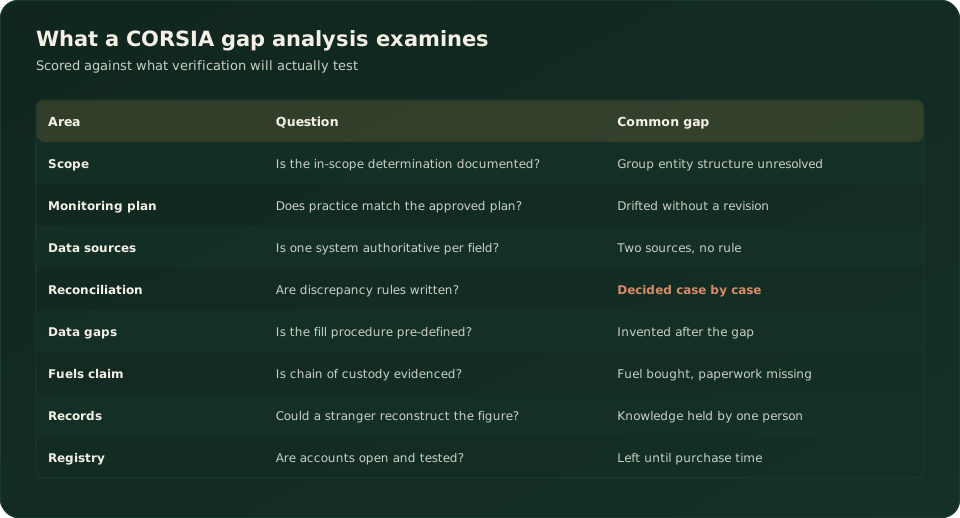
What it covers. Scope and threshold determination, entity identification, data readiness testing, gap analysis against what verification will test, and a view on feasibility and effort.
What it produces. A written position with a prioritised list of what needs doing, sized in days.
When it fits. First. Almost always first.
Why it comes first. It is cheap relative to everything else and it prevents committing budget to the wrong work. An operator who discovers at assessment that they are below the threshold has saved the entire remaining programme.
The signal to watch for: a consultant unwilling to start with a bounded assessment, or one whose assessment always concludes that a large follow-on engagement is required. A genuine diagnostic must be capable of concluding that you are in reasonable shape.
2. Build
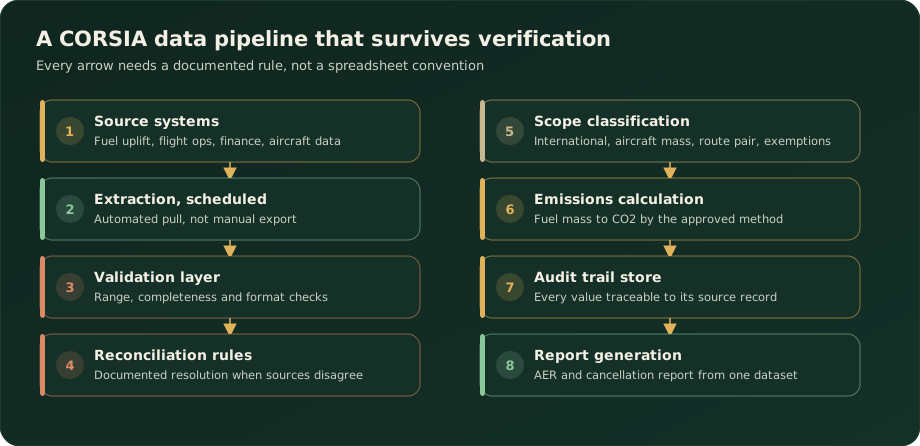
What it covers. The monitoring plan, authority engagement, the data pipeline, reconciliation rules, the evidence structure, and role-based training on what was built.
What it produces. Artefacts that persist — an approved plan, documented rules, a working pipeline, a decision log format.
When it fits. After assessment, before the reporting year.
The critical term: you own the artefacts. Not a summary, not a PDF — the working papers, the rules, the reasoning. A build engagement that leaves the logic in the consultant's model rather than in your documentation has created a dependency, not a capability.
This is where an operator gets the best return from external help, because the outputs are durable and the work is genuinely specialised.
3. Annual Cycle
What it covers. Recurring support through data collection, report compilation, verification liaison and requirement calculation.
When it fits. Where internal capacity genuinely does not exist, and after the build.
The trap: buying the annual cycle before the build. Recurring support wrapped around a defective monitoring plan is expensive maintenance of a problem rather than a fix. If the plan is wrong, no amount of annual support corrects it — the error surfaces at verification every year.
Watch for scope creep in the other direction too. Once the build is done and the pipeline works, much of the annual cycle is work an internal team can run. An engagement that never shrinks is an engagement that is not transferring capability.
4. Transaction
What it covers. Requirement calculation, supply identification, pre-purchase due diligence, contract support, and registry execution.
When it fits. When a purchase is actually imminent.
The term that matters most is risk allocation. If the consultant sources units that prove ineligible, who absorbs that? Agree it in writing before the engagement, separately from any compliance scope. Bundling sourcing into a general advisory retainer leaves the question unanswered until it matters.
On Retainers
Open-ended retainers with vague scope suit the consultant more than the client.
There is a legitimate version: market and regulatory watch. Tracking ICAO Council decisions on programme approvals and vintage windows, participation changes, and supply conditions — with a defined output such as a quarterly note and availability when something material happens. Define it as that, with a modest fee, and it earns its place.
What does not earn its place is "ongoing support" with no defined deliverable. If you cannot state what you receive each month, you are buying availability rather than work.
Sequencing to Avoid Paying Twice
Assess, then build, then run internally, with transaction support when purchasing.
The most common expensive pattern is the reverse: engaging a large ongoing arrangement first, because it feels like covering the risk. It costs more, transfers less capability, and leaves the underlying assessment undone.
A second pattern worth avoiding is buying the build without the assessment. It produces a monitoring plan that may be well written and built on an untested assumption about what your data can support.
Scoping the Contract
Define deliverables concretely. "Compliance support" is not a deliverable. An approved monitoring plan, documented reconciliation rules, a verified emissions report, a documented requirement calculation, a completed cancellation — these are.
Allocate risk explicitly, particularly on sourcing.
Require documentation standards. Working papers, sources and reasoning delivered, and owned by you.
Name the team. Sold by a partner, delivered by a junior is a familiar pattern. Ask who does the work and whether you will meet them.
Keep internal capability. Someone in your organisation must be able to explain your own data. Outsourcing understanding is how organisations become permanently dependent, and the accountability cannot be outsourced regardless.
Judging a Proposal
The written proposal reveals what the conversation does not.
Scope described only in verbs. "Support", "assist", "advise" and "manage" are not deliverables. If you cannot tell from the document what you will hold at the end, neither will the consultant.
No request to see your data. A proposal for monitoring work that does not ask to examine your actual fuel and flight records before recommending a method has been written from a template. The method decision cannot be made from a conversation.
Generic risk language. Boilerplate about market volatility with no reference to vintage windows, programme approval status, host-State authorisation or participation change indicates the risks specific to this scheme have not been considered.
A price with no basis. A CORSIA unit price quoted without stating the vintage, programme, volume and authorisation status is a number with nothing behind it.
A timeline that ignores third parties. Authority review, verifier availability, registry onboarding and host-State authorisation all sit outside the consultant's control. A schedule treating them as instantaneous has not been thought through.
No named team. Ask who does the work and whether you will meet them before signing.
Silence on working papers. You need the reasoning, not just the conclusion. If the contract does not say the working papers are yours, ask before it is signed rather than after.
What to Keep In-House Regardless
Ownership of the obligation. The operator is accountable. A consultant can prepare; they cannot be accountable.
Understanding of your own data. If nobody internally can explain where the fuel figures come from, verification will be painful whoever wrote the report.
Authority to decline a transaction. Diligence that cannot stop a purchase is not diligence.
Transferring Capability Deliberately
The measure of a good build engagement is that the annual engagement afterwards is smaller. That does not happen by itself.
Name an internal counterpart for the duration of the build, who sits alongside the consultant rather than receiving the output at the end. They will not do the specialist work; they will understand why each decision was made, which is what matters later.
Require the reasoning in writing, not just the conclusion. A monitoring plan states the method; the working note explaining why that method was chosen against your data is what allows someone internal to defend it two years on.
Have the internal counterpart run the second month. Not the first, when everything is new, and not the twelfth, when the habit is set. The second month, with the consultant available but not driving.
Agree a taper in the contract. Full support for the first cycle, reduced for the second, on-call for the third. Writing it in makes the transfer a commitment rather than an intention.
Test the transfer. Before the annual engagement reduces, have the internal team produce a figure end to end and explain it. If they cannot, the transfer has not happened and reducing the support will simply produce a gap.
An engagement designed this way costs more in year one and materially less across three. One that is not tends to run at a constant level indefinitely, which is a comfortable arrangement for the consultant and an expensive one for the operator.
Frequently Asked Questions
What should a CORSIA consultant cost? It varies with scope. Ask for scope-based pricing tied to defined deliverables rather than a day rate against an open scope. See CORSIA consultant cost and fees.
Can one firm do everything? Advisory, yes. Verification, no — that requires independence from anyone who advised. Plan for two suppliers.
Should we start with an assessment even if we know we are in scope? Yes. The scope question is only part of it; data readiness is the part that determines whether the monitoring plan will work.
How do we avoid becoming dependent? Own the artefacts, keep a named internal owner, and expect the annual engagement to shrink as capability transfers.
Is a retainer ever worth it? As a defined market and regulatory watch with a stated output, yes. As undefined ongoing support, rarely.
What if we have already engaged badly? Get an independent view on the monitoring plan specifically. It is the document everything else depends on, and correcting it early is far cheaper than at verification.
Who should own the relationship internally? Whoever owns the obligation. See board reporting and governance.
Planning your CORSIA position? DSTechnoverse provides CORSIA carbon credit services for Indian operators and project developers — scope and readiness assessment, monitoring plans, data pipelines, verification support, unit sourcing and second-phase modelling. We are based in Indore, Madhya Pradesh and work across India.
Apply as a CORSIA buyer or seller
Talk to our carbon markets team about your position.