Two scheduled changes will raise most Indian operators' CORSIA obligations, and both arrive on dates already known. Neither can be extrapolated from current cost, because both are step changes rather than trends.
What Changes and When
From 2027 — participation becomes mandatory for States meeting defined aviation activity thresholds, broadly those with a significant share of international activity measured in revenue tonne kilometres.
Exemptions remain for least developed countries, small island developing States, landlocked developing countries and States with very small aviation sectors, unless they volunteer.
The practical effect: route pairs that generate no offsetting obligation today, because one end is non-participating, begin to count.
From 2030 — the individual growth factor enters the calculation:
| Period | Sectoral weight | Individual weight |
|---|---|---|
| To 2029 | 100% | 0% |
| 2030-2032 | 85% | 15% |
| 2033-2035 | 70% | 30% |
A carrier expanding faster than the global sector progressively carries more of its own burden.
Why This Hits Indian Carriers Harder
Two structural features interact badly with rapid growth.
Route coverage. Indian carriers serve a mix of destinations, and networks built around trade and diaspora flows rather than around CORSIA participation include States not currently in the scheme. When those become mandatory participants, coverage expands.
Growth rate. Indian aviation is among the fastest growing markets globally. From 2030, growing faster than the sector means carrying proportionally more — and the weighting roughly doubles again in 2033.
The combined effect: a carrier's CORSIA cost curve is steeper than its emissions curve. That is a planning fact, not a forecast, and it belongs in the fleet and network model rather than arriving as an unexplained cost line.
The Change Is Network-Specific
The most important practical point, and the one most often got wrong.
Applying a percentage uplift to your current obligation will be wrong, quite possibly by a large margin, in one direction or the other.
A carrier flying predominantly to already-participating States sees relatively little change. Its routes already count.
A carrier with significant traffic to currently non-participating States can see covered emissions rise substantially, because a large block of previously uncovered flying enters scope at once.
Two operators with identical total emissions can therefore face very different 2027 changes. There is no general multiplier.
Modelling It Properly
The work is straightforward and needs doing with your own data.
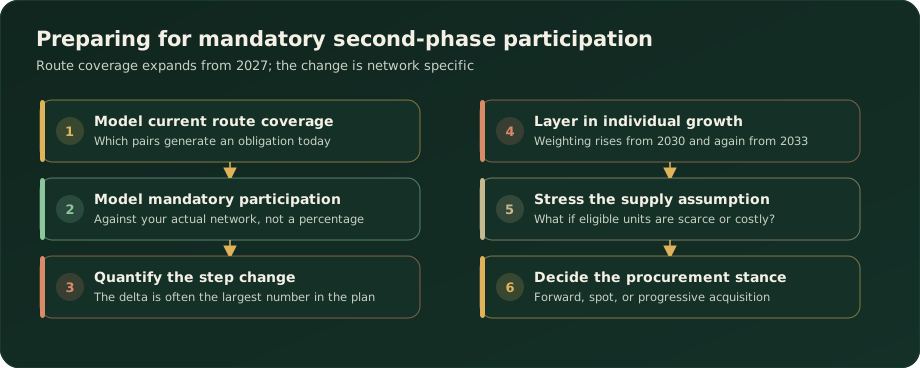
1. Establish current covered emissions. International flights, aircraft above 5,700 kg, exempt types removed, on route pairs where both States participate today.
2. Build the second-phase participation scenario. Which of your destination States fall above the activity thresholds and will therefore participate mandatorily. Some judgement is required at the margins; state your assumptions.
3. Re-run covered emissions under that scenario against your actual route network.
4. Quantify the delta. This is frequently the largest single number in a CORSIA forward plan.
5. Project forward on the fleet and network plan, since the network in 2027 will not be today's network.
6. Layer in individual growth from 2030 against the weighting schedule.
7. Stress the supply assumption. What if eligible units are scarce or substantially more expensive when the whole sector's obligation steps up simultaneously?
What to Have in Place Before 2027
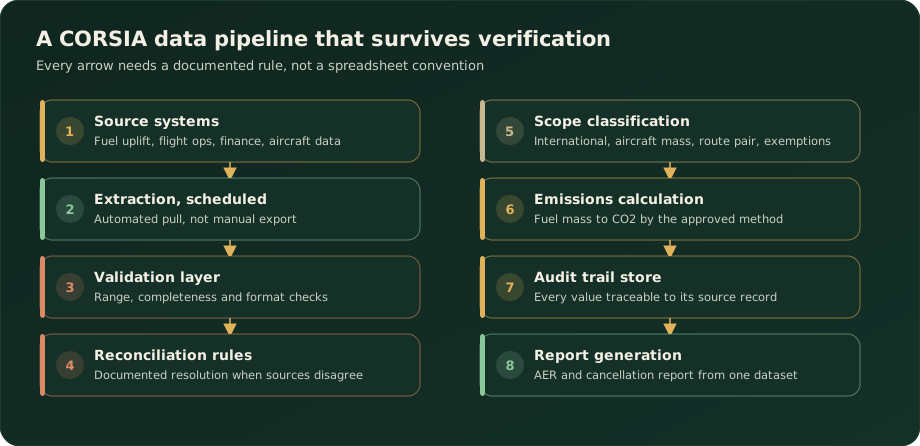
A monitoring plan that scales. More covered flights means more data. A process that works by manual effort at today's volume will not survive the increase. If the pipeline requires heroic effort now, fix it before the volume rises.
Registry accounts open and tested. With more than one authorised representative. Opening them under time pressure in a period when everyone else is transacting is avoidable.
A documented procurement stance. Forward, spot or progressive acquisition, decided deliberately rather than defaulted into. Deferring the decision is itself a decision to buy late.
A supply relationship or two. In an illiquid market, having assessed counterparties before you need them is worth more than it looks.
Board awareness. The step change is large enough for several operators that it belongs in front of the board before it lands, not in the year it arrives.
The Supply Side Consideration
Demand across the whole covered sector steps up on the same date. Supply depends on host-State authorisation decisions that cannot be forecast, and analyses have repeatedly projected that authorised supply will lag obligations.
The risk is asymmetric. If supply improves faster than expected, an operator who contracted forward has slightly overpaid. If it falls short, an operator who waited faces high prices, thin availability and an unmet legal obligation.
Those outcomes are not equally bad, and that asymmetry — rather than any price forecast — is the argument for acting early rather than optimally.
Sequencing the Preparation
Working backwards from 2027, the order matters because several items depend on others.
Now — model the network change. Everything else follows from knowing the size of the step. Without it, procurement strategy, budget and board reporting are all guesses.
Now — fix the pipeline if it needs heroic effort. More covered flights means more data. A process held together by one person's manual work at today's volume will fail at a higher one, and fixing it under load is much harder.
Within a year — open and test registry accounts. With more than one authorised representative. Doing this in a period when the whole sector is transacting is the avoidable version.
Within a year — assess counterparties. Having two or three assessed suppliers before you need them is worth more in an illiquid market than a better price obtained under pressure.
Ahead of 2027 — decide the procurement stance. Forward, spot or progressive, deliberately. Deferring the decision is a decision to buy late.
Ahead of 2027 — brief the board. With the modelled number, not a general warning.
From 2030 — connect fleet planning to the individual growth factor, so growth decisions carry their compliance cost visibly rather than arriving as a surprise line later.
The first item is the gate. Almost every other decision is uninformed without it, which is why it is worth doing properly with your own route data rather than approximating.
What Might Still Change
CORSIA has a periodic review mechanism, and it has been used — the baseline was reset from a 2019-2020 average to 2019 alone after the pandemic.
Further adjustment to growth factor weighting, vintage windows or phase design is possible. Individual States can join or leave. Programme approvals change.
This is not a reason to defer planning. It is a reason to build flexibility in — avoid concentrating in a single vintage, avoid assuming a fixed price path, diversify across programmes, and revisit the model when Council decisions land.
An adviser presenting the 2027 and 2030 parameters as immovable is not following the scheme closely.
What This Means Commercially
The second-phase change is a compliance fact with commercial consequences that reach beyond the compliance team.
Route economics shift. A route to a State that becomes a mandatory participant carries an offsetting cost it did not carry before. On a marginal route that cost is not trivial, and it belongs in the route profitability model rather than in a separate compliance line.
Fleet decisions gain a carbon dimension. Obligation is a percentage of covered emissions, so fuel efficiency reduces it proportionally. A more efficient aircraft has always had a fuel case; from 2027 it has a slightly larger one.
Growth carries a rising cost from 2030. The individual growth factor means expansion is progressively more expensive in compliance terms. This does not argue against growth; it argues for the cost being visible when growth is planned.
SAF becomes relatively more attractive as unit prices rise and growth factors increase, because qualifying fuel reduces the requirement directly. An operator who compared SAF against units three years ago may be carrying a stale conclusion.
Supply relationships have option value. In a market where demand steps up on a known date and supply depends on unpredictable government decisions, having assessed counterparties in advance is worth more than a marginally better price obtained under pressure.
The framing that lands with commercial teams: this is a cost line with a known step change and several levers. Treated as a compliance obligation alone, it arrives as a surprise. Treated as a planning input, it is manageable.
Frequently Asked Questions
Will our obligation definitely increase in 2027? If you serve States that will become mandatory participants, yes. The size depends entirely on your network.
Which States will be mandatory participants? Those above the defined aviation activity thresholds, with exemptions for least developed countries, small island developing States and landlocked developing countries unless they volunteer. Check the current ICAO position rather than a saved list.
Can we use a percentage uplift to estimate it? No. The change is network-specific and a generic multiplier will be wrong.
When should we start modelling? Now. The value of the model is that it informs procurement and fleet decisions, and those are being made already.
Does the individual growth factor apply to everyone? It enters for all operators from 2030, weighted at 15% and then 30%. Its effect is larger for operators growing faster than the sector.
Should we contract forward now? It depends on confidence in your volume forecast. Forwards secure existence as well as price, which matters more in an illiquid market than in a liquid one.
What is the single most useful thing to do first? Model covered emissions under mandatory participation against your actual route network. Everything else follows from that number. See budgeting and forecasting CORSIA costs.
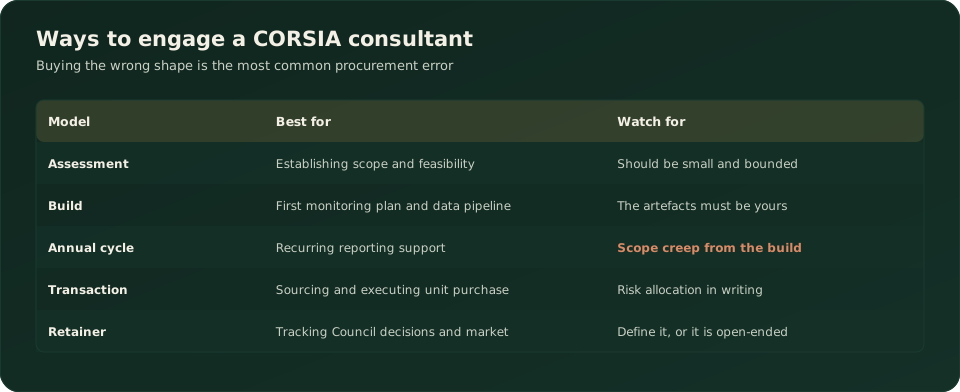
Planning your CORSIA position? DSTechnoverse provides CORSIA carbon credit services for Indian operators and project developers — scope and readiness assessment, monitoring plans, data pipelines, verification support, unit sourcing and second-phase modelling. We are based in Indore, Madhya Pradesh and work across India.
Apply as a CORSIA buyer or seller
Talk to our carbon markets team about your position.