CORSIA is an annual cycle, not a project. That single fact shapes the whole make-or-buy decision, because anything you outsource permanently you will pay for every year, and anything you build internally has to be maintained through staff turnover.
The Three Models
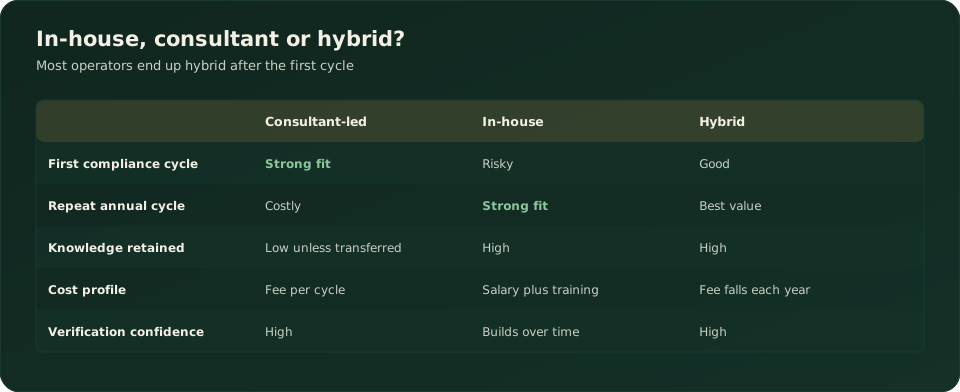
| Consultant-led | In-house | Hybrid | |
|---|---|---|---|
| First compliance cycle | Strong fit | Risky | Good |
| Repeat annual cycle | Costly | Strong fit | Best value |
| Knowledge retained | Low unless transferred | High | High |
| Cost profile | Fee per cycle | Salary plus training | Fee falls each year |
| Verification confidence | High | Builds over time | High |
| Key person risk | On the consultant | On you | Shared |
| Regulatory monitoring | Included | You must track it | Included, lighter |
What Cannot Be Outsourced
Whatever model you choose, some capability has to sit inside the operator:
Accountability. The verified report is the operator's statement, submitted under the operator's name. A consultant prepares it; the operator owns it. The accountable manager signs, and cannot delegate that to a vendor.
Data at source. Fuel figures are generated by your operation — flight crew records, fuel uplift documents, station reports, ACARS or flight data systems. No consultant can improve data that is not captured correctly at the point it arises.
System change. Changes to how data is captured and stored require your IT and operations teams. Consultants specify; you implement.
Day-to-day quality control. Monthly checks for gaps and anomalies have to happen through the year. Discovering in January that six weeks of data are missing is a much worse position than catching it in March.
That list is why the pure consultant-led model does not really exist. The realistic question is how much of the annual cycle sits internally, not whether any of it does.
What a Minimum Internal Team Looks Like
| Role | Responsibility | Time commitment |
|---|---|---|
| Accountable manager | Signs the report, owns the obligation | Low, but must be engaged |
| Compliance lead | Runs the cycle, owns the plan, manages the verifier | Part-time, peaks at year end |
| Data owner (fuel) | Ensures fuel data is captured and complete | Embedded in existing role |
| Data owner (flight records) | Sector data, aircraft, route pairs | Embedded in existing role |
| IT / systems contact | Extracts, retention, change control | Occasional |
| Finance contact | Reconciliation against fuel purchase records | Occasional, valuable |
The compliance lead is the role that matters. One named person who understands the monitoring plan, owns the calendar and manages the verifier makes the difference between a controlled cycle and an annual scramble — regardless of how much external support exists.
The finance reconciliation is underrated. Comparing reported fuel burn against fuel purchase and invoice records is one of the strongest independent checks available, and it is the check verifiers most often perform themselves.
The Cost Comparison, Honestly
Compare over five years rather than one, because the profiles differ:
| Year | Consultant-led | In-house | Hybrid |
|---|---|---|---|
| 1 | Full fee | Recruitment, training, high risk | Full fee, transfer built in |
| 2 | Full fee | Salary | Reduced fee |
| 3 | Full fee | Salary | Light review fee |
| 4 | Full fee | Salary | Light review fee |
| 5 | Full fee | Salary, plus turnover risk | Light review fee |
In-house wins on cost over time and loses on year one risk. Consultant-led wins on year one and never stops costing. Hybrid front-loads the transfer and then tapers, which is why it is where most operators settle.
Two factors shift the answer:
Scale. A large operator with several AOCs, complex routes and continuous change has enough work to justify a dedicated internal function. A small operator with a handful of international sectors does not, and should buy the capability.
Adjacency. If you already run an environmental or sustainability function handling other reporting obligations, CORSIA fits alongside it at low marginal cost. If the compliance lead role would exist purely for CORSIA, the case for in-house weakens considerably.
Building the Capability Internally
If you decide to bring it in-house, do it deliberately:
- Appoint the compliance lead before the first cycle, not after
- Have them work alongside the consultant through the first cycle rather than receiving a handover at the end
- Require the artefacts — procedures, data flow diagram, evidence pack template, worked example
- Send them to the verification fieldwork. Watching a verifier work teaches more than any document
- Give them a deputy. Single-person capability is one resignation away from being no capability
- Budget for a light external review in years two and three before verification
- Assign regulatory monitoring explicitly — participating states and eligible unit criteria change, and someone must track them
Point 4 is the highest-value training available and costs nothing extra. The verifier's questions are the specification, expressed more clearly than any guidance document manages.
When to Keep External Support
Even a capable internal team benefits from external input in specific situations:
- The first cycle after a material change — new AOC, merger, significant route expansion
- A regulatory phase change, when obligations shift
- After a material verification finding, where an independent review adds credibility
- Emissions unit procurement, where market knowledge is specialised and periodic
- Corresponding adjustment questions, which involve government engagement most operators do not do routinely
- A pre-verification review, which is cheap relative to closing findings under deadline pressure
That last one is the most cost-effective external engagement available to an in-house team: a few days of independent challenge before the verifier arrives, at a fraction of the cost of remediating findings afterwards.
Making the Decision
Answer these, honestly:
- How many international sectors and state pairs are in scope?
- How many legal entities or AOCs?
- Is there an existing environmental or sustainability reporting function?
- Is fuel data already reconciled per flight, with retained source documents?
- Can you name a person who would own the compliance calendar?
- Would that person have a deputy?
- How much change — fleet, routes, entities — do you expect over three years?
Mostly yes to 3-6 with a stable operation points to in-house. Mostly no, or a small operation, points to hybrid with a consultant. Nobody should choose pure consultant-led as a permanent model — it is the most expensive option over any horizon longer than two years, and it leaves the capability outside the organisation that carries the accountability.
Continuity Risk
The argument against in-house that operators most often overlook is not capability. It is continuity.
A single trained compliance lead is a genuine asset and a genuine single point of failure. If they leave three months before the reporting deadline, the operator is in a worse position than if the work had been external all along — the knowledge went with them, and a consultant appointed under deadline pressure pays the emergency premium.
Practical mitigations, in order of value:
| Mitigation | Why it works |
|---|---|
| Written procedures, kept current | The cycle survives the person |
| A named deputy who attends verification | Two people who have seen the process |
| Evidence pack templates | The structure does not have to be reinvented |
| A standing relationship with an external reviewer | Someone who already knows your operation |
| Cross-training with the safety or quality team | Audit discipline transfers readily |
| Calendar and obligations register held centrally | Not in one person's inbox |
The standing relationship is the cheapest insurance available. A few days a year of external review keeps a firm familiar with your operation, so if the compliance lead leaves you are engaging someone who already knows your monitoring plan rather than starting a procurement.
This is also why the pure in-house model is rarely the honest recommendation for a small operator. One person doing CORSIA alongside three other jobs is a capability on paper and a risk in practice.
Frequently Asked Questions
Should we use a CORSIA consultant or build in-house? Use external support for the first cycle with knowledge transfer written in, then move to a hybrid model where the internal team runs the annual cycle with a light external review.
What internal roles are essential? An accountable manager, a named compliance lead, and data owners for fuel and flight records. A finance contact for reconciliation is very valuable.
Can a consultant take full responsibility? No. The verified report is submitted in the operator's name and the accountable manager signs it. Preparation can be outsourced; accountability cannot.
How long until an internal team is self-sufficient? Typically one full cycle working alongside external support, with a lighter external review in the second.
What is the cheapest model over five years? Hybrid — full external support in year one with transfer, tapering to a pre-verification review thereafter.
When does in-house genuinely make sense? Larger operators, several AOCs, or where an environmental reporting function already exists to absorb the role.
What is the biggest risk of going in-house too early? An unaccepted monitoring plan or material verification findings in the first cycle, both of which cost more to fix than the external support would have cost.
Does the internal team need a technical background? Data discipline matters more than technical carbon knowledge. Someone comfortable with data flows, controls and audit evidence learns the CORSIA specifics quickly.
What should we keep external permanently? Emissions unit procurement advice, corresponding adjustment engagement, and a pre-verification independent review.
Need a CORSIA consultant in India? DSTechnoverse advises airlines and aircraft operators on CORSIA monitoring, reporting and verification, and works with project developers on eligible credit supply, corresponding adjustments and buyer due diligence. We are based in Indore, Madhya Pradesh and work with clients across India. See our CORSIA carbon credit services, our carbon credit portal at carboncredit.dstechnoverse.com, or talk to our team about your compliance year.
This article is general information, not legal or regulatory advice. CORSIA rules and the list of participating states change — verify the current position with ICAO and the DGCA before acting.