ICAO writes the standards. It cannot fine an airline. Everything that actually binds an Indian operator arrives through the Directorate General of Civil Aviation, and the quality of that relationship shapes how smoothly compliance runs.
What the National Authority Does
| Function | What it means for you |
|---|---|
| Approve the Emissions Monitoring Plan | Nothing proceeds until this is done |
| Receive Annual Emissions Reports | Verified, on the national calendar |
| Oversee verification | Recognition of accredited bodies |
| Report to ICAO | Your data feeds the sectoral growth factor |
| Receive Cancellation Reports | Closes the compliance loop |
| Enforce | Under Indian law, not ICAO's |
That last row matters and is often misunderstood. Penalties are set nationally, not by ICAO. Any general statement about CORSIA penalties is meaningless without naming the State, and the position for Indian operators is a matter of Indian implementing law.
The Monitoring Plan Submission
The first and most consequential interaction.
What they examine:
- Method justification. Why this fuel use monitoring method, given your fleet and systems? A choice asserted without reasoning invites questions.
- Data source specificity. "Our fuel system" is not a data source. Name it.
- Scope logic. How exactly is a flight classified as in or out of scope, and could a new employee apply the rule identically?
- Fleet completeness. Does the aeroplane list match your operating certificate?
- Gap procedures. Defined in advance, or left to be decided when a gap appears?
- Roles. Named functions with real responsibility, or an organogram?
Expect questions. A first submission rarely passes untouched, and that is normal rather than a signal of a poor plan.
Allow real time. The plan must be approved before the reporting year it covers begins, which means submission well ahead of year end. An operator submitting in November for a January start has left no room for a revision cycle.
Engaging Well
Engage early rather than at the deadline. A question answered in a week is a delay; the same question two weeks before year-end is a problem.
Ask rather than assume. Where implementation detail is ambiguous, authorities generally prefer a question in advance to a correction afterwards. This is particularly true for novel situations — an unusual operating structure, a wet lease arrangement, a mixed fleet.
Document every interaction. Guidance received, positions agreed, clarifications given. These become part of the evidence trail that defends a decision years later, when the people involved have moved on.
Be consistent. Positions taken in one submission should match those in another. Inconsistency between your monitoring plan and your report invites scrutiny of both.
Escalate foreseeable problems early. If eligible supply cannot be sourced, or a verification finding cannot be resolved in time, the authority is better placed to respond to a warning than to a missed deadline.
The Reporting Calendar
Exact dates are set in national implementing law and can change. Check the DGCA's published calendar rather than assuming a date common to all States, and rather than assuming this year matches last year.
The recurring pattern:
- Monitoring plan approved before the reporting year
- Verified Annual Emissions Report after the year end, on the national deadline
- Emissions Unit Cancellation Report following the close of each compliance period
Build contingency into each. A verification finding requiring correction and re-verification consumes weeks, and a calendar with no margin turns a technical issue into a compliance failure.
When Your Situation Is Unusual
Several situations are common enough in the Indian market to arise regularly and unusual enough not to be covered by general guidance:
Group structures with several Air Operator Certificates, where the operator determination affects which entity reports what.
Wet lease and ACMI arrangements, where the operating certificate rather than the commercial contract determines the operator.
Operators near the 10,000-tonne threshold, where the answer may change year to year.
Mixed domestic and international networks, where the covered portion is a modest share of total activity.
New entrants with no track record and no historical data to test a method against.
In each case, a documented position agreed with the authority in advance is worth far more than a defensible position asserted afterwards. Ask.
Preparing a Submission That Moves Quickly
Authorities are resourced finitely and a well-prepared submission genuinely gets through faster — not through favour, but because it generates fewer questions.
Answer the obvious questions before they are asked. Why this method, given this fleet and these systems. How a flight is classified. What happens when a data source fails. Each of these will be asked; addressing them in the document removes a round trip.
Be specific about systems. Name them, with versions where relevant. Vague references invite clarification requests.
Make the fleet list match the certificate exactly. A mismatch is the easiest thing for a reviewer to spot and it undermines confidence in everything else.
Use functions, not personal names, for roles. Individuals move; a plan naming "Head of Flight Operations" survives turnover without amendment.
Include a short covering note setting out what changed since any previous version and why. A reviewer looking at a revision should not have to diff two documents to find the change.
Keep it proportionate. A small operator submitting a plan modelled on a major carrier's produces a document that is harder to review and harder to follow in practice. Describe what you will genuinely do.
The underlying principle: the plan is a document someone else has to read and be satisfied by. Written for that reader rather than for internal completeness, it moves faster.
What They Are Not
Two clarifications that save wasted effort.
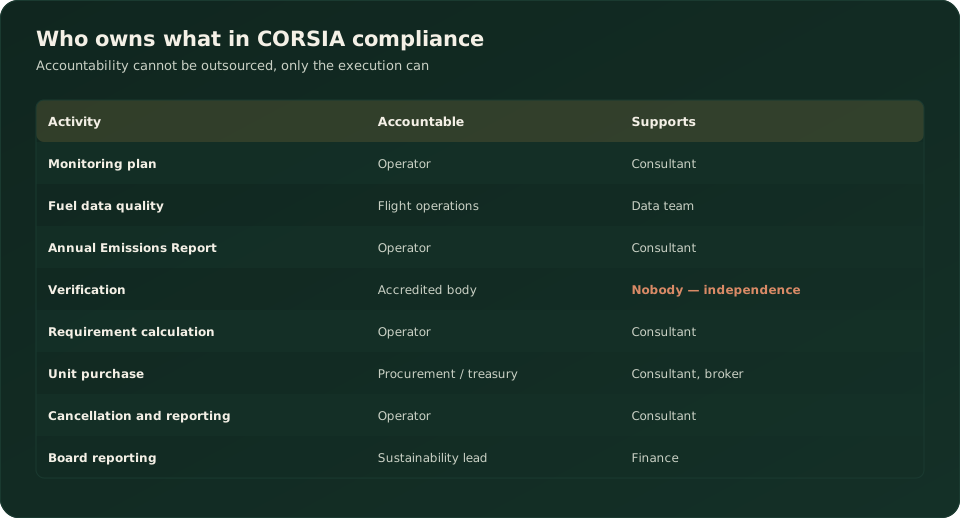
The authority does not verify your report. That is an accredited independent body, and its independence extends to being separate from anyone who advised on the report.
The authority does not source or approve your units. Eligibility is determined by the ICAO criteria and evidenced by you. The authority receives the cancellation report; it does not pre-approve the purchase.
Keeping the Record of Interactions
Regulatory correspondence becomes evidence, and it is worth treating as such rather than leaving it in individual inboxes.
Maintain a single register of submissions, questions received, responses given and positions agreed, with dates. When a verifier asks why a particular treatment was applied, "the authority confirmed this position in writing on this date" is a complete answer.
Save the correspondence itself, not a summary. The exact wording of a clarification matters when it is relied on years later.
Record verbal guidance in writing and, where it is material, confirm it back by email. A position agreed in a call and never documented is a position nobody can evidence.
Note who was involved. People move on both sides, and knowing who agreed what helps when a question resurfaces.
Keep it with the compliance file, not in a personal folder. The most common failure here is a well-maintained record that leaves with the person who maintained it.
This costs almost nothing while it is happening and is irrecoverable afterwards. It also has a secondary benefit: a register of agreed positions prevents the organisation from inadvertently taking a different position in a later submission, which is the kind of inconsistency that invites scrutiny of everything else.
Frequently Asked Questions
Who is India's CORSIA national authority? The Directorate General of Civil Aviation.
When must the monitoring plan be approved? Before the reporting year it covers begins. This constraint drives the whole compliance timeline.
How long does approval take? Allow generous time, particularly for a first submission or an unusual operating structure. Engage early.
How formal should our engagement be? Written for anything material. Verbal clarification is useful and should be confirmed back in writing where it will be relied on.
What are the penalties for non-compliance in India? Set under Indian implementing law rather than by ICAO. Confirm the current position with the authority rather than relying on a general statement.
Can we ask the DGCA for guidance on an unusual situation? Yes, and you should. A position agreed in advance is worth more than one argued afterwards.
Should we copy another operator's monitoring plan? As a structural reference, useful. As a template to submit, no — the plan must describe your systems and your data, and a mismatch between the plan and your actual operation is the most common finding.
Does the DGCA approve our choice of verifier? Verification bodies operate under accreditation arrangements. Confirm the recognition requirements rather than assuming any accredited body qualifies.
Do we need a consultant to deal with the DGCA? No, and familiarity with the authority's expectations shortens the process. The submission is yours either way.
Can positions agreed with the authority be relied on later? If documented in writing, yes — which is the argument for keeping the register.
What if we realise mid-year that CORSIA applies to us? Engage the authority and get advice specific to your situation. Being late is handled far better openly than by reconstructing data. See your first year of CORSIA compliance.
Planning your CORSIA position? DSTechnoverse provides CORSIA carbon credit services for Indian operators and project developers — scope and readiness assessment, monitoring plans, data pipelines, verification support, unit sourcing and second-phase modelling. We are based in Indore, Madhya Pradesh and work across India.
Apply as a CORSIA buyer or seller
Talk to our carbon markets team about your position.