Operators frequently prepare for CORSIA verification by tidying documents. Verifiers test data. The gap between those two activities is where most findings come from.
What Verification Actually Is
An accredited independent body forms an opinion on whether your Annual Emissions Report is materially correct and whether it was produced in accordance with your approved monitoring plan.
Two things follow from that sentence, and both are frequently missed.
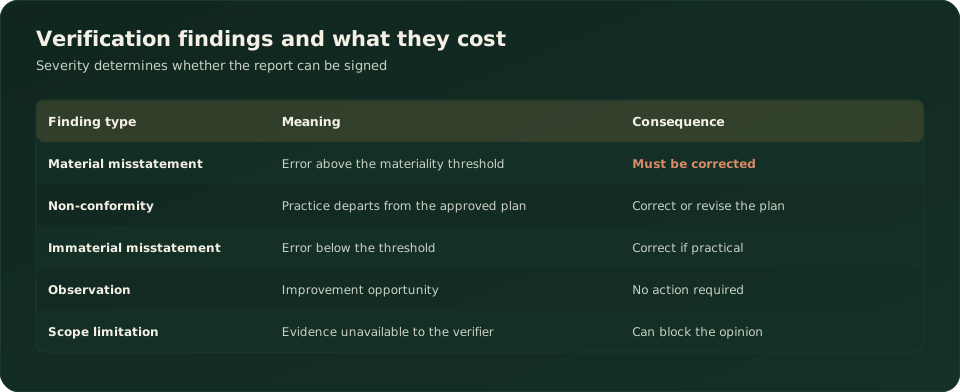
It tests against your plan, not against best practice. If your plan says you will do X and you did Y, that is a non-conformity even where Y is better. The plan is the standard you are measured against.
It is evidence-based, not assurance by inspection. The verifier samples records and traces them. Presenting a well-organised folder of documents demonstrates organisation, not accuracy.
What They Sample
Fuel records against source. They will pick flights and ask to see the underlying uplift docket, not the value in your spreadsheet. Expect them to choose awkward cases — an outstation, a diversion, a date near a system change.
Flight list completeness. They will take a period and test whether every flight that operated appears. This is the direction that catches missing positioning legs, charters and ad hoc sectors.
Scope classification. They will test a sample of flights against your in-scope logic. Was this correctly classified as international? Was this aircraft above the mass threshold? Was this exempt flight properly evidenced?
Reconciliation decisions. Where sources disagreed, which rule was applied and is it the rule your plan describes?
Data gaps. How were they filled, was the method pre-defined, and was it applied consistently?
Fuels claims. If you claimed CORSIA Eligible Fuels, they will want the approved-scheme certification and the chain-of-custody documentation, per batch.
Plan conformity. Does what you actually did match the plan version in force during the period?
Materiality
Verifiers work to a materiality threshold — the size of misstatement that would change a user's conclusion. Errors below it are noted; errors above it must be corrected.
Two practical implications. A small error found is not a crisis, and treating it as one wastes everyone's time. And an accumulation of small errors can exceed the threshold in aggregate even where none individually does, so a pattern of minor problems is worth taking seriously.
Running an Internal Dry Run
The single most effective preparation is to do to yourself what the verifier will do, several weeks before they arrive.
Sample twenty flights, chosen badly on purpose. A diversion, an outstation uplift, a charter, a flight near a monitoring plan revision, a month with a system outage, an aircraft type used rarely. Routine flights test the part that was always going to work.
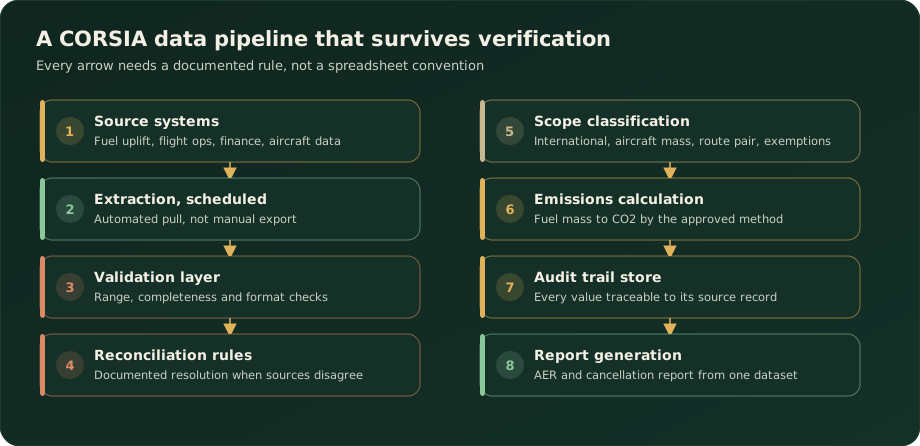
Trace in both directions. From reported figure back to source, and from source record forward to the report.
Hand each to someone uninvolved. Ask them to explain the figure from the files alone. If they cannot, a verifier will not be able to either — and that is the finding, before it becomes a finding.
Check plan conformity explicitly. Read the approved plan and compare it against what the team actually does. Drift is extremely common and entirely fixable if found early.
Test the awkward questions. Why was this discrepancy resolved this way? Where is the evidence this flight was humanitarian? Which plan version applied in March?
Record what the dry run finds and fix it. This is cheap; a finding at verification is not.
The Questions Verifiers Actually Ask
Preparing for the questions is more useful than preparing documents. These recur across verifications, and a team that can answer them fluently has a straightforward audit.
"Show me where this number came from." Pointing at a spreadsheet cell is not an answer. The answer is the source record, the rule applied, and the trail between them.
"How do you know this flight list is complete?" Requires an independent reconciliation — slot data, ATC records, schedule plus known ad hoc movements. "It comes out of the system" is not evidence of completeness.
"Why was this discrepancy resolved this way?" Requires the documented rule, and the decision log entry if it was escalated.
"Which version of the monitoring plan applied in March?" Requires version control with approval dates. Operators who keep only the current version cannot answer.
"What happened in this month — the figures look different." Usually a system change, a route change or a data feed problem. Have the explanation ready rather than discovering it under questioning.
"How did you fill this gap, and where is that method defined?" Requires the gap register and the pre-defined procedure from the plan.
"Who else can explain this if you are unavailable?" A question about key-person risk, and one where the honest answer is often uncomfortable.
Run these as a rehearsal with the actual team a few weeks before verification. The questions they struggle with are the findings you have time to prevent.
What to Have Ready
| Item | Why |
|---|---|
| Approved monitoring plan, all versions with dates | Verification is against the version in force |
| Source data, unmodified | The evidence base |
| Reconciliation rules, documented | Tests consistency of resolution |
| Decision log for manual interventions | Explains judgement calls |
| Data gap register with methods applied | Tests pre-definition |
| Fuels certification and chain of custody | Supports any CEF claim |
| Scope determination with reasoning | Entity and route-pair logic |
| Previous year's findings and their closure | Repeat findings are treated seriously |
That last row deserves emphasis. A finding raised again after being reported closed is regarded far more seriously than a first occurrence, because it suggests the corrective action was cosmetic.
Remote and On-Site Elements
Verification is normally a mix, and knowing which parts happen where lets you prepare each properly.
Remote review covers the monitoring plan, the report, the reconciliation rules, the decision log and a first pass of sampled records. Most of the document work happens here, and most findings originate here.
On-site or interview work covers how records are actually created — walking the process with the people who do it, seeing where a fuel docket physically arrives and what happens to it, and testing whether the described process matches the lived one.
The site element is where drift between plan and practice surfaces, because it is very hard to describe a process in a document in a way that survives someone watching it happen.
Prepare differently for each. For the remote phase, the evidence pack must stand alone without commentary. For the interview phase, the people doing the work need to be available and to understand their own process — which is an argument for having trained them on your actual pipeline rather than on the scheme in general.
One practical point: make sure the person who can answer data provenance questions is genuinely available on the days concerned. Verifications lose time to the one person who knows the reconciliation logic being on leave.
Managing the Engagement
Engage early. Accredited bodies are limited and demand clusters in the same window for everyone. Late engagement means whoever remains, at their price and their schedule.
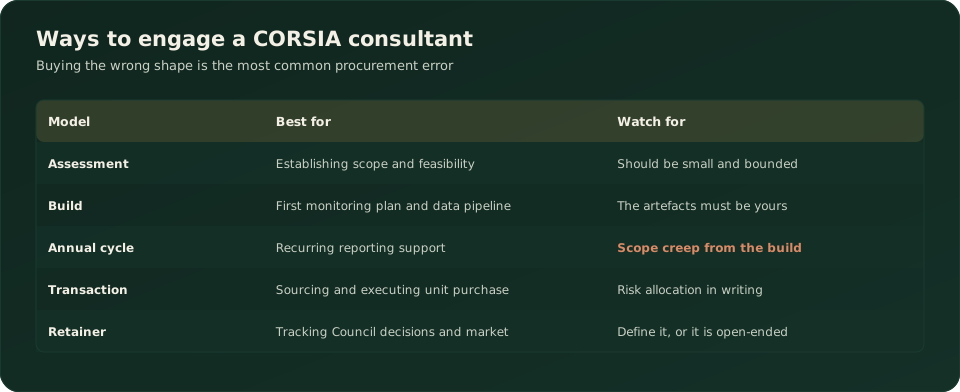
Confirm independence. The body verifying cannot have advised on the report. If a consultant wrote your monitoring plan, that firm cannot verify against it. Plan for two suppliers from the outset — this surprises operators used to buying advice and assurance together.
Give them what they ask for, promptly. A scope limitation — evidence the verifier cannot obtain — can block the opinion entirely, which is a worse outcome than a finding.
Do not argue with a valid finding. Understand it, correct it, and address the cause. Disputing a well-founded finding costs credibility that matters in later years.
Do ask for clarification where a finding is unclear or where you believe it rests on a misunderstanding of your operation. Verifiers are professionals and will engage with a reasoned position.
Building Schedule Contingency
Assume findings. Plan the calendar so there is time to correct and re-verify without missing the national submission deadline.
Operators who schedule verification to finish the week before the deadline have no room for a material finding, and a material finding at that point becomes a compliance problem rather than a technical one.
Frequently Asked Questions
How long does CORSIA verification take? Allow three to six months from engagement to a signed opinion, including time to resolve findings.
Can our consultant verify our report? No. Independence is required. Two suppliers.
What happens if a material misstatement is found? It must be corrected and the affected work re-verified. Build time for this into the schedule.
What is a scope limitation? Evidence the verifier needs and cannot obtain. It can prevent an opinion being issued, which is more serious than an ordinary finding.
Do verifiers visit the site? Usually some combination of remote review and site work. The site element matters most where the question is how records are actually created.
How do we reduce findings next year? Address root causes rather than symptoms, and run an internal dry run before the verifier arrives.
What is the most common finding? Practice that has drifted from the approved monitoring plan, and reconciliation decisions with no documented rule behind them. See CORSIA data systems.
Need CORSIA compliance that survives verification? DSTechnoverse builds monitoring plans, data pipelines and reporting processes for Indian operators, and supports project developers through eligibility and placement. See our CORSIA carbon credit services. We are based in Indore, Madhya Pradesh and work across India.
Apply as a CORSIA buyer or seller
Talk to our carbon markets team about your position.