Verification is the step that converts your emissions report into something the authority can rely on. It is performed by an accredited third party, it is independent of you and of your consultant, and its opinion cannot be negotiated.
Understanding how it works is the fastest way to make it uneventful.
What Verification Is
A CORSIA verification is an independent assurance engagement, conducted to a reasonable assurance standard, against the requirements of the scheme and your accepted monitoring plan. The verifier forms an opinion on whether the reported emissions are free from material misstatement.
Two implications follow:
It is not a consultancy. The verifier cannot design your monitoring plan, fix your data flow or write your procedures and then verify them. That would destroy independence. A verifier can tell you that something does not meet the requirement; they cannot tell you how to build it.
Reasonable assurance is a high bar. It is stronger than limited assurance, requiring more evidence and more testing. Expect sampling, tracing of individual figures to source, and testing of whether your controls actually operated.
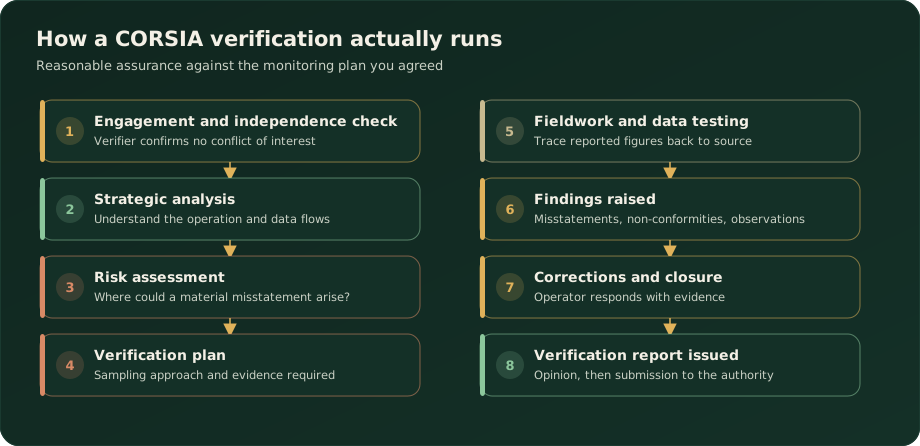
The Eight Stages
| Stage | What happens |
|---|---|
| Engagement and independence check | The verifier confirms no conflict of interest |
| Strategic analysis | Understanding the operation, fleet, routes and data flows |
| Risk assessment | Where could a material misstatement arise? |
| Verification plan | Sampling approach and evidence required |
| Fieldwork and data testing | Tracing reported figures back to source documents |
| Findings raised | Misstatements, non-conformities, observations |
| Corrections and closure | Operator responds with evidence |
| Verification report issued | The opinion, then submission to the authority |
The stages that surprise first-time operators are the first four. A substantial part of the engagement happens before any data is tested, because the verifier must understand the operation well enough to sample intelligently. Time spent explaining your data flow clearly at strategic analysis reduces the sampling that follows.
Selecting a Verification Body
| Criterion | What to check |
|---|---|
| Accreditation | Accredited for CORSIA verification under the applicable scheme and standard |
| Recognition | Acceptable to the DGCA for Indian operators |
| Aviation experience | Has verified aircraft operators, not only industrial installations |
| Team competence | Named verifier and technical reviewer, with relevant experience |
| Independence | No advisory relationship with you, and none with your consultant on this work |
| Capacity and timing | Availability in the deadline window, which is a real constraint |
| Location and travel | Fieldwork may require site visits; travel cost is yours |
| Fee basis | Fixed, or day rate with an estimate; what a re-visit costs |
Accreditation is not optional and not a formality — check it directly against the accreditation body's register rather than accepting a logo on a proposal. For the Indian position, confirm acceptability with the DGCA, and for the scheme framework the ICAO CORSIA documents set out the verification requirements.
Independence: The Rule That Catches People
The verifier must be independent of the preparation of the report. In practice:
- Your consultant cannot verify their own work
- The verification body cannot have provided advisory services on the same scope
- Individual verifiers must be free of conflicts, not just the firm
- Long-standing relationships may require rotation of the lead verifier
The common trap is a firm offering "compliance support and verification" as a package. That combination cannot be delivered by the same entity on the same scope. Where a large firm offers both, they must be genuinely separated — and it is your obligation to check that the separation is real, not just organisational.
Appoint Early
Verification capacity is finite and concentrated around deadlines. Appointing in the fourth quarter, before your compliance year closes, delivers three advantages:
- Better availability, and usually a better fee
- Strategic analysis can start early, so the verifier understands your operation before the data arrives
- Early sight of problems — a verifier who reviews your monitoring plan against your process before year end can flag mismatches while they are still fixable
That third point does not compromise independence. A verifier telling you that your plan says one thing and your stations do another is stating a fact, not designing your system.
What Fieldwork Involves
Expect the verifier to:
- Trace a sample of flights end to end — reported figure back to uplift document
- Test controls by asking for the evidence that a monthly check actually happened
- Review the gap log and test whether the substitution method was applied consistently
- Reconcile totals against fuel purchase and finance records
- Check scope — that flights in and out of scope were classified correctly
- Examine plan compliance — whether practice matches the accepted monitoring plan
- Interview staff at various levels, including people who enter data
The interviews matter more than operators expect. A verifier asking a station coordinator how they record an uplift will learn whether the documented process is the real one, and that is a faster route to the truth than any document review.
Findings and Closure
| Type | Meaning | Typical response |
|---|---|---|
| Material misstatement | The reported figure is wrong by more than materiality | Correct the figure and the underlying cause |
| Non-material misstatement | An error below materiality | Correct where practical, explain otherwise |
| Non-conformity | Practice does not follow the plan or requirements | Fix the process; may require a plan update |
| Observation | No breach, but improvement recommended | Address before next cycle |
Respond with evidence rather than explanation. "We have corrected the process" is weaker than the amended procedure, the sign-off and the corrected data extract.
Where a finding is genuinely contestable, contest it — with evidence and courteously. Verifiers are professionals applying judgement, and a well-evidenced position is considered. What does not work is arguing without documentation.
Making It Cheaper Next Year
- Close findings properly rather than cosmetically — repeat findings are expensive
- Keep the evidence pack structure the verifier used and populate it monthly
- Update the monitoring plan for anything the verification exposed
- Keep the same verification body where independence rules permit, so the strategic analysis is not rebuilt each year
- Run an internal dry run before fieldwork — see CORSIA fuel data quality management
What Verification Costs
Verification is priced as a professional assurance engagement, and the drivers are familiar from any audit:
| Driver | Effect on fee |
|---|---|
| Fleet size and sector count | More sampling, more testing |
| Number of entities or AOCs | Each may need its own opinion |
| Data quality and system maturity | Poor data means more sampling and more queries |
| First verification versus repeat | Year one carries the strategic analysis |
| Site visits and travel | Outstation visits add cost |
| Findings raised | Re-testing and re-review after correction |
| Timing | Peak-window engagements price higher |
Two points worth planning around. The verification fee is not negotiable down by choosing a cheaper opinion — the scope of testing required is set by the assurance standard, so a materially lower quote usually reflects a smaller assumed scope, which is worth questioning rather than accepting.
Data quality moves this fee as much as it moves the consultant fee. A verifier who can trace samples quickly does less work than one who must chase documents across stations, and that difference appears in the invoice as well as in the findings list.
Ask three things of every quote: what is included in the base fee, what triggers additional cost, and what a repeat year would cost. The last question tells you whether the firm expects your systems to mature — and whether they intend to price for it.
Frequently Asked Questions
Who can verify a CORSIA emissions report? An accredited verification body, independent of the operator and of the preparation of the report, recognised by the national authority.
Can our consultant verify our report? No. Verification must be independent of the party that prepared the report and the monitoring plan.
What assurance level applies? Reasonable assurance, which requires substantive testing and more evidence than limited assurance.
When should we appoint the verifier? Before the compliance year closes — ideally in the fourth quarter, for availability, fee and early sight of problems.
What will the verifier test? A risk-based sample of reported figures traced to source, the operation of your controls, the gap log, scope classification and consistency with the monitoring plan.
What is a material misstatement? An error large enough to affect the reliability of the reported emissions, assessed against a materiality threshold.
What happens if we get a finding? You respond with evidence, correct the figure or the process, and the verifier closes it before issuing the opinion.
Can we challenge a finding? Yes, with evidence and professionally. Verifiers apply judgement and will consider a well-documented position.
Does the verifier visit our offices? Usually, at least for a first verification. Fieldwork typically includes on-site work, and travel cost sits with the operator.
How do we make verification cheaper? Clean data, controls with evidence, a proactive gap log, an organised evidence pack and findings closed properly the first time.
Running your first CORSIA compliance cycle? DSTechnoverse supports Indian aircraft operators with applicability assessment, emissions monitoring plans, fuel data quality management and verification readiness — and hands the annual cycle back to your team. We are based in Indore, Madhya Pradesh and work with clients across India. See our CORSIA carbon credit services, our carbon credit portal at carboncredit.dstechnoverse.com, or talk to our team about your reporting year.
This article is general information, not legal or regulatory advice. CORSIA rules, thresholds and participating-state lists change — verify the current position with ICAO and the DGCA before acting.