Not every emission reduction can become a carbon credit, and in India the gap between "reduces emissions" and "generates sellable credits" has widened as the country's clean energy has become cheaper.
This article works through the main project types available to Indian developers, what each requires, and where each tends to fail.
The Four Tests Every Project Type Faces
| Test | Question |
|---|---|
| Methodology | Does an approved methodology cover this activity? |
| Additionality | Would this have happened anyway without carbon revenue? |
| Measurability | Can the reduction be monitored continuously and defensibly? |
| Volume | Does it generate enough credits to cover fixed transaction costs? |
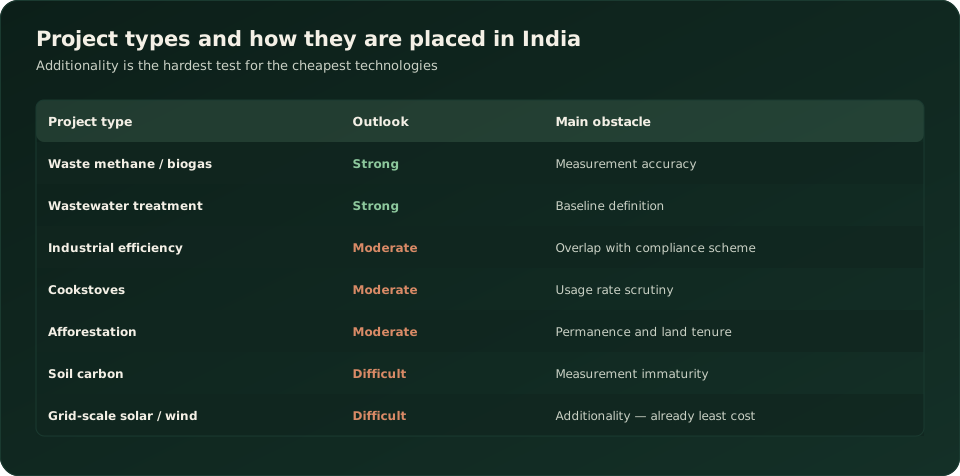
Additionality is where most Indian projects now fail, and the reason is a good news story: as clean technology becomes the cheapest option, the argument that carbon revenue was necessary becomes harder to make. A technology that wins on its own economics does not need a subsidy, and a carbon credit is a subsidy.
Waste Methane and Biogas — Strong
What it is: capturing methane from landfill, agricultural waste, distillery effluent or animal manure, and either flaring it or using it for energy.
Why it works: methane has a global warming potential many times that of CO₂ over a century, so capturing a modest volume generates substantial credits. And crucially, capturing methane is rarely the cheapest option for the operator — the business-as-usual case is venting. That makes additionality straightforward.
| Aspect | Assessment |
|---|---|
| Additionality | Strong — capture is not business as usual |
| Methodology availability | Well established across programmes |
| Measurement challenge | Gas flow metering, methane fraction, capture efficiency |
| Typical volume | Good credits per unit of investment |
| Main failure mode | Metering gaps and uncalibrated instruments |
What it needs to survive verification: continuous flow measurement with calibrated meters, regular methane fraction analysis, documented downtime, and a clear boundary around what is captured versus what escapes. Data gaps are the primary reason issuance is delayed, and verifiers apply conservative assumptions to any period without valid data.
Wastewater Treatment — Strong
What it is: treating industrial or municipal wastewater in a way that prevents anaerobic methane generation, or captures it.
Why it works: similar logic to landfill gas. Untreated or lagoon-treated effluent generates methane, and treatment that prevents or captures it is a genuine, measurable reduction rarely justified on its own economics.
The hard part is baseline definition. How much methane would the untreated effluent have produced? This depends on chemical oxygen demand, temperature, retention time and the specific treatment configuration — all of which must be measured and defended. Baseline over-estimation is the most common finding in verification for this project type.
Industrial Energy Efficiency — Moderate
What it is: process improvements, waste heat recovery, motor and drive upgrades, cogeneration.
Two problems.
First, additionality. Efficiency projects usually pay for themselves through energy savings. If the internal rate of return is attractive without carbon revenue, the project is not additional. The credible cases are those with long payback periods, high perceived technology risk, or capital constraints that a barrier analysis can document.
Second, overlap with the compliance mechanism. If your facility is a notified obligated entity under the CCTS, efficiency gains already count towards your intensity target. Crediting them separately through the offset mechanism would be double counting. Efficiency projects are therefore most viable outside the obligated sectors — see the Indian carbon market and CCTS explained.
Improved Cookstoves — Moderate, With Scrutiny
What it is: distributing efficient cookstoves that reduce fuelwood consumption, and crediting the avoided emissions.
Why it is attractive: large volumes, strong health and gender co-benefits that command price premiums, and a natural aggregation model.
Why it is under scrutiny: the credit volume depends on assumptions about how much the stove is used, what fraction of the displaced wood was non-renewable, and how much fuel was actually saved. Independent research has found systematic over-crediting in some cookstove programmes, and buyers now examine these assumptions closely.
| Assumption | Risk | Mitigation |
|---|---|---|
| Usage rate | Stoves distributed but not used | Sensor-based usage monitoring, not surveys alone |
| Fraction of non-renewable biomass | Over-stated | Use conservative, regionally justified values |
| Fuel savings | Lab efficiency does not equal field efficiency | Kitchen performance tests in real conditions |
| Stove survival | Breakage over the crediting period | Field verification, replacement programme |
A cookstove project with sensor-monitored usage data and conservative parameters is a genuinely good project that will price well. One built on survey-based usage claims and optimistic default values is exactly what buyers are now screening out.
Afforestation and Reforestation — Moderate
What it is: planting trees, restoring degraded land, agroforestry.
The appeal: these are removals rather than avoidance, which buyers pay more for, and the co-benefits are real and visible.
The three hard problems:
- Permanence. Carbon stored in trees can be released by fire, disease, drought or felling. Programmes manage this with buffer pools — a share of credits withheld as insurance — and with long-term monitoring commitments running decades.
- Land tenure. Who owns the land, and who owns the carbon? In India, with fragmented holdings, community forest rights and complex tenure, this is frequently the binding constraint. Get it documented before anything else.
- Measurement. Biomass estimation via allometric equations, sample plots and increasingly remote sensing. Achievable, but requires sustained field capability.
Timeline reality: trees sequester slowly. Meaningful credit volumes arrive years after planting, and the crediting period runs for decades. This is a long-horizon business, not a project that reaches revenue in two years.
Soil Carbon — Difficult
What it is: agricultural practices that increase soil organic carbon — no-till, cover cropping, residue management, improved rotations.
Why it is difficult: soil carbon is genuinely hard to measure. It varies enormously across a single field, changes slowly against a large existing stock, and reverses quickly if practices lapse. Measurement requires soil sampling at scale or modelling with substantial uncertainty, and verifiers apply conservative discounts to both.
Methodologies exist and the science is improving. For now, treat soil carbon as a frontier with high measurement cost and heavy uncertainty deductions rather than as a reliable revenue source.
Grid-Scale Solar and Wind — Difficult
What it is: utility-scale renewable generation displacing grid electricity.
Why it no longer works in India: renewables are now the least-cost source of new generation. A project that is commercially viable on its own cannot credibly claim that carbon revenue was necessary for it to proceed. Most programmes have restricted or excluded grid-connected renewables in countries where they are commercially established, and India is firmly in that category.
Older renewable energy credits still trade, at low prices, precisely because the market discounts them for exactly this reason.
The limited exceptions: off-grid and mini-grid systems serving genuinely unserved populations, and storage or integration projects where the economics remain genuinely marginal. Both need a documented barrier analysis, not an assertion.
Comparing the Options
| Project type | Additionality | Measurement | Volume | Timeline to revenue |
|---|---|---|---|---|
| Waste methane / biogas | Strong | Moderate | Good | 18-30 months |
| Wastewater treatment | Strong | Moderate | Good | 18-30 months |
| Industrial efficiency | Weak to moderate | Straightforward | Variable | 18-24 months |
| Cookstoves | Moderate | Hard — usage monitoring | High | 24-36 months |
| Afforestation | Moderate | Hard — biomass | Slow build | 4-10 years |
| Soil carbon | Moderate | Very hard | Uncertain | 3-5 years |
| Grid renewables | Weak | Easy | High | Usually ineligible |
The pattern worth internalising: the easiest projects to measure have the weakest additionality, and the strongest additionality cases are the hardest to measure. Waste methane sits at the best point on that trade-off, which is why it is where most credible new Indian project development is concentrated.
Choosing Your First Project
- Start where you have domain access. A project in a sector you already understand operationally beats a theoretically better project in one you do not.
- Prefer strong additionality over easy measurement. Measurement problems can be engineered around; additionality problems cannot.
- Check the approved activity list for your intended market — domestic CCTS or international programme — before any spend.
- Read registered project documents for your chosen type on Verra or the Gold Standard registries. They show exactly what survived validation.
- Design monitoring before designing the project. If you cannot describe how each parameter will be measured, logged and audited, the project is not ready.
- Model at conservative volume and price. See carbon credit prices in India.
Frequently Asked Questions
Which carbon credit projects work best in India? Waste methane capture and wastewater treatment — both have strong additionality arguments and established methodologies.
Why don't solar projects get carbon credits any more? Because grid-scale renewables are now the least-cost option in India, so carbon revenue cannot be shown to be necessary. That fails the additionality test.
What is additionality? The requirement that the emission reduction would not have happened without the carbon finance. It is the most common reason projects are rejected.
Are cookstove projects still viable? Yes, but only with rigorous usage monitoring and conservative parameters. Buyers now scrutinise this category closely after documented over-crediting.
How long do afforestation projects take to generate credits? Years — meaningful volumes typically start four to ten years after planting, with crediting periods running decades.
What is a buffer pool? A share of credits withheld by the programme as insurance against reversal in land-based projects, released only if the carbon remains stored.
Can small projects generate credits? Individually, rarely — fixed transaction costs dominate. Aggregation into a bundled project is the standard route for small activities.
What kills projects during verification? Data gaps, uncalibrated instruments, undocumented assumptions and over-stated baselines. Almost all of it is preventable with disciplined monitoring design.
Do I need an approved methodology? Yes. You cannot invent your own accounting; an approved methodology for your activity type must exist under the standard you are using.
Planning a carbon credit project in India? DSTechnoverse supports feasibility screening, baseline and additionality assessment, monitoring plan design, data systems and MRV documentation — and works with buyers on credit due diligence. We are based in Indore, Madhya Pradesh and work with developers across India. See our carbon credit services, or talk to our team about your project.
This article is general information, not legal, financial or regulatory advice. India's carbon market rules are still being built out — verify the current position with the Bureau of Energy Efficiency and your legal advisers before committing capital.