"What is the price of a carbon credit?" has no single answer, and treating it as though it does is the most common error in carbon project financial models.
Credits are not a commodity in the way steel or wheat are. Two credits, each representing one tonne of CO₂-equivalent, can trade an order of magnitude apart depending on how they were produced, who verified them, and what the buyer needs them for.
Why Price Varies So Widely
A carbon credit's price reflects the buyer's confidence in the claim behind it — and their purpose in buying it.
| Price driver | Effect | Why |
|---|---|---|
| Removal vs avoidance | Removals command a large premium | A tonne removed is more defensible than a tonne "not emitted" |
| Permanence | Durable storage priced far above biological | Reversal risk is priced in |
| Additionality strength | Weak arguments discounted heavily | Buyers face reputational scrutiny |
| Co-benefits | Community and biodiversity benefits add value | Corporate buyers report on SDG contribution |
| Vintage | Older credits discounted | Recent reductions seen as more relevant |
| Standard and verifier | Recognised programmes price higher | Diligence cost is lower for the buyer |
| Corresponding adjustment | Adjusted credits price higher | Required for some compliance uses |
| Volume and contract length | Large offtakes discounted per unit | Certainty traded against price |
| Country and story | Varies by buyer preference | Reputational, not technical |
The first row explains most of the spread in the market. Avoidance credits — a project that stops an emission from happening — are inherently counterfactual claims. Removal credits, where carbon is physically taken out of the atmosphere and stored, are more verifiable and priced accordingly.
Indicative Price Bands
These are indicative ranges, not quotes. Prices move, sometimes sharply, and any specific project transacts on its own merits.
| Credit type | Indicative range (USD/tonne) | Notes |
|---|---|---|
| Renewable energy, older vintage | 1-4 | Additionality widely questioned |
| Landfill gas / methane capture | 4-12 | Solid additionality |
| Improved cookstoves | 4-15 | Wide spread on usage-rate credibility |
| Waste and wastewater methane | 6-15 | Strong methodologies |
| Afforestation / reforestation | 8-30 | Permanence risk priced in |
| REDD+ avoided deforestation | 3-15 | Heavily scrutinised, volatile |
| Biochar | 100-160 | Durable removal |
| Direct air capture | 300-600+ | Highest durability, smallest volume |
The gap between the top and bottom of that table is a factor of several hundred. Any project model built on "the carbon price" without specifying which of these it is describing is not a model.
The Domestic Picture
India's Carbon Credit Trading Scheme introduces a domestic price formation mechanism distinct from voluntary market pricing.
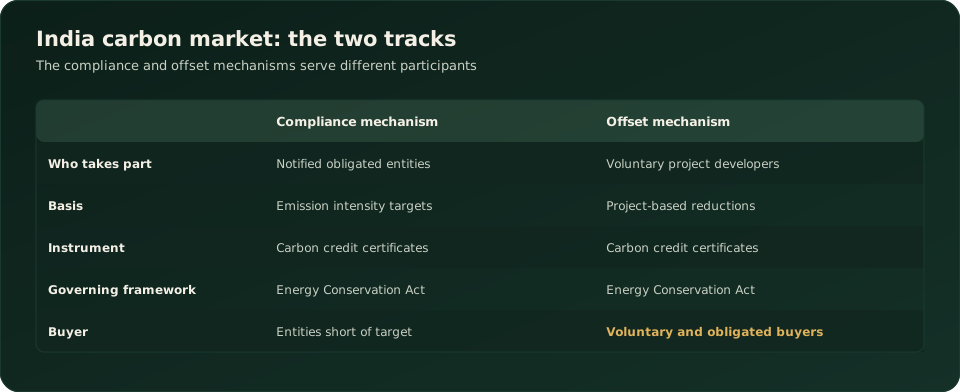
Under the compliance mechanism, obligated entities in notified energy-intensive sectors receive greenhouse gas emission intensity targets. Those who beat their target earn Carbon Credit Certificates; those who miss it must buy CCCs or face penalties. Trading takes place through notified power exchanges.
What sets the price in a compliance market:
- Target stringency. Loose targets create surplus certificates and a weak price. This has been the recurring lesson from every compliance scheme internationally, including India's earlier PAT/ESCert experience.
- The penalty for non-compliance. This effectively caps the price — nobody pays more for a certificate than the cost of not having one.
- Any floor and ceiling mechanism. Where a scheme sets price bounds, those bounds become the practical trading range.
- Banking and borrowing rules. Whether certificates can be carried forward materially affects price stability.
- Offset mechanism supply. How much project-based supply is admitted into the compliance market, and under what limits.
Because the scheme's parameters have been issued in stages, and sectoral targets and trading arrangements continue to be notified, price expectations should be checked against current Bureau of Energy Efficiency publications and CERC orders rather than against any secondary summary.
For an international comparison of how a compliance market's price behaves relative to voluntary markets, see CORSIA credits versus voluntary carbon credits.
What Actually Reaches the Developer
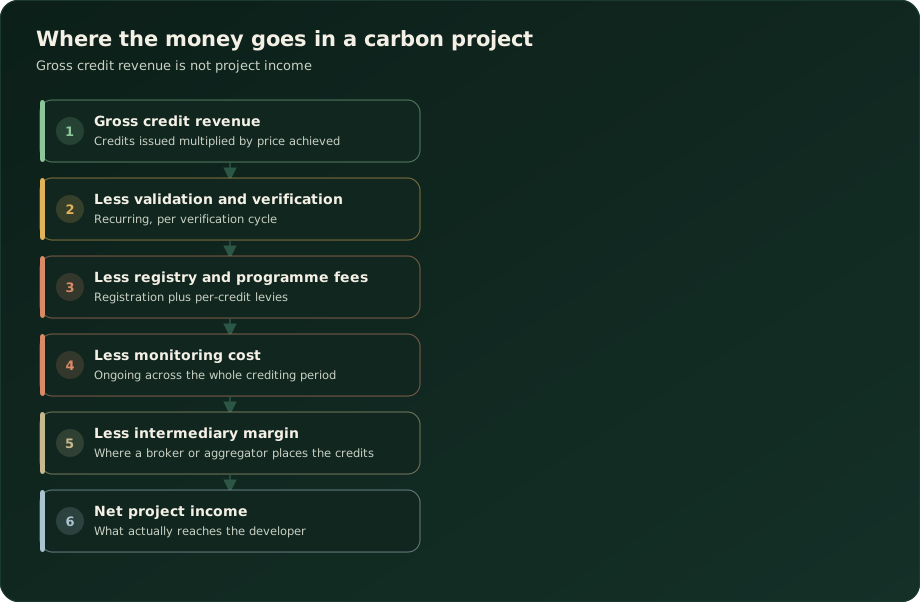
Headline price is not developer revenue. A realistic model for a project selling at $8 per credit:
| Line | Per credit |
|---|---|
| Gross price achieved | $8.00 |
| Less broker / aggregator margin (15%) | −$1.20 |
| Less registry and programme levies | −$0.30 |
| Less verification cost amortised per credit | −$0.60 |
| Less monitoring cost amortised per credit | −$0.40 |
| Net to developer | $5.50 |
Roughly 30% of gross disappears before it reaches the project, and the proportion is higher for smaller projects because verification and registry costs are largely fixed. A project generating 5,000 credits a year bears the same verification cost as one generating 50,000, so per-credit costs are ten times higher.
This is the single most important arithmetic in project feasibility. Two projects at the same headline price can have completely different economics purely on volume.
Contract Structures
| Structure | Price characteristic | Risk |
|---|---|---|
| Spot sale | Market price at the time | Full price exposure, maximum flexibility |
| Forward contract | Fixed price, future delivery | Delivery risk if issuance is delayed |
| Long-term offtake | Discounted, often 20-40% below spot | Certainty; caps upside for the whole crediting period |
| Streaming / prepay | Upfront capital against future credits | Financing cost, effectively expensive debt |
| Floor price with upside share | Downside protected, upside shared | Complexity, counterparty quality matters |
For a first project, a long-term offtake that funds development is often the difference between a project existing and not existing — but understand what you are giving up. Locking in a price for a ten-year crediting period is a substantial bet on the market not appreciating.
Building a Revenue Model That Survives
- Estimate annual credit volume conservatively. Use the lower bound of your monitoring estimate. Over-estimation is the norm and it is what breaks financial models.
- Apply a haircut for verification adjustment. Verifiers routinely trim claimed reductions. A 10-15% buffer is prudent.
- Use a price band, not a point. Model low, central and high cases.
- Subtract all deductions — margin, levies, verification, monitoring — per credit.
- Push first revenue to month 24 or later.
- Model the crediting period, not one year. Seven years is common, with renewal in some programmes.
- Stress-test at half your central price. If the project fails there, it is a price bet more than a project.
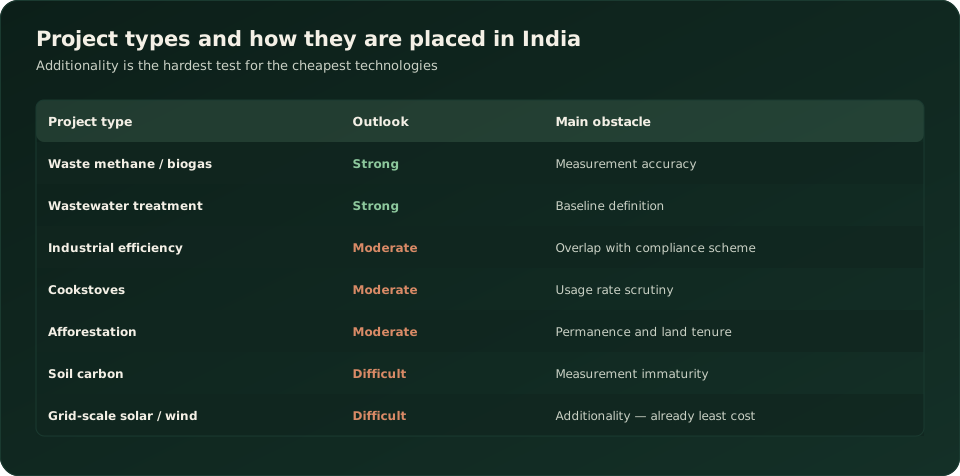
Point 7 separates viable projects from speculative ones. A waste methane project with strong additionality and low monitoring costs survives a price halving. A marginal project at a high assumed price does not.
What Raises Your Price
Practical, controllable actions:
- Choose a project type with a strong additionality story. The single largest price determinant is buyer confidence.
- Document co-benefits properly. Health, employment, gender and biodiversity outcomes are worth real money to corporate buyers who must report them — but only if measured and verified, not asserted.
- Certify to a recognised co-benefit standard where it fits the project.
- Keep verification clean. A project with no adverse findings is easier to buy and cheaper to diligence.
- Sell direct where volume allows. Intermediary margin is 10-30%; large corporate buyers will contract directly for meaningful volume.
- Get the rights and consents documented early. Unclear land tenure or credit title is the most common reason a diligence process stalls.
Frequently Asked Questions
What is the price of a carbon credit in India? There is no single price. Voluntary market credits range from roughly $1 to $30 per tonne depending on type and quality; engineered removals trade far higher. Domestic CCTS pricing depends on target stringency, penalty levels and any price bounds set by the regulator.
Why do carbon credit prices vary so much? Because buyers are pricing confidence in the underlying claim, not a standardised commodity. Removals, permanence, additionality strength and co-benefits all move the price.
Are removal credits more expensive than avoidance credits? Substantially, and the gap has widened as buyers have become more cautious about counterfactual claims.
How much does a developer actually receive? Typically 60-75% of gross, after intermediary margin, levies, verification and monitoring. Smaller projects retain less because fixed costs dominate.
Will carbon prices rise? Compliance demand is growing and quality supply is constrained, which supports higher prices for high-integrity credits. Low-quality credits have moved the other way. Do not build a model that requires prices to rise.
What is a long-term offtake agreement? A contract to buy future credits at an agreed price, usually below spot. It funds development in exchange for capping upside.
How do I find a buyer? Directly with corporates who have public commitments, through brokers and exchanges, or through the aggregator or developer partner who took the project through validation. See how to sell carbon credits in India.
Does vintage affect price? Yes. Recent vintages price higher; credits from older periods, particularly pre-2016 renewable energy credits, trade at a steep discount.
Is the domestic market better than exporting? It depends on your project type, on export policy, and on which buyers value your credit attributes. Model both, and take current regulatory advice before committing.
Planning a carbon credit project in India? DSTechnoverse supports feasibility screening, baseline and additionality assessment, monitoring plan design, data systems and MRV documentation — and works with buyers on credit due diligence. We are based in Indore, Madhya Pradesh and work with developers across India. See our carbon credit services, or talk to our team about your project.
This article is general information, not legal, financial or regulatory advice. India's carbon market rules are still being built out — verify the current position with the Bureau of Energy Efficiency and your legal advisers before committing capital.