India has moved from having no domestic carbon market to having a two-mechanism national scheme, built on the Energy Conservation Act as amended in 2022 and administered by the Bureau of Energy Efficiency. For energy-intensive industry it changes what compliance means; for project developers it creates a domestic buyer that did not previously exist.
This article explains the structure, who it affects, and what to do about it.
The Legal Basis
The Energy Conservation (Amendment) Act, 2022 gave the central government the power to specify a carbon credit trading scheme and to prescribe carbon emission standards for entities. The Carbon Credit Trading Scheme was notified under that authority, with subsequent detailed procedures issued in stages.
The institutional map:
| Body | Role |
|---|---|
| Ministry of Power | Administering ministry |
| Bureau of Energy Efficiency (BEE) | Administrator of the scheme |
| National Steering Committee | Governance and direction |
| Grid Controller of India | Registry function |
| Central Electricity Regulatory Commission | Regulation of trading |
| Power exchanges | Trading platforms |
| Accredited carbon verification agencies | Independent verification |
Because procedures and sectoral targets have been notified progressively, the authoritative current position is on the BEE and Ministry of Power websites. Treat any summary — including this one — as orientation rather than as the operative rule.
The Compliance Mechanism
Who it covers: notified obligated entities in energy-intensive sectors. The sectors identified for the first compliance cycles span heavy industry — aluminium, cement, chlor-alkali, fertiliser, iron and steel, pulp and paper, petrochemicals, petroleum refineries and textiles among them.
How it works:
- Each obligated entity receives a greenhouse gas emission intensity target — emissions per unit of output, not an absolute cap.
- The entity measures and reports actual emission intensity for the compliance year.
- Performance is independently verified by an accredited carbon verification agency.
- Beat the target and the entity is issued Carbon Credit Certificates for the outperformance.
- Miss the target and the entity must purchase CCCs to make up the shortfall, or face a penalty.
- Certificates trade on notified power exchanges.
Why intensity rather than an absolute cap? Because India's emissions are expected to grow as the economy grows. An intensity target decouples emissions from output, allowing production to expand while requiring efficiency to improve — consistent with India's NDC framing of reducing emissions intensity of GDP.
The practical consequence for industry: growing your output does not automatically put you out of compliance, but failing to improve efficiency does.
The Offset Mechanism
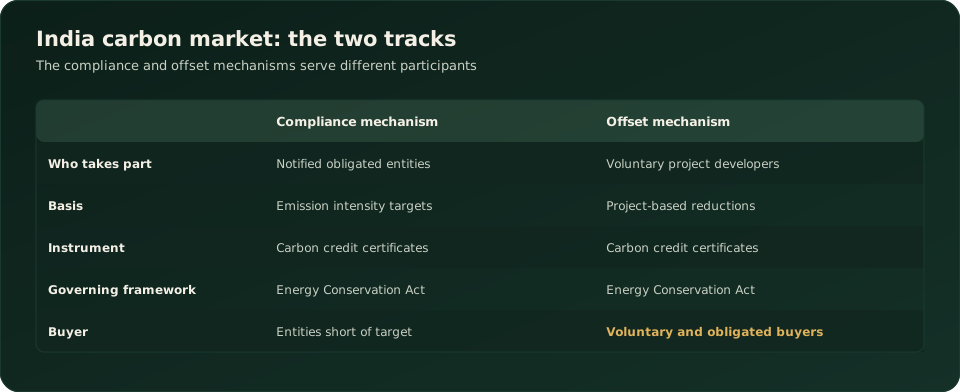
The offset mechanism admits non-obligated entities — project developers, in effect — to generate Carbon Credit Certificates from project-based emission reductions or removals.
| Compliance mechanism | Offset mechanism | |
|---|---|---|
| Participants | Notified obligated entities | Voluntary project proponents |
| Basis | Emission intensity performance against target | Project reductions against a baseline |
| Verification | Accredited carbon verification agency | Accredited agency, project-specific |
| Output | Carbon Credit Certificates | Carbon Credit Certificates |
| Demand source | Entities short of target | Obligated entities and voluntary buyers |
This is the route by which a biogas plant, a waste methane project or an efficiency project outside the obligated sectors can generate tradeable credits domestically. Approved methodologies and activity categories are issued by BEE, and the list matters enormously — an activity outside it cannot be credited domestically regardless of its climate merit.
For what this means commercially, see how to start a carbon credit business in India and carbon credit project types in India.
How This Differs From PAT
India's earlier Perform, Achieve and Trade scheme covered designated consumers with energy-efficiency targets, issuing Energy Saving Certificates for outperformance. PAT is the direct ancestor of the CCTS, and the transition from ESCerts to Carbon Credit Certificates is part of the scheme's design.
| PAT / ESCerts | CCTS / CCCs | |
|---|---|---|
| Metric | Specific energy consumption | Greenhouse gas emission intensity |
| Scope | Designated consumers | Notified obligated entities, plus offset projects |
| Coverage of non-energy emissions | Limited | Broader GHG framing |
| Project-based supply | No | Yes, via the offset mechanism |
| Instrument | Energy Saving Certificate | Carbon Credit Certificate |
The most important lesson carried forward from PAT is about target stringency. Where targets are set loosely, certificates are over-supplied and the price collapses, removing the incentive the scheme exists to create. Every compliance market internationally — including the EU ETS in its early phases — has learned this the same way.
What Obligated Entities Should Be Doing
- Confirm whether you are notified, for which sector, and for which compliance year.
- Establish a defensible GHG inventory. Scope, boundaries and data sources documented. This is the foundation, and gaps here surface during verification when they are most expensive.
- Measure your current emission intensity accurately. Including how output is defined and measured, which is often where disputes arise.
- Model your gap to target across the compliance cycles, not just the first year.
- Compare abatement cost against certificate price. If reducing a tonne internally costs less than buying a certificate, reduce it. If not, buying may be the rational choice — that is precisely what a market mechanism is for.
- Set up data systems that survive audit. Meter calibration records, continuous data capture, documented calculation methods, change control. Verification failures are data failures.
- Assign ownership. Compliance sits across operations, energy management and finance. Someone must own the number.
Point 6 is where most first-cycle problems arise. Data that was adequate for internal energy management is often not adequate for third-party verification against a regulatory target, and the difference is discovered late.
Our work on data integrity is written for laboratories, but the audit-trail principles transfer directly to emissions data.
What It Means for Project Developers
The offset mechanism creates domestic demand — a structural change for Indian developers who previously had to sell internationally.
The advantages: domestic buyers with a compliance obligation, no export policy exposure, no corresponding-adjustment question, and a regulated registry.
The constraints: the approved activity list defines what can be credited, any limits on how much offset supply the compliance mechanism will absorb cap the demand, and domestic price formation is driven by target stringency rather than by international buyer preference.
The strategic question for a developer is which market to build for. International voluntary buyers pay premiums for co-benefits and strong stories; a domestic compliance buyer is buying a compliance instrument and will pay the market clearing price for it. These are genuinely different customers, and the documentation each expects differs.
The International Interface
India's participation in international carbon markets runs through Article 6 of the Paris Agreement, which permits transfer of mitigation outcomes between countries with corresponding adjustments — the accounting step that prevents two countries counting the same tonne.
The policy tension is straightforward: credits exported with a corresponding adjustment cannot count towards India's own NDC. India has accordingly taken a cautious position on which activities may generate credits for export, and this remains an area of active policy development.
For airlines and aviation, the parallel scheme is CORSIA, which has its own eligibility criteria for the credits it accepts — see what is CORSIA and ICAO-approved crediting programmes.
Building the Emissions Data System
Whether you are an obligated entity or a project developer, the compliance burden ultimately lands on data. Verification is a documentation exercise, and the organisations that struggle are those whose numbers were adequate for internal management but not for third-party audit.
What an audit-ready emissions data system needs:
| Element | Requirement |
|---|---|
| Defined boundary | Which facilities, which sources, which gases — documented and stable |
| Source register | Every emission source, with its measurement method |
| Calibration records | Meters and analysers, calibrated on schedule with certificates retained |
| Raw data retention | Original readings, not just calculated outputs |
| Documented calculation method | Emission factors, their source, and the version used |
| Change control | Any change to method or boundary recorded with a reason |
| Data gap procedure | A pre-defined, conservative method for handling missing data |
| Segregation of duties | The person recording is not the only person checking |
| Audit trail | Who entered what, when, and what changed |
The data gap procedure is the one most often missing. Meters fail, and a verifier confronted with an undocumented gap will substitute a conservative assumption that costs you certificates. Having a written, pre-agreed gap-filling method — applied consistently, not chosen after seeing which value is favourable — protects the number.
None of this is exotic. It is the same discipline any regulated measurement carries, and it is far cheaper to build before the first compliance cycle than to reconstruct during verification.
Frequently Asked Questions
What is the CCTS? India's Carbon Credit Trading Scheme, established under the Energy Conservation Act as amended in 2022, comprising a compliance mechanism for notified obligated entities and an offset mechanism for voluntary projects.
Who administers it? The Bureau of Energy Efficiency under the Ministry of Power, with the Grid Controller of India as registry and CERC regulating trading.
Who is an obligated entity? Entities in notified energy-intensive sectors, specified by the central government. Confirm current notification status directly with BEE.
What is a Carbon Credit Certificate? The tradeable instrument under the CCTS, representing one tonne of CO₂-equivalent, issued either for beating an intensity target or for verified project-based reductions.
How is it different from PAT? PAT targeted specific energy consumption and issued ESCerts; CCTS targets greenhouse gas emission intensity, covers a broader emissions scope, and admits project-based offset supply.
Can voluntary projects participate? Yes, through the offset mechanism, for activity types with approved methodologies.
Is it a cap-and-trade system? Not in the absolute-cap sense. It sets emission intensity targets, allowing absolute emissions to grow with output while requiring efficiency improvement.
What happens if an entity misses its target? It must acquire Carbon Credit Certificates to cover the shortfall or face the penalty specified under the scheme.
How does this affect Indian companies selling credits abroad? Export of credits interacts with corresponding adjustments and India's NDC accounting. Policy in this area is evolving — take current advice.
Where do I find the official rules? The Bureau of Energy Efficiency and Ministry of Power publish the scheme documents, procedures and sectoral targets.
Planning a carbon credit project in India? DSTechnoverse supports feasibility screening, baseline and additionality assessment, monitoring plan design, data systems and MRV documentation — and works with buyers on credit due diligence. We are based in Indore, Madhya Pradesh and work with developers across India. See our carbon credit services, or talk to our team about your project.
This article is general information, not legal, financial or regulatory advice. India's carbon market rules are still being built out — verify the current position with the Bureau of Energy Efficiency and your legal advisers before committing capital.