"Carbon credit business" describes at least four different businesses, with different capital requirements, different skills and very different risk profiles. Deciding which one you are actually starting is the first real step, and skipping it is why most entrants spend a year on the wrong problem.
This guide covers what each model involves in India, how a project actually reaches revenue, what it costs, and the eligibility tests that quietly disqualify most ideas.
The Four Business Models
| Model | What you do | Capital needed | Revenue |
|---|---|---|---|
| Project developer | Own or co-own the emission-reducing activity and the credits it generates | High — the underlying asset | Credit sales, over a crediting period of years |
| Consultant / MRV advisor | Prepare project documents, baselines, monitoring plans and verification support | Low — expertise and people | Fees per project, retainer |
| Aggregator | Bundle many small activities into one registerable project | Medium — working capital and field network | Margin on credits, or a share |
| Broker / trader | Match buyers and sellers, hold inventory, manage contracts | Medium to high — working capital | Trading margin |
Most people asking "how do I start a carbon credit business" have the second or third in mind and describe the first. The distinction matters because the developer takes the project risk and waits years for revenue, while the consultant is paid regardless of whether the project ever issues a credit.
If you have no existing emission-reducing asset, the realistic entry points are consulting and aggregation. Both build the domain knowledge and the client relationships that make later development work possible.
What a Carbon Credit Actually Is
One carbon credit represents one tonne of CO₂-equivalent either prevented from being emitted, or removed from the atmosphere, relative to what would have happened otherwise.
The phrase carrying all the weight is what would have happened otherwise. A credit is not a measurement of an emission; it is a measurement of a difference between reality and a counterfactual baseline that by definition never occurred. Everything difficult about this industry follows from that:
- The baseline must be estimated, defended and independently verified.
- The reduction must be additional — it would not have happened without the carbon revenue.
- The reduction must be permanent, or the risk of reversal must be managed.
- It must not be double counted by another party or another scheme.
A buyer paying for a credit is paying for a claim about a counterfactual. That is why verification, methodology and registry infrastructure exist, and why credits from weak projects trade at a fraction of the price of strong ones.
The Two Tracks in India
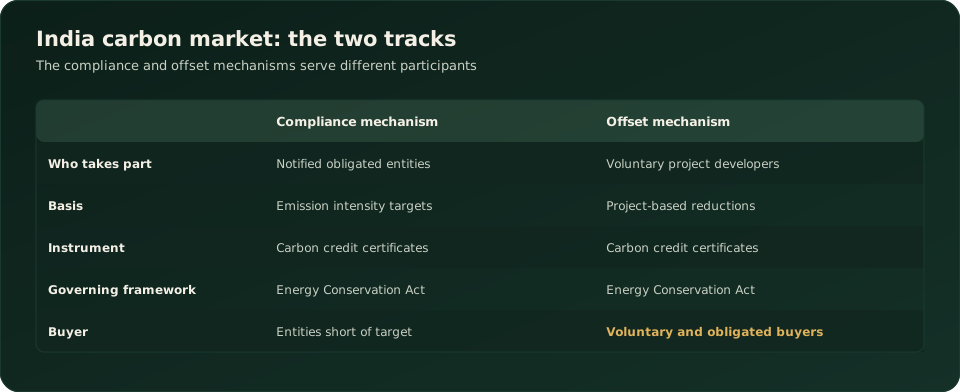
India's domestic framework is the Carbon Credit Trading Scheme (CCTS), established under the Energy Conservation Act as amended in 2022 and administered by the Bureau of Energy Efficiency under the Ministry of Power. It has two distinct mechanisms:
| Compliance mechanism | Offset mechanism | |
|---|---|---|
| Who takes part | Notified obligated entities in energy-intensive sectors | Voluntary project developers, non-obligated entities |
| Basis | Greenhouse gas emission intensity targets | Project-based emission reductions or removals |
| Instrument | Carbon Credit Certificates | Carbon Credit Certificates |
| Buyers | Entities short of their target | Obligated entities and voluntary buyers |
| Trading | Through notified power exchanges | Same |
Alongside this sits the international voluntary carbon market — Verra's VCS, the Gold Standard and similar programmes — where Indian projects have historically been among the world's largest suppliers, first under the CDM and later under voluntary standards.
A third route, Article 6 of the Paris Agreement, allows credits to be transferred between countries with corresponding adjustments. India has signalled a cautious approach here, since credits exported with a corresponding adjustment cannot count towards India's own NDC.
The practical implication for a new entrant: decide early whether you are building for the domestic compliance market, for international voluntary buyers, or for both. The methodology, the registry, the documentation and the buyer are different in each case, and retrofitting a project from one track to another is expensive.
Because the CCTS is still being built out — sectoral targets, procedures and trading arrangements have been issued in stages — check the current position directly with the Bureau of Energy Efficiency and the Ministry of Power rather than relying on any summary, including this one.
The Project Lifecycle
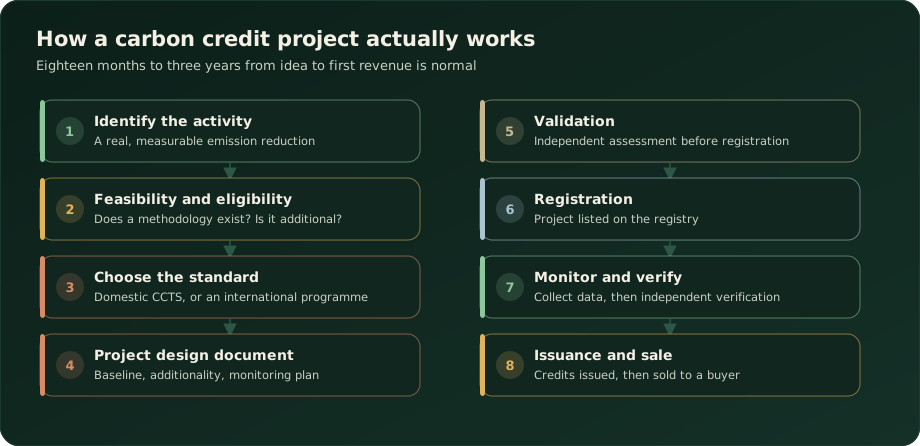
| Stage | What happens | Typical duration |
|---|---|---|
| 1. Identify the activity | A real, measurable emission reduction | Weeks |
| 2. Feasibility and eligibility | Does a methodology exist? Is it additional? Is the volume viable? | 1-2 months |
| 3. Choose the standard | Domestic CCTS offset mechanism, or an international programme | Weeks |
| 4. Project design document | Baseline, additionality argument, monitoring plan | 2-4 months |
| 5. Validation | Independent third-party assessment before registration | 2-4 months |
| 6. Registration | Project listed on the registry | 1-3 months |
| 7. Monitor and verify | Collect data, then independent verification | Ongoing; first cycle 6-12 months |
| 8. Issuance and sale | Credits issued to your registry account, then sold | 1-3 months after verification |
Eighteen months to three years from idea to first revenue is normal. Anyone promising credits in six months is describing a project already well into stage 4, or is describing something that will not survive validation.
That timeline is the single most important planning fact in this business. It determines your working capital requirement, and it is why aggregators and consultants — who are paid earlier — are more common than pure developers among new entrants.
The Eligibility Tests That Stop Most Ideas
Before spending anything, run the activity through five tests. Failing any one of them usually ends the project.
1. Is there an approved methodology? You cannot invent your own accounting. An approved methodology under the chosen standard must cover your activity type. Developing a new methodology takes years and substantial money.
2. Is it additional? Would this have happened anyway? If the activity is already the cheapest option, already mandated by law, or already common practice in your sector, it is not additional. This is where grid-scale solar and wind projects in India now generally fail — they are commercially viable without carbon revenue.
3. Is the volume material? Transaction costs are largely fixed. Validation, verification and registry fees do not scale down. A project generating 2,000 credits a year rarely covers its own compliance cost — which is exactly the gap aggregation exists to fill.
4. Can you measure it defensibly? Monitoring must be continuous, documented and auditable for the whole crediting period. "We will estimate it annually" does not survive verification.
5. Do you have clear rights to the credits? Who owns the reduction — the landowner, the equipment owner, the operator, the financier? Get this in writing before validation, not after. Unclear title is a common reason for transactions collapsing at the diligence stage.
What It Costs
Indicative ranges for a mid-size project. Actual figures vary widely with type, scale and standard.
| Cost item | Indicative range | Frequency |
|---|---|---|
| Feasibility study | ₹2-8 lakh | One-off |
| Project design document | ₹5-20 lakh | One-off |
| Validation | ₹8-25 lakh | One-off |
| Registration fee | Varies by programme | One-off |
| Monitoring systems and data collection | ₹3-15 lakh setup, plus ongoing | Continuous |
| Verification | ₹6-20 lakh | Per verification cycle |
| Registry and issuance levies | Per-credit charge | Per issuance |
| Broker or aggregator margin | 10-30% of gross | Per sale |
Two structural points follow. First, costs are front-loaded and revenue is back-loaded — you spend for 18-36 months before the first credit is sold. Second, fixed costs dominate, which is why small projects are uneconomic on their own and why the sub-scale segment is served by aggregators.
Where the Money Actually Goes
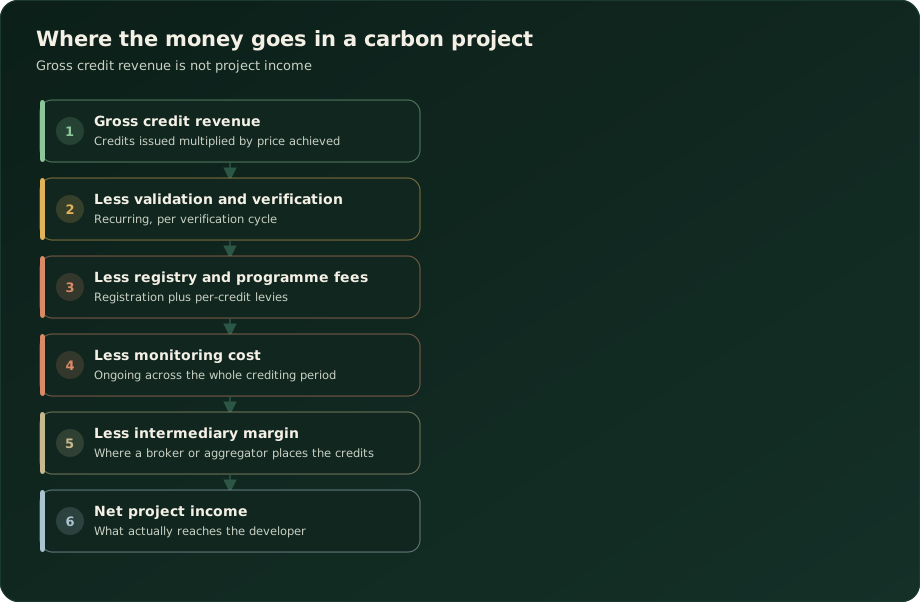
Gross credit revenue is not project income:
Gross revenue (credits issued × price achieved) less validation and verification costs, recurring per cycle less registry and programme fees, including per-credit levies less monitoring costs across the whole crediting period less intermediary margin where a broker or aggregator places the credits equals net project income.
Model this before committing. Projects that look attractive at a headline price frequently do not clear once verification cycles and intermediary margin are included — particularly at lower price points, where fixed costs consume most of the gross.
Price is the other half of that equation, and it varies enormously by project type and quality. See carbon credit prices in India.
Which Project Types Work in India
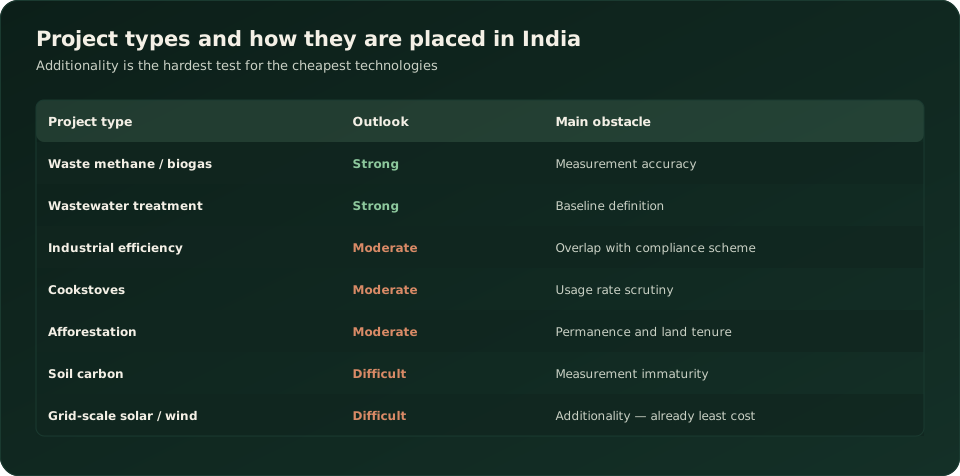
| Project type | Outlook | Main obstacle |
|---|---|---|
| Waste methane capture / biogas | Strong | Measurement accuracy |
| Wastewater treatment | Strong | Baseline definition |
| Industrial energy efficiency | Moderate | Overlap with the compliance scheme |
| Improved cookstoves | Moderate | Usage rate scrutiny |
| Afforestation and reforestation | Moderate | Permanence, land tenure |
| Soil carbon | Difficult | Measurement immaturity |
| Grid-scale solar and wind | Difficult | Additionality — already least-cost |
The uncomfortable pattern: the cheapest technologies have the hardest additionality argument. Renewable energy in India is now commercially competitive, which is good for the country and bad for the carbon-credit case. Methane-related projects hold up best because methane capture is rarely the least-cost option for the operator, making additionality straightforward to argue.
Full treatment in carbon credit project types in India.
Starting as a Consultant or Aggregator
If you do not own an emission-reducing asset, this is the realistic entry.
As a consultant, the sellable capabilities are: eligibility screening, baseline and additionality argumentation, monitoring plan design, data systems, verification support, and buyer-side due diligence. The barrier is credibility — you need a demonstrable track record, and the fastest route is usually working under an established developer or validation body first.
As an aggregator, the model is to bundle many small activities into one registerable project. Cookstoves, small biogas units, and smallholder land-use projects only work this way. It requires a field network, household-level data collection, and enough working capital to fund 18-36 months of costs before revenue. The margin comes from the gap between the small operators' individual uneconomic position and the aggregated project's viability.
For both, the durable competitive advantage is data discipline. Verification failures are overwhelmingly data failures — missing records, unexplained gaps, uncalibrated meters, undocumented assumptions. A developer or aggregator with genuinely audit-ready systems commands both better pricing and lower verification costs.
Risks to Underwrite Honestly
- Regulatory change. India's framework is actively evolving, including on the export of credits. A business model that depends on selling internationally carries policy risk that is not in your control.
- Price volatility. Voluntary market prices have moved sharply in both directions. Long-term offtake agreements transfer this risk but cap the upside.
- Verification failure. Credits are issued only after successful verification. Data problems can delay issuance by a full cycle.
- Reputational scrutiny. Investigative journalism into over-crediting has damaged whole project categories, notably some avoided-deforestation programmes. Buyers now conduct real diligence — see carbon credit due diligence.
- Double counting and corresponding adjustments. If a credit is used towards another country's target, it cannot also count towards India's. This is the single most consequential accounting question in the market — see corresponding adjustments explained.
A Realistic First Ninety Days
- Choose your model — developer, consultant, aggregator, or broker.
- Pick one project type and learn its methodology in depth. Breadth is worth nothing here; depth in one methodology is sellable.
- Read three registered project design documents for that type on a public registry such as Verra or the Gold Standard. This teaches more than any course.
- Map the current CCTS position for your sector directly from BEE publications.
- Build a financial model with realistic timelines — first revenue at month 24, not month 6.
- Find one real activity and run the five eligibility tests against it.
- Talk to a validation body early. What they will and will not accept is the actual constraint.
Step 3 is the highest-value hour you will spend. Registered PDDs are public, detailed, and show exactly what a successful additionality argument and monitoring plan look like in practice.
Frequently Asked Questions
How do I start a carbon credit business in India? Decide whether you are a project developer, consultant, aggregator or trader; select a project type with an approved methodology; test additionality and volume; then follow the design, validation, registration, monitoring, verification and issuance sequence.
Is a carbon credit business profitable in India? It can be, but revenue arrives 18-36 months after costs begin and depends on credit price, project scale and verification success. Fixed costs mean small projects are usually uneconomic without aggregation.
How much investment is needed? For a mid-size project, tens of lakhs before first revenue — feasibility, design documents, validation, monitoring systems and the first verification cycle. Consulting requires expertise rather than capital.
Do I need a licence? Not a licence as such, but participation in the CCTS offset mechanism requires registration with the designated authorities, and international programmes require registry accounts and adherence to their rules.
How long until first revenue? Typically 18 to 36 months from project start to first credit sale.
What is the CCTS? India's Carbon Credit Trading Scheme, established under the Energy Conservation Act as amended in 2022, with a compliance mechanism for obligated entities and an offset mechanism for voluntary projects, administered by the Bureau of Energy Efficiency.
Can I sell Indian carbon credits internationally? It depends on the programme, the credit type and the prevailing policy on exports and corresponding adjustments. This is the area of greatest regulatory uncertainty — take current advice before building a business model on it.
What is the best carbon credit project type in India? Methane-related projects — waste and wastewater — have the most robust additionality arguments. Grid-connected renewables are now difficult to credit.
Do I need a technical background? For consulting and MRV, yes: the work is measurement, engineering and documentation. For brokerage, commercial and contractual skills matter more.
What is additionality? The requirement that the emission reduction would not have occurred without the carbon revenue. It is the most common reason projects are rejected.
Planning a carbon credit project in India? DSTechnoverse supports feasibility screening, baseline and additionality assessment, monitoring plan design, data systems and MRV documentation — and works with buyers on credit due diligence. We are based in Indore, Madhya Pradesh and work with developers across India. See our carbon credit services, or talk to our team about your project.
This article is general information, not legal, financial or regulatory advice. India's carbon market rules are still being built out — verify the current position with the Bureau of Energy Efficiency and your legal advisers before committing capital.