Two credits sit in the same registry account. Same project, same methodology, same vintage year, same verification body. One can be used by an airline for CORSIA compliance. The other cannot. Understanding why is the single most useful thing a buyer or seller can learn about this market.
The Short Version
A voluntary carbon credit is purchased by an organisation that has chosen to offset. Nobody compels the purchase, and the buyer sets its own quality bar.
A CORSIA Eligible Emissions Unit is purchased by an aircraft operator to discharge a legal obligation under the ICAO scheme. The quality bar is not the buyer's to set — ICAO defines it, and a unit either clears it or is useless for the purpose.
The practical consequence: every CORSIA credit could be sold voluntarily, but only a small minority of voluntary credits can be sold into CORSIA.
Difference One: Who Sets the Standard
In the voluntary market, standards compete. Verra, Gold Standard, the Climate Action Reserve and others each publish methodologies, and buyers choose which they trust. A corporate buyer might insist on a particular project type, co-benefit profile or geography. Ratings agencies have emerged precisely because quality varies and buyers need help judging it.
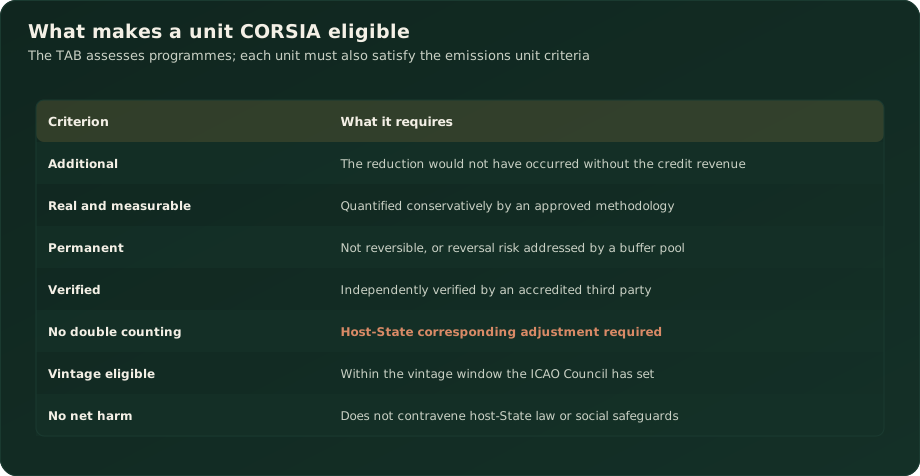
Under CORSIA, the ICAO Technical Advisory Body assesses programmes against the Emissions Unit Criteria and the ICAO Council approves them. The buyer's preference is irrelevant to eligibility. An airline that loves a particular project cannot use its credits unless the programme is approved and the unit-level criteria are met.
This is a genuine shift in market structure. Voluntary buyers exercise discretion; CORSIA buyers exercise procurement within a fixed specification.
Difference Two: The Corresponding Adjustment
This is the difference that actually determines supply.
Under Article 6 of the Paris Agreement, when a host State authorises a credit for use toward another country's target or toward an international mitigation purpose such as CORSIA, it must apply a corresponding adjustment — adding those tonnes back into its own national inventory. The reduction happened in that country, but the country cannot count it toward its own Nationally Determined Contribution if someone else is claiming it.
Most voluntary credits carry no corresponding adjustment. The buyer makes a claim, the host State also counts the reduction in its inventory, and the same tonne is effectively claimed twice. The voluntary market has largely accommodated this by adjusting the language of buyer claims rather than by requiring adjustments.
CORSIA does not accommodate it. A unit without a corresponding adjustment is not eligible, full stop.
And host States are frequently unwilling. Authorising means accepting a harder path to your own climate target in exchange for foreign exchange and project investment. Some governments have decided that trade is not worth making, at least for certain project types. Others have simply not built the administrative machinery to issue authorisations. Either way, the project cannot supply CORSIA.
This one requirement removes a very large share of the global credit pool from CORSIA eligibility, and it is the primary reason for the price gap.
Difference Three: Vintage
Voluntary buyers care about vintage as a quality signal, but rarely as a hard cutoff. A 2016 credit from a good project can still be sold.
CORSIA sets eligible vintage windows by ICAO Council decision for each compliance period. Credits outside the window are ineligible regardless of quality. Windows have been adjusted before, which cuts both ways: it introduces uncertainty for holders of older inventory, and it means a definitive statement about what will be eligible in 2030 cannot honestly be made today.
For sellers this creates a real timing risk. A project that issues credits but cannot place them before the window closes may find its inventory has quietly moved from the premium tier to the general voluntary tier.
Difference Four: Price
The scarcity created by corresponding adjustments and vintage limits shows up directly in price.
General voluntary market credits have traded across an enormous range — from very low single digits per tonne for older renewable energy credits to well above thirty dollars for high-integrity removals. Headline market averages are close to meaningless because they blend incompatible products.
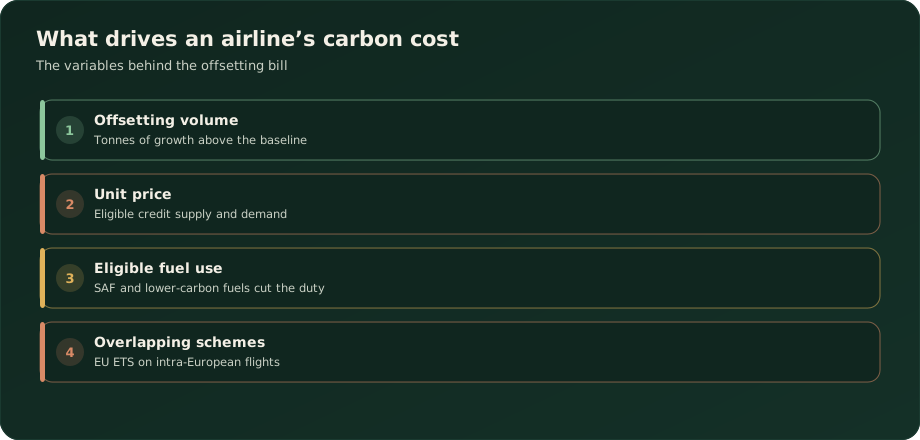
CORSIA-eligible supply trades at a premium to comparable non-eligible supply from the same project types. The premium reflects the authorisation cost, the administrative burden on the host State, and simple scarcity. A buyer budgeting from voluntary market averages will be wrong, usually badly.
For sellers, the corollary is that securing corresponding adjustment is not merely a compliance step — it is the value-creating step. It is what moves a credit from the general pool into the premium pool.
Difference Five: What "Retirement" Means
In the voluntary market, a buyer retires a credit and makes a claim — carbon neutrality, offset flights, a net zero contribution. The claim is largely self-defined and increasingly scrutinised.
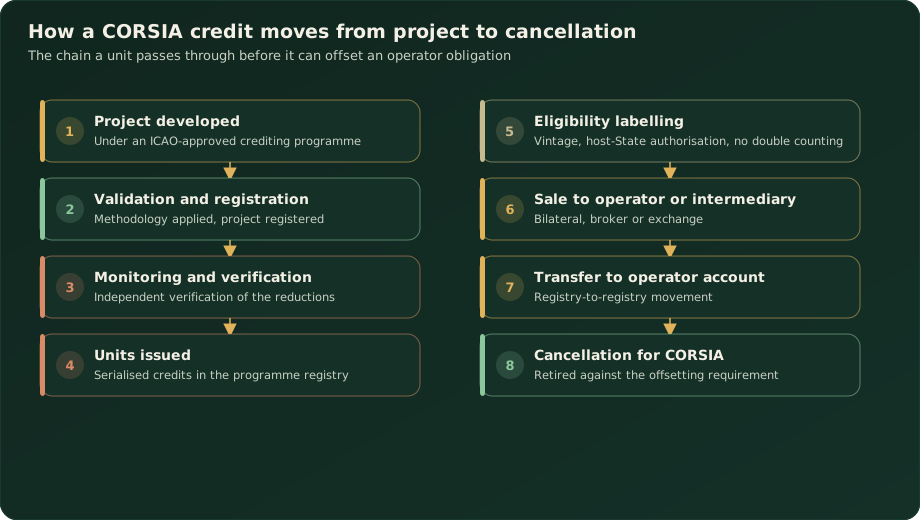
Under CORSIA, the operator cancels the unit and reports the cancellation to its national authority in an Emissions Unit Cancellation Report. There is no marketing claim attached and no discretion in how the cancellation is described. It either discharges the offsetting requirement or it does not.
This matters for sellers because it changes what the buyer is buying. A voluntary buyer is often purchasing a story — project narrative, co-benefits, photographs, a geography that resonates with its customers. A CORSIA buyer is purchasing regulatory discharge. Marketing material that works for one audience frequently misses the other entirely.
Difference Six: Documentation and Traceability
Voluntary transactions vary in rigour. Some are meticulously documented; some are a spreadsheet and a retirement certificate.
CORSIA transactions sit inside a compliance chain that will be verified and may be audited years later. Buyers need evidence of programme approval status at the time of transaction, vintage, corresponding adjustment authorisation, serialisation, transfer records and the cancellation entry. That evidence needs to survive staff turnover and system migration.
Sellers who can supply that documentation package cleanly have a real commercial advantage. Sellers who cannot will find sophisticated buyers walking away regardless of project quality.
Difference Seven: Market Infrastructure and Liquidity
The voluntary market has spot exchanges, standardised contracts, index prices, ratings agencies and a large population of intermediaries. It is not a deep market by commodity standards, but it functions as a market.
The CORSIA-eligible segment does not, yet. Volumes are small, transactions are largely bilateral and negotiated, and there is no reliable public price reference. A buyer cannot look up a screen price and transact; it has to find supply, verify it, and negotiate.
This has three practical consequences.
Price discovery is expensive. Establishing what a fair price is requires talking to multiple sellers and understanding what each unit's documentation actually supports. Buyers who take the first quote frequently overpay; buyers who grind purely on price frequently end up with units carrying documentation gaps.
Timing risk is asymmetric. In a liquid market, a buyer who waits pays the market price. In an illiquid one, a buyer who waits may find that the available supply for their compliance period has been contracted by someone else. Forward contracting has a real value here that goes beyond price hedging.
Counterparty quality varies enormously. The scarcity premium has attracted intermediaries whose understanding of the eligibility criteria is thin. A seller describing units as "CORSIA-ready", "CORSIA-aligned" or "eligible pending authorisation" is describing units that are not currently eligible. Those phrases are not standards; they are marketing.
Can the Same Project Serve Both Markets?
Yes, and many do. A project registered under an ICAO-approved programme can issue credits, place some into the voluntary market without corresponding adjustment, and place others into CORSIA with it — provided the host State authorises the specific volume.
This is actually a sensible commercial strategy, because it hedges the authorisation risk. If authorisation is delayed or partial, the project still has a route to market. Developers who build their entire financial model around CORSIA placement and then fail to secure authorisation face a much harder problem.
What This Means If You Are Buying
- Do not benchmark against voluntary market prices.
- Verify the programme's approval status at the time of transaction, not from a list you saved last year.
- Demand corresponding adjustment evidence, not an assurance that it is in progress.
- Check the vintage against the window for your compliance period.
- Keep the full documentation package, not just the retirement certificate.
- Model the risk that eligible supply is thinner than the market expects when you come to buy.
What This Means If You Are Selling
- Test host-State authorisation before anything else.
- Choose an ICAO-approved programme deliberately rather than defaulting to the one you already use.
- Build the documentation package as you go — reconstructing it later is painful.
- Price the corresponding adjustment work into your model; it is not free.
- Keep a voluntary market fallback so authorisation risk does not sink the project.
Frequently Asked Questions
Can I convert a voluntary credit into a CORSIA credit? Not by any action of your own. If the issuing programme is ICAO-approved and the host State is willing to authorise the specific units and apply a corresponding adjustment, they may become eligible. That is a governmental decision, not a market transaction.
Are CORSIA credits higher quality? They are more tightly specified, particularly on double counting. That is a real integrity difference. It does not automatically mean better co-benefits or a better project — those are separate questions.
Why would a country refuse to authorise? Because doing so makes its own climate target harder to meet. It is a rational trade-off, not obstruction.
Do CORSIA credits ever trade in the voluntary market? They can. A corresponding-adjusted unit is attractive to voluntary buyers who want the strongest possible double-counting claim, and some pay a premium for exactly that.
Which is better to invest in as a developer? It depends entirely on whether your host State will authorise. Establish that first; the rest follows.
What does "CORSIA-eligible pending authorisation" mean? It means not eligible. Authorisation is the gate, and until it is granted the unit cannot be used for compliance. Treat the phrase as a description of a hope rather than a product.
Do voluntary buyers ever want corresponding adjustments? Increasingly, yes. Corporate buyers concerned about the integrity of their claims see the adjustment as the strongest available protection against double counting, and some will pay for it even with no CORSIA obligation at all. This competition for adjusted supply adds to the scarcity operators face.
Ready to act on CORSIA? DSTechnoverse provides specialist CORSIA carbon credit services for aircraft operators, project developers and traders — eligibility screening, offsetting requirement calculation, unit sourcing and due diligence, corresponding adjustment support and registry execution. We are based in Indore, Madhya Pradesh and work with clients across India and internationally.
Apply as a CORSIA buyer or seller
Talk to our carbon markets team about your specific position.