For decades the price of carbon barely touched an airline's income statement. That is changing. Between CORSIA offsetting, the EU Emissions Trading System and the cost premium of sustainable fuel, carbon is turning into a genuine line item — one that finance teams now model alongside jet fuel and currency. This is how that cost is built and what moves it.
The Cost Is a Product, Not a Number
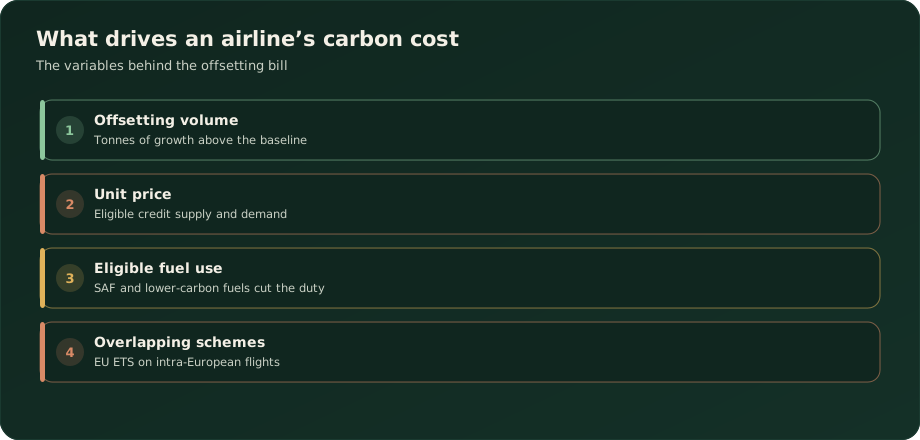
An airline's carbon cost is not a single price; it is a product of several variables:
carbon cost ≈ offsetting volume × unit price − eligible-fuel reductions + ETS liabilities
Each term moves independently, which is why two airlines of similar size can face very different bills.
What Drives the Cost
Three variables move the bill more than any other.
What Sets the Offsetting Volume
Volume is driven by how far an airline's covered emissions rise above the CORSIA baseline, scaled by the growth factor. A carrier expanding rapidly into long-haul international markets generates more offsetting volume than a mature network airline flying flat capacity — although the early reliance on a sectoral growth factor softens that gap. Fleet efficiency also matters: newer aircraft burn less fuel per seat, shrinking both emissions and obligation.
What Moves the Unit Price
The price of an eligible credit is a supply-and-demand story. Demand is the aggregate offsetting requirement of all participating airlines. Supply is the pool of corresponding-adjusted, CORSIA-eligible units — which, as covered in eligible emissions units, is much smaller than the total carbon-credit universe. When eligibility rules tightened, supply contracted and eligible units re-priced upward relative to generic voluntary credits. Price is therefore as much a policy variable as a market one.
The EU ETS Overlap
CORSIA is not the only carbon cost in aviation. The EU Emissions Trading System caps emissions on flights within the European Economic Area, and those allowances have often been considerably more expensive than CORSIA units. The two are designed not to double-charge the same flight: broadly, the EU applies its ETS to intra-European flights and CORSIA to flights leaving the region. An airline with heavy intra-EU operations can face a larger ETS bill than its CORSIA one, so geography of the network shapes exposure as much as total size.
Sustainable Fuel Cuts the Bill — At a Price
Eligible fuels reduce the offsetting requirement, but SAF today costs a multiple of conventional jet fuel. So SAF trades one cost for another: a higher fuel bill in exchange for a lower offsetting bill and progress toward long-term targets. Whether that trade makes sense depends on the SAF premium versus the eligible-credit price at that moment — a live calculation for airline treasuries, and one that improves for SAF as credit prices rise and fuel policy support grows.
A Worked Cost Example
Consider an airline with a 200,000-tonne offsetting requirement.
- At a low eligible-unit price, say a few dollars a tonne, the raw offsetting cost is modest relative to a multi-billion-dollar fuel bill.
- If eligibility tightens and the price climbs toward the mid-teens per tonne, that same volume costs several times more.
- Add EU ETS liabilities on European flying, where allowance prices have run far higher, and the combined carbon cost becomes material to route profitability.
The lesson is that carbon cost is volatile and policy-sensitive, not a fixed surcharge.
Does It Reach the Ticket?
Partly. Airlines operate on thin margins in competitive markets, so they pass through cost increases where they can — through fares, fuel-and-carbon surcharges, or route decisions. But competition limits how much lands on any single fare, and on many routes the per-passenger carbon cost is still small relative to the total ticket. Where it bites hardest is at the margin: thin, price-sensitive routes where a rising carbon cost can tip profitability.
Strategic Responses
Airlines are not passive. They hedge and pre-purchase eligible units to manage price risk, invest in fuel-efficient fleets to cut both fuel and offsetting volume, sign long-term SAF offtake agreements to lock in supply, and factor carbon into network and pricing decisions. Increasingly, carbon strategy sits inside commercial strategy rather than beside it. For the wider view of whether all this actually reduces emissions, see can carbon markets cut aviation emissions.
Frequently Asked Questions
How much does CORSIA add to a ticket? It varies widely with credit price and route, but on many flights the per-passenger offsetting cost is currently small relative to the fare — though it rises as eligible-unit prices climb.
Why is the EU ETS more expensive than CORSIA? The ETS is a cap-and-trade system with a shrinking cap, so allowance prices have generally been far higher than CORSIA offset prices.
Do airlines pass carbon costs to passengers? They try to, through fares or surcharges, but competition limits full pass-through on many routes.
Does sustainable aviation fuel save money? Not directly today — it costs more than jet fuel — but it lowers the offsetting requirement and hedges against rising carbon and future fuel policy.
Will aviation carbon costs rise? Most analysts expect eligible-unit prices to firm as demand grows and eligible supply stays constrained, and ETS costs to rise as caps tighten.
Working on aviation emissions, CORSIA compliance or carbon credit due diligence? DSTechnoverse handles the data side of carbon and environmental compliance — monitoring design, emissions reconciliation, verification support and defensible reporting. See our CORSIA carbon credit services and data analytics. We are based in Indore, Madhya Pradesh and work across India and internationally.
Apply as a CORSIA buyer or seller
Talk to our team, or start with the complete carbon credits guide.