Aviation carbon is usually framed as an airline problem. For businesses and investors that is a mistake, because the same market touches corporate travel budgets, ESG disclosures, project-finance returns and the price of a whole class of carbon credits. You do not have to run an airline to be exposed. This primer maps the market for the people outside the cockpit.
Why Non-Airlines Should Care
Three groups have skin in this game even if they never buy jet fuel. Companies carry aviation emissions inside their own Scope 3 footprint through employee travel and freight. Investors hold airlines, fuel producers and project developers whose economics now include carbon. And project developers and traders supply the credits airlines must buy, making aviation a major, policy-driven source of demand. Aviation carbon is, in short, a market — and markets have participants far beyond the obvious buyer.
Map the Participants
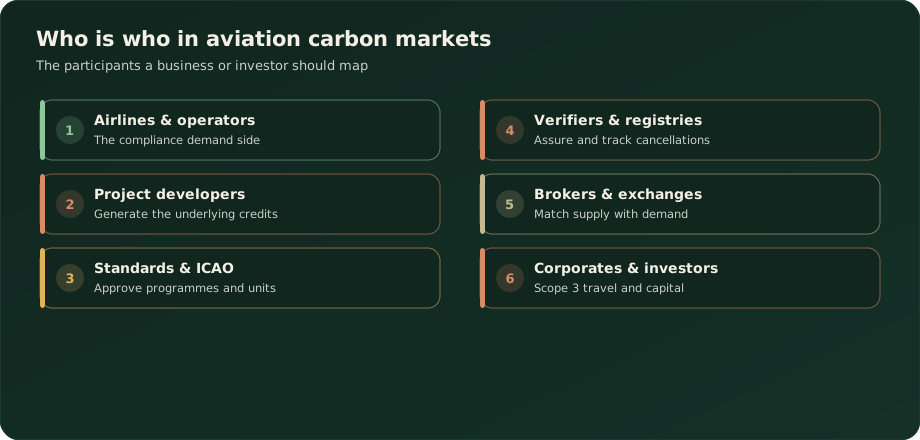
Understanding any market starts with who is in it:
- Airlines and operators — the compliance demand side under CORSIA.
- Project developers — generate the underlying reductions and removals.
- Standards and ICAO — approve programmes and units, setting what qualifies.
- Verifiers and registries — assure integrity and record cancellations.
- Brokers and exchanges — match supply with demand and provide price signals.
- Corporates and investors — buy for Scope 3 claims or deploy capital into supply.
Each node is a potential point of exposure — or opportunity.
Reading the Market
Three forces set value in aviation carbon — demand, supply and policy.
What Drives Demand
Demand for aviation-eligible carbon has a clearer trajectory than most carbon markets because it is anchored in regulation. CORSIA's move to mandatory participation from 2027 and its tightening baseline create a fairly predictable, rising need for eligible units, as set out in the future of CORSIA. Layer on voluntary corporate demand for business-travel offsets, and aviation becomes one of the more visible sources of pull in the credit market.
What Drives Supply — and Who Profits
Supply is the harder half. Eligible, corresponding-adjusted units are scarce relative to the broader credit universe, so developers who can secure host-country adjustments and approved-programme registration hold the more valuable product. For investors, that scarcity is the thesis: high-integrity, adjusted supply is structurally short against regulated demand. The risk is that integrity scrutiny, host-country politics or oversupply of ineligible credits distort returns — which is why the eligibility rules are not a footnote but the core of the investment case.
Price and Policy Risk
This is a policy-made market, so policy is the dominant risk factor. Eligibility decisions, baseline changes, the pace of the 2027 transition and the scale-up of sustainable fuel all move price more than ordinary supply-and-demand would. That cuts both ways: policy tightening can lift eligible-credit prices sharply, while faster SAF adoption or looser rules can soften demand. Anyone taking exposure should model policy scenarios, not just market ones — and should read the price alongside carbon pricing and airlines.
The Corporate Business-Travel Angle
For most companies, the practical entry point is Scope 3. Employee flights create emissions a business must measure and, increasingly, address. That pulls companies into the same quality questions airlines face: which credits are credible, which claims are defensible, and how to avoid the reputational risk of low-integrity offsets. The discipline is identical to an airline's — run real offset quality due diligence before buying anything, and keep the evidence.
How to Approach It With Discipline
Whether you are a corporate buyer or an investor, the same principles apply. Anchor decisions in eligibility and integrity, not price or story. Understand that this is a regulated, policy-sensitive market where rules move value. Diversify across project types and vintages rather than betting on one narrative. And treat data and verification as the asset they are — a credit you cannot substantiate is a liability, not an offset. The winners in aviation carbon will be the participants who treat integrity as the product.
Frequently Asked Questions
Can investors buy CORSIA credits directly? Access is typically through brokers, exchanges, funds or direct project deals; eligibility and registry rules make it a specialist market rather than a retail one.
Why should a non-aviation company care about CORSIA? Business travel puts aviation emissions in a company's Scope 3 footprint, and the same eligibility and quality questions apply to any offsets it buys.
Is aviation carbon a good investment? The demand outlook is regulation-driven and rising, and eligible supply is constrained — but policy risk is high, so integrity and eligibility due diligence are essential.
What is the biggest risk in this market? Buying credits that turn out to be ineligible or low-integrity, and policy changes that reprice supply and demand.
How is aviation carbon different from other carbon markets? Its demand is anchored in a global compliance scheme (CORSIA) with defined eligibility, making it more rules-driven than the broader voluntary market.
Working on aviation emissions, CORSIA compliance or carbon credit due diligence? DSTechnoverse handles the data side of carbon and environmental compliance — monitoring design, emissions reconciliation, verification support and defensible reporting. See our CORSIA carbon credit services and data analytics. We are based in Indore, Madhya Pradesh and work across India and internationally.
Apply as a CORSIA buyer or seller
Talk to our team, or start with the complete carbon credits guide.