Here is the uncomfortable question that sits under every aviation-offset headline: if a credit pays for a reduction somewhere else, is flying actually getting any cleaner? It is worth answering honestly, because the case for carbon markets in aviation is real but narrower than either boosters or critics claim.
Offsetting Is Not Reduction
Start with the distinction that most confusion ignores. When an airline buys and cancels a credit, aviation's own emissions do not fall — a reduction elsewhere is financed instead. That is legitimate climate action if the reduction is real, but it is compensation, not decarbonization of the sector. A scheme like CORSIA that runs on offsetting is therefore, by construction, a bridge instrument. It buys time and channels finance; it does not, by itself, make aircraft emit less.
Why Aviation Leans on Markets Anyway
Aviation is one of the hardest sectors to abate directly. You cannot electrify a long-haul widebody with today's batteries; the energy density is not there. Sustainable fuels exist but are scarce and expensive. New propulsion is years to decades from scale for the flights that emit most. So while the in-sector levers mature, the emissions are real and continuing — and a market that at least prices and partially compensates them is better than pricing nothing. That is the honest case for offsetting in aviation: not that it is ideal, but that the alternative in the near term is doing nothing about the residual.
Where Markets Genuinely Help
Carbon markets do three useful things here.
They move finance to cheaper reductions
A tonne avoided in a cookstove or forestry project can cost far less than a tonne avoided in a jet engine today. Directing money to the cheapest real reductions is economically rational while in-sector options are costly.
They put a price on the residual
Even a modest, volatile carbon price nudges fleet, fuel and network decisions in the right direction and makes efficiency investments pay back faster.
They can fund early SAF and removals
Well-designed demand — including from aviation — helps scale the very technologies that will eventually replace offsetting.
Where They Fall Short
The limits are equally important.
Quality is not guaranteed. The environmental value of offsetting is only as good as the credits bought. Weak additionality, shaky baselines or reversals can mean the "reduction" was partly illusory — which is why offset quality due diligence is not optional.
It can delay real change. If offsetting is cheap enough, it can blunt the incentive to invest in harder in-sector reductions. The risk is treating a bridge as a destination.
It does not touch non-CO2 effects. Aviation's warming impact includes contrails and nitrogen oxides at altitude, which CORSIA's CO2-only accounting does not address at all.
The Abatement Stack
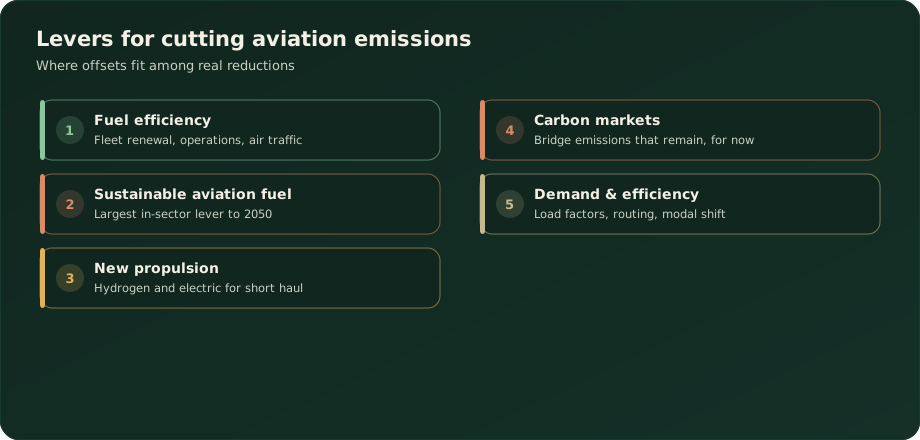
The credible way to see markets is as one layer in a stack, ordered by how directly they cut aviation's own emissions:
| Lever | Cuts aviation's own emissions? | Time horizon |
|---|---|---|
| Fuel efficiency & operations | Yes | Now, incremental |
| Sustainable aviation fuel | Yes | Scaling to 2050 |
| Hydrogen / electric propulsion | Yes | Long term, short-haul first |
| Carbon markets / offsetting | No — compensates | Now, as a bridge |
Markets are the only layer that does not reduce aviation's own emissions — which is exactly why they should shrink as the others grow.
A Credible Position
The defensible stance is neither "offsetting solves aviation" nor "offsetting is greenwashing". It is this: aviation should cut what it can in-sector as fast as it can, price and compensate the residual through high-integrity markets in the meantime, and let the offsetting share fall every year as fuels and technology scale. Used that way, carbon markets are a legitimate transition tool. Used as a permanent substitute for real reductions, they are not. The direction of travel — toward mandatory participation and a net-zero 2050 goal — only makes sense if the in-sector levers do the heavy lifting over time.
Frequently Asked Questions
Does buying offsets make my flight carbon neutral? It compensates the emissions if the credits are genuinely high quality, but the flight itself still emitted CO2 and non-CO2 warming effects.
Why not just ban offsetting and force real cuts? The in-sector technology to cut most aviation emissions is not yet available at scale; removing the bridge would leave the residual emissions unpriced.
Do carbon markets slow down real decarbonization? They can, if cheap offsets reduce the pressure to invest in fuels and efficiency — which is why credible plans shrink offsetting over time.
What about contrails and other non-CO2 effects? CORSIA accounts only for CO2. Non-CO2 warming is significant and is an active area of policy and science, but outside the current market mechanism.
Will offsetting always be part of aviation? Most roadmaps expect it to decline as sustainable fuel and new propulsion scale, covering a shrinking residual rather than the bulk of emissions.
Working on aviation emissions, CORSIA compliance or carbon credit due diligence? DSTechnoverse handles the data side of carbon and environmental compliance — monitoring design, emissions reconciliation, verification support and defensible reporting. See our CORSIA carbon credit services and data analytics. We are based in Indore, Madhya Pradesh and work across India and internationally.
Apply as a CORSIA buyer or seller
Talk to our team, or start with the complete carbon credits guide.