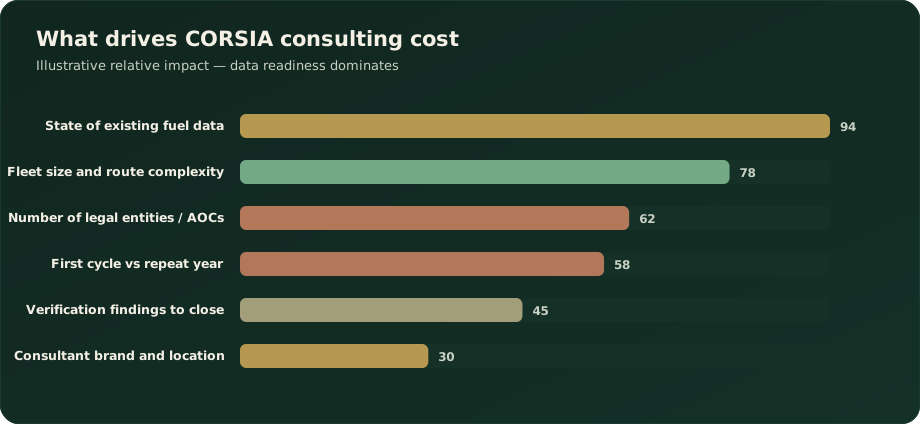
Consulting proposals for CORSIA vary enormously in price for what looks like the same scope, and the variation is usually real rather than opportunistic. It reflects how much work the consultant expects to do — which depends almost entirely on the state of your data, not on the size of your fleet.
The Six Cost Drivers
| Driver | Why it moves the fee |
|---|---|
| State of existing fuel data | The dominant factor. Reconciled per-flight data is a review; scattered station records are a data project |
| Fleet size and route complexity | More aircraft types, more state pairs, more scope to define and test |
| Number of legal entities or AOCs | Each may need its own monitoring plan, report and verification |
| First cycle versus repeat year | Year one carries the plan, the data flow and the procedures |
| Verification findings to close | Unbudgeted rework, and the most avoidable cost in the list |
| Consultant brand and location | Real, but the smallest contributor |
The first row deserves the emphasis it gets. Two operators with identical fleets can differ by a factor of three in cost purely because one already reconciles fuel uplift to flight records and the other reconstructs it annually from paperwork.
Before requesting proposals, do a two-day internal check: can you produce, for any randomly chosen flight last year, the fuel figure used, the source document behind it, and the person who owns that system? If yes, say so in the brief — it should reduce every quote you receive. If no, that gap is the work, and hiding it only produces a variation order later.
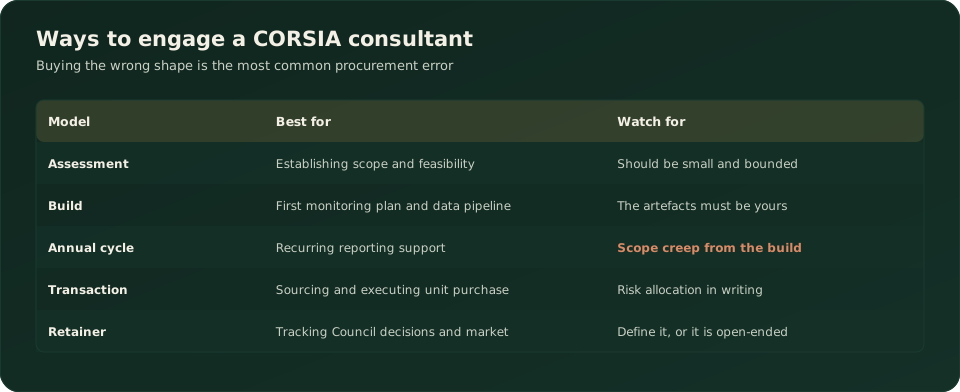
Fee Structures
| Structure | How it works | Suits |
|---|---|---|
| Fixed fee per deliverable | Priced per document — plan, report, verification support | Well-defined first cycles |
| Fixed annual retainer | Covers the full compliance cycle | Repeat years, predictable scope |
| Time and materials | Day rate against an estimate | Genuinely uncertain scope |
| Phased | Fixed fee for gap analysis, then priced scope | Usually the most honest |
| Success-linked | Part of the fee on acceptance or clean verification | Rare, and be careful how success is defined |
Phased pricing is worth pushing for on a first engagement. A short paid gap analysis — a week or two — lets both sides price the real scope instead of guessing. It also gives you a low-cost trial of how the firm actually works before committing to the full cycle.
Be cautious with success-linked fees tied to verification outcomes. A verifier's opinion is independent, and a fee structure that rewards a particular opinion creates pressure in exactly the wrong place.
Costs Outside the Consultant Fee
The consultant is rarely the largest line in the compliance budget. Budget separately for:
| Cost | Notes |
|---|---|
| Verification body fee | Independent, accredited, and not something the consultant can discount |
| Internal staff time | Compliance lead, fuel and operations data owners, finance |
| System changes | Reporting extracts, data capture at stations, retention |
| Training | So the annual cycle can be run internally |
| Emissions units | Where an offsetting requirement applies |
| Registry and cancellation | Account setup and transaction charges |
| Legal review | Contracts for unit purchase, corresponding adjustment terms |
| Contingency for findings | 10-15% is realistic in a first cycle |
The verification fee is a separate procurement and should stay that way. Verification must be independent of the party preparing the report, so a proposal that bundles "verification included" needs unpacking — either the verifier is subcontracted at arm's length and disclosed, or something is wrong with the independence model. See choosing a CORSIA verification body in India.
Why Year Two Should Cost Less
A first cycle builds assets that persist:
- An accepted monitoring plan
- A documented data flow with named owners
- Written procedures including the data gap procedure
- A verification evidence pack structure
- A trained internal compliance lead
If all five exist at the end of year one, year two is a lighter engagement — review, quality control and verification support rather than build. If the fee is identical, the assets probably were not built, or were not transferred.
Write knowledge transfer into the scope, with named artefacts: procedures document, data flow diagram, evidence pack template, and a working session with your team. It is the highest-return clause in the contract.
Project-Side Costs Are Different
For a developer supplying CORSIA-eligible credits, the cost structure resembles carbon project development rather than compliance advisory:
| Item | Character |
|---|---|
| Feasibility and eligibility screening | One-off, early, cheap relative to what it prevents |
| Project design document | One-off, substantial |
| Validation | Third-party, one-off |
| Registration | Programme fee |
| Monitoring systems | Setup plus continuous cost |
| Verification | Recurring per issuance cycle |
| Corresponding adjustment support | Government engagement — timeline outside your control |
| Buyer documentation pack | Small, and it raises the price achieved |
The corresponding adjustment line is the one that breaks project timelines, because it depends on a host country decision rather than on anything the developer or consultant does. Budget for the elapsed time, not just the effort. See corresponding adjustments for Indian CORSIA projects.
Getting Comparable Quotes
Proposals only compare if the brief is specific. Give every firm:
- Fleet list, aircraft types and approximate international sectors
- Number of legal entities and AOCs in scope
- An honest description of your current fuel data and systems
- Whether a monitoring plan exists and whether it has been accepted
- Which compliance year is in scope
- Whether verification support is required
- Whether knowledge transfer is required, and to how many people
- Your internal capacity to do part of the work
Then require every quote to state: deliverables by name, who does the work, days by grade, what is excluded, how findings are handled, and what year two looks like.
Watch for the exclusions. A low fee with "data remediation excluded" against messy data is not a low fee; it is a variation order waiting to happen.
What Cheap Actually Costs
The failure mode is not usually a bad document — it is a document that has never been tested against a verifier. A monitoring plan written from a template, with a data flow nobody validated, passes internal review comfortably and produces material findings at verification. Closing those findings costs consultant time, verifier re-work, internal time and, if the deadline is close, considerable stress.
The cheapest genuine saving available is having your fuel data in order before the engagement starts. It reduces the fee, reduces verification effort, and reduces the risk of conservative adjustments being applied where data is incomplete — see CORSIA fuel data quality management.
A Worked Budget Shape
Illustrative proportions for a first CORSIA compliance cycle at a mid-size operator. The absolute figures depend entirely on your data position; the shape is what transfers.
| Line | Share of total year-one budget |
|---|---|
| Consultant — gap analysis and monitoring plan | 25% |
| Consultant — data flow, procedures, dry run | 20% |
| Consultant — verification support and submission | 15% |
| Verification body fee | 20% |
| Internal staff time (costed) | 10% |
| System and reporting changes | 5% |
| Contingency for findings | 5% |
Two observations. The consultant is around 60% of the budget, not 90% — the verification fee and internal time are substantial and often left out of the initial approval request, which is why CORSIA budgets are so frequently exceeded on paper without anything actually going wrong.
Emissions units are not in that table at all. Where an offsetting requirement applies, unit purchase is a separate and potentially much larger commercial line, driven by the offsetting requirement and the unit price achieved rather than by any advisory cost — see CORSIA compliance cost management.
In year two the first three lines should compress substantially, the verification fee stays broadly flat, and internal time rises as the cycle moves in-house. That shift — advisory down, internal up, verification steady — is what a healthy CORSIA cost trajectory looks like.
Frequently Asked Questions
How much does a CORSIA consultant cost in India? It varies widely with data readiness, fleet complexity, entity count and whether it is a first cycle. Ask for phased pricing — a paid gap analysis first, then a scoped fee.
What is the biggest cost driver? The state of your existing fuel and flight data, by a wide margin.
Is verification included in the consultant fee? It should not be. Verification is independent and procured separately, though a consultant can help you select and manage the verifier.
Should we pay a fixed fee or day rate? Fixed fee per deliverable for well-defined scope; phased pricing where scope depends on what the gap analysis finds.
Why is year two cheaper? Because the monitoring plan, data flow, procedures and evidence structure already exist. If year two is not cheaper, ask what assets year one produced.
What costs sit outside the consultant fee? Verification, internal staff time, system changes, training, emissions units, registry charges and a contingency for findings.
How do I compare proposals fairly? Issue an identical, specific brief and require named deliverables, staffing by grade, exclusions, findings handling and a year-two price.
What does a project developer pay? A different structure entirely — feasibility, project design document, validation, registration, monitoring, verification and corresponding adjustment support.
Can we do it in-house to save cost? For repeat cycles, often yes. For a first cycle, the risk of an unaccepted plan or a failed verification usually outweighs the saving — see consultant versus in-house.
Need a CORSIA consultant in India? DSTechnoverse advises airlines and aircraft operators on CORSIA monitoring, reporting and verification, and works with project developers on eligible credit supply, corresponding adjustments and buyer due diligence. We are based in Indore, Madhya Pradesh and work with clients across India. See our CORSIA carbon credit services, our carbon credit portal at carboncredit.dstechnoverse.com, or talk to our team about your compliance year.
This article is general information, not legal or regulatory advice. CORSIA rules and the list of participating states change — verify the current position with ICAO and the DGCA before acting.