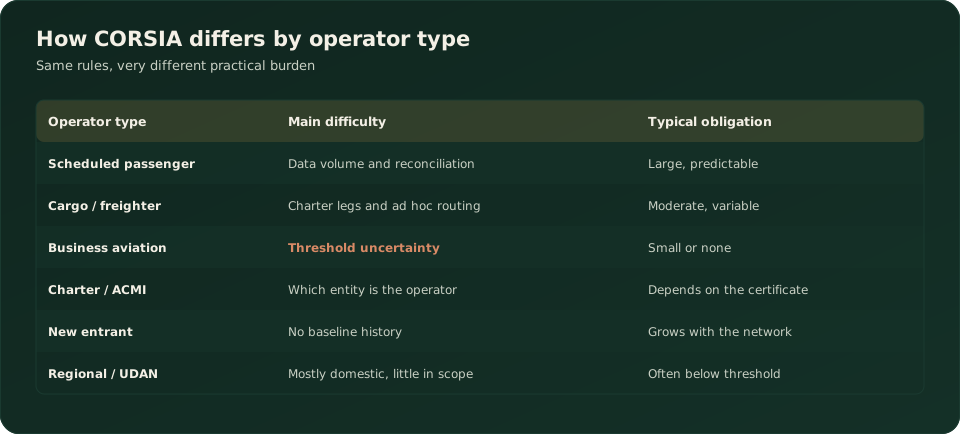
Business aviation sits in an awkward position under CORSIA. The aircraft threshold captures almost every business jet. The operator threshold excludes almost every business aviation operator. Working out where you actually stand is the whole exercise.
Two Thresholds, Two Different Answers
The aircraft threshold is 5,700 kg maximum certificated take-off mass. This is low. It captures light jets and above — a Phenom 300, a Citation, a Learjet, and everything larger. Only very light aircraft and turboprops below the mass sit outside it.
The operator threshold is 10,000 tonnes of CO2 per year from international flights. This is high relative to business aviation. Ten thousand tonnes corresponds to roughly 3,165 tonnes of jet fuel.
To put that in perspective: a midsize business jet burning around a tonne of fuel per flight hour would need roughly 3,000 international flight hours a year to reach it. That is a very heavily utilised aircraft, or a fleet.
The practical consequence: most single-aircraft and small-fleet operators are below the offsetting threshold. Larger charter operators, fractional programmes and fleet managers running substantial international operations may well be above it.
Establishing Your Position
The determination is not difficult, but it must be done rather than assumed.
- Identify the operator entity. For business aviation this is frequently the charter operator holding the Non-Scheduled Operator's Permit, not the aircraft owner. An owner whose aircraft is managed and chartered by an operator is generally not the CORSIA operator.
- List all international flights flown under that certificate across the year. Domestic sectors are out of scope entirely.
- Exclude aircraft at or below 5,700 kg MTOM.
- Exclude exempt flight types — medical, humanitarian, firefighting, State aircraft. Air ambulance operations genuinely conducted as medical flights are exempt.
- Convert fuel to CO2 at 3.16 kg CO2 per kg of jet fuel.
- Compare against 10,000 tonnes.
Document the calculation. An operator sitting comfortably below the threshold still benefits from a written determination, because the question will recur annually and because a growing operation can cross the line without anyone noticing.
If You Are Below the Threshold
You have no offsetting obligation. Whether any reporting obligation applies depends on how your State has implemented the scheme, so confirm with the DGCA rather than assuming.
Three things still worth doing:
Recalculate annually. A fleet addition or a shift toward international charter can push you over. Crossing the threshold without having built any monitoring capability is the difficult position.
Keep basic fuel records by flight. If you cross the threshold, the first monitoring year is far easier if usable historical data exists. Data cannot be collected retrospectively.
Understand the direction of travel. Business aviation faces increasing scrutiny on emissions from customers, financiers and regulators independently of CORSIA. Records that exist are useful in several contexts.
If You Are Above the Threshold
The full obligation applies, and the practical difficulty is that business aviation operations are structured very differently from scheduled airlines.
Operator determination is genuinely complex. Managed aircraft, fractional ownership, owner-flown legs and multiple commercial arrangements each raise the question of which certificate the flight was conducted under. Resolve it per arrangement.
Flight records are less systematic. Scheduled carriers have integrated operations systems. Business aviation often runs on scheduling software plus handling agent paperwork, and the fuel record may be a receipt from an FBO rather than a system feed.
Routing is unpredictable by nature. Scope classification cannot be built around a published schedule.
International FBO uplift records vary widely in format and reliability across countries.
Choosing a Monitoring Method
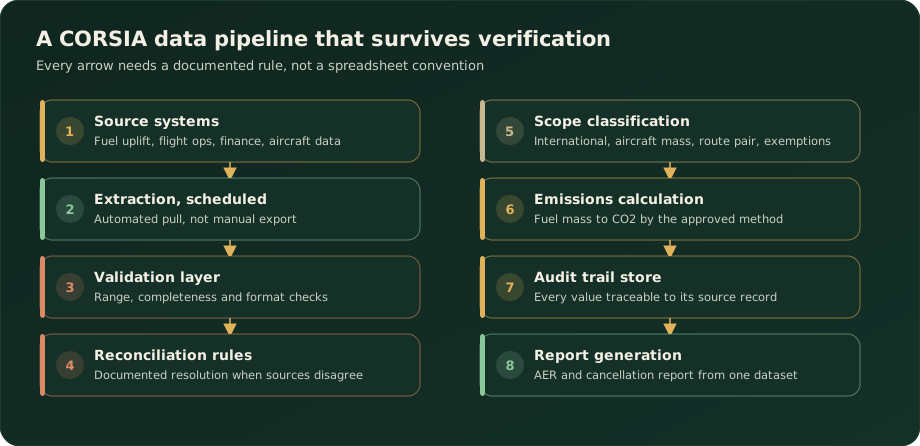
The method must survive your least organised station, not your best one.
For business aviation the fuel uplift method is usually most practical, because an uplift receipt exists for every fuelling even where systems are thin. Methods depending on tank readings at block times require aircraft data capture that many operations do not have systematically.
Test before committing. Take a genuinely messy month — several countries, several FBOs, a diversion — and attempt to produce the required figures. The result determines the method, not the other way round.
Note also that the CERT tool is available to small emitters. An operator near the threshold should understand the eligibility conditions and, importantly, plan for the transition if growth takes them past the point where CERT may be used.
The Cost Problem at Small Scale
CORSIA's fixed costs do not scale down, and for business aviation operators above the threshold this is the dominant commercial issue.
A monitoring plan costs broadly the same to write for a three-aircraft operation as for a thirty-aircraft one. Verification has a floor price regardless of how few flights are examined. Registry account opening is the same process either way. Those fixed elements spread across a much smaller emissions base, so the cost per tonne is substantially higher than for a scheduled carrier.
Three responses that genuinely help:
Keep the monitoring approach simple. A less precise method that your FBO receipts can feed without manual work is cheaper to run every year and no less compliant. Precision beyond what your data supports buys nothing.
Automate what recurs. The annual cycle is the cost that repeats. Investing once in a repeatable extraction and reconciliation process is worth more at small scale than at large, because the alternative is the same manual effort every year with no economies.
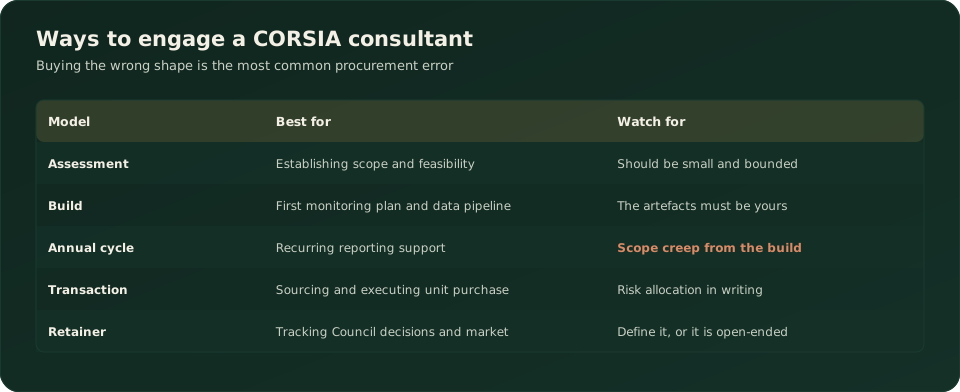
Buy advisory in the right shape. A bounded assessment and build, then internal running of the annual cycle, costs far less than an open-ended retainer. See consultant engagement models.
What does not help is deferring the work. The fixed costs arrive whenever you engage; deferring only compresses the timeline and removes your options on method and verifier.
What Owners and Financiers Increasingly Ask
Even where CORSIA does not apply, the questions it raises are arriving from other directions, and an operator who has done the scope work can answer them cheaply.
Aircraft financiers and lessors increasingly ask about emissions exposure as part of credit assessment. A documented scope determination and fuel record answers it in a paragraph.
Corporate charter customers with their own reporting obligations ask for per-flight emissions figures to include in their own scope 3 accounting. An operator who can supply a credible figure has a commercial advantage over one who cannot.
Insurance and finance counterparties are beginning to include environmental disclosure in their processes.
None of these are CORSIA obligations. All of them are answered by the same underlying data, which is a reason to build the record even when the threshold has not been crossed.
Where a Consultant Helps Most
The threshold determination itself, especially where the answer is close. This is a bounded piece of work with a clear output and it prevents both unnecessary compliance spend and unrecognised non-compliance.
Operator entity analysis for managed and fractional structures.
Method selection tested against actual FBO records.
First monitoring plan, because errors here compound and surface at verification.
What genuinely does not need outsourcing: routine annual data collection once a process exists, and understanding of your own flight records.
Frequently Asked Questions
Does CORSIA apply to private jets? The aircraft threshold of 5,700 kg captures most business jets, but the operator must also exceed 10,000 tonnes of annual international CO2. Most small operators are below that.
Who is the operator — the owner or the charter company? Generally the entity holding the operating certificate under which the flight is flown. For managed aircraft that is usually the operator, not the owner.
Are owner-flown legs different from charter legs? Potentially, if they are flown under a different certificate or as private rather than commercial operations. Establish the basis per arrangement.
Is an air ambulance flight exempt? Medical flights are exempt. The exemption attaches to the flight, not the operator, so a mixed operation excludes only the medical sectors.
We are just below the threshold. What should we do? Document the calculation, keep flight-level fuel records, and recalculate annually. Crossing the line without data is the position to avoid.
Can we use the CERT tool? It is available to small emitters under defined conditions. Confirm eligibility, and plan the transition to full monitoring if you are growing.
Does the aircraft owner have any obligation? Generally not, where the aircraft is operated under someone else's certificate. The obligation follows the operator, not the asset. Owners should still understand the position, because it affects the economics of the management agreement.
How do we handle flights that are partly private and partly commercial? Classify per flight against the certificate under which it was flown, and document the basis. A blanket assumption either way will not survive verification.
Does CORSIA apply to helicopters? No. The scheme applies to aeroplanes.
What does compliance cost at this scale? Proportionally more per tonne than for a large airline, because the fixed elements — plan, verification, registry — do not scale down. See CORSIA consultant cost and fees.
Working out what CORSIA means for your operation? DSTechnoverse provides CORSIA carbon credit services for Indian operators and project developers — scope assessment, monitoring plans, data pipelines, verification support and unit sourcing. We are based in Indore, Madhya Pradesh and work across India.
Apply as a CORSIA buyer or seller
Talk to our carbon markets team about your position.