A CORSIA unit that fails eligibility after you have cancelled it does not merely waste the purchase price. It leaves an unmet obligation, discovered at the worst possible moment, in a market where replacement supply may not be available at any sensible price.
Diligence is therefore not a formality. This is the checklist, organised by what you are actually testing.
Section A: Programme Status
A1. Is the issuing programme currently approved by the ICAO Council?
Verify against the ICAO emissions units page at the time of transaction. Not from a saved list, not from the seller's website, not from an article. Approvals change by Council decision, and at least some have lapsed.
A2. Is the approval full or conditional?
Conditional approvals carry limitations — frequently relating to how the programme handles corresponding adjustments, sometimes to specific methodologies or project types.
A3. If conditional, does the condition affect these specific units?
Read the condition. A conditional approval that excludes the exact methodology your units come from makes them ineligible.
A4. When is the approval next reviewed?
Relevant if you are contracting forward against future issuance from that programme.
Section B: Vintage
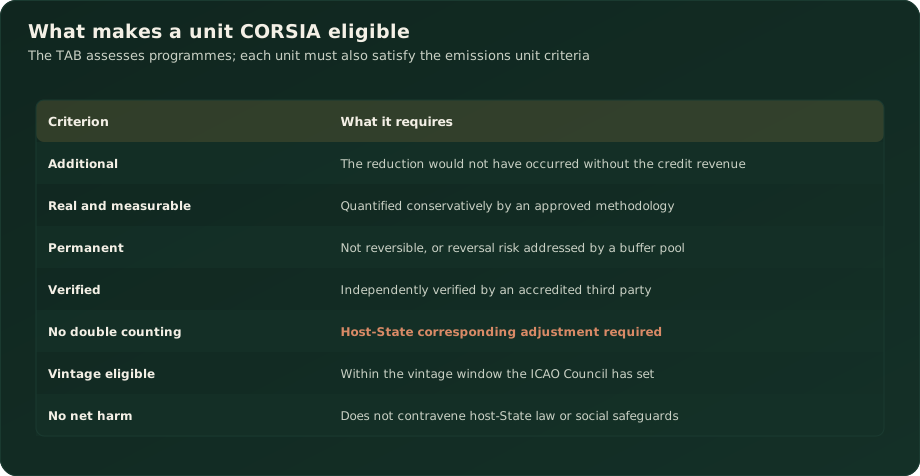
B1. In which monitoring period did the reduction occur?
The registry record shows this. The issuance date is not the vintage.
B2. Is that vintage inside the eligible window for your compliance period?
Not for any compliance period — for yours.
B3. How close to the boundary is it?
Units near a window edge carry the risk that the boundary moves, or that you cannot cancel before it closes.
B4. If contracting forward, what is the vintage risk allocation?
If the window shifts between contracting and delivery, who absorbs it? The contract should say.
Section C: Corresponding Adjustment
This section eliminates more supply than every other section combined. Do not compress it.
C1. Is there a formal host-State authorisation document?
An actual document, from the designated national authority, not an email from the seller and not a statement on a project page.
C2. Does it name these specific units?
Authorisation is granted for defined volumes, vintages or project outputs. A general statement that the country supports Article 6 transfers is not an authorisation.
C3. Has the corresponding adjustment been applied, or only committed?
Commitment and application are different. Understand which you have, and what happens if the application does not follow.
C4. Is there evidence in national reporting?
The adjustment should ultimately be visible in the host State's Article 6 reporting.
C5. Could the authorisation be revoked or narrowed?
Governments have changed position. Assess the specific jurisdiction rather than assuming stability.
C6. If the seller says "pending", what exactly is pending, and on what timeline?
"Eligible pending authorisation" describes a unit that is not eligible. If you proceed, price and contract for that.
Section D: Verification
D1. Is the verification report from a body accredited under the programme's rules?
D2. Does the report cover the specific monitoring period the units come from?
D3. Does it carry qualifications, and what do they say?
Qualified opinions are not automatically disqualifying, but you need to understand what was qualified and why.
D4. Is the verification body independent of the developer, and of any validator conflict?
Section E: Registry and Chain of Custody
E1. Are the units uniquely serialised?
E2. Does the registry record show a complete, unbroken chain from issuance to the current holder?
E3. Has any part of this parcel been previously retired, cancelled or claimed?
E4. Does the seller actually hold them?
Confirm the holding in the registry. Brokered supply that the broker does not hold introduces a delivery risk you should be aware of.
E5. Are there liens, options or prior commitments over these units?
Section F: Project Integrity
F1. Is the additionality argument credible for this project, in this market, at this time?
Additionality that was defensible a decade ago may not be now, particularly for grid-connected renewables in markets where they are the least-cost option.
F2. Is the quantification conservative?
Look at the assumptions, particularly usage rates for distributed technologies and baseline rates for land-based projects.
F3. For storage-based projects, how is permanence handled?
Buffer pool contribution, monitoring commitments, legal protection of the stock. Buffer adequacy is under active scrutiny as reversal losses accumulate.
F4. Is there evidence of no net harm?
Environmental and social impact assessment, stakeholder consultation, free prior and informed consent where relevant, and a grievance mechanism. Land tenure disputes are the most common failure, particularly in forestry.
F5. Has the project attracted public criticism or ratings downgrades?
Not decisive, but worth knowing before you own it.
Section G: Counterparty
G1. Who is the legal seller, and what is their standing?
G2. Do they hold the units, or are they intermediating?
G3. What is their track record on CORSIA delivery specifically?
G4. Can payment be structured to reduce exposure — escrow, staged, or payment against delivery?
Section H: Contract
H1. What does the seller warrant on eligibility, and what is the remedy on breach?
H2. Who bears authorisation risk on forward deals?
H3. Who bears vintage window risk?
H4. What happens on late delivery relative to your cancellation deadline?
H5. Is delivery of the full documentation package a contractual obligation?
H6. What is the governing law and dispute mechanism, and is it practically usable given where the counterparty sits?
Section I: The Evidence Package
The test: could someone who was not involved reconstruct the eligibility case three years from now, from your files alone, without contacting the seller?
Retain at minimum:
- The executed contract
- Registry records showing serialisation and chain of custody
- The host-State authorisation document
- Evidence of the corresponding adjustment
- Programme approval status as at the transaction date, captured, not merely referenced
- The verification report and any qualifications
- Project design documentation
- Transfer confirmations
- Cancellation confirmations with serials and references
- The Emissions Unit Cancellation Report and the authority's acknowledgement
Capture, not link. Web pages change, and a URL is not evidence of what a page said on the day you relied on it.
Section J: Proportionality
Not every purchase warrants the same depth. Calibrate rather than applying the full checklist mechanically to a small repeat trade with a known counterparty.
Always do in full, regardless of size: Sections A, B and C — programme approval, vintage and corresponding adjustment. These are the eligibility determinants, they are cheap to check, and failure on any of them makes the unit worthless for your purpose.
Scale with value: Sections F and G — project integrity and counterparty. A large first-time purchase from an unfamiliar developer deserves site-level scrutiny. A small tranche from a project you have already bought from, under the same authorisation, does not need the analysis repeated.
Scale with structure: Section H — contract. A spot purchase settling in days carries less contractual risk than a five-year forward against future issuance. The forward deserves real legal attention; the spot trade may not.
Never scale down: Section I — the evidence package. Small purchases produce audit questions exactly as large ones do, and the marginal cost of filing the documents properly at the time is close to zero. The cost of reconstructing them later is not.
A practical shortcut for repeat purchases: maintain a standing file per project and per host-State authorisation, and per transaction record only what is transaction-specific — serials, volume, price, transfer and cancellation. That keeps the effort proportionate without leaving gaps.
Red Lines
Circumstances in which the correct answer is to walk away:
- No host-State authorisation document, and no credible timeline for one
- Programme approval lapsed, or conditional in a way that touches these units
- Vintage outside your window
- Seller will not permit registry verification of the holding
- Documentation offered only as summary or certificate, with underlying evidence withheld
- Pressure to transact before diligence completes
That last one deserves emphasis. Genuine scarcity does create real urgency, and sellers will say so honestly. But urgency is also the standard tool for shortening diligence, and a unit bought under time pressure that later fails is worse than a unit not bought.
Frequently Asked Questions
Can I rely on a broker's diligence? No. Your authority holds you accountable, not your broker. Review their work; do not substitute it for your own.
How long does diligence take? One to three weeks per tranche for a first-time buyer, less once you have a process and are dealing with a known counterparty and programme.
Is a ratings agency assessment sufficient? Ratings address project quality, which is useful but is not the same as CORSIA eligibility. A highly rated project without a corresponding adjustment is still ineligible.
What if diligence surfaces a problem after I have paid? Your contract determines the remedy. This is exactly why sections G and H exist.
Should I re-verify programme approval before cancelling? Yes, if significant time has passed since the transaction. It is a few minutes of work against a material risk.
Who should own this process internally? Someone accountable, with the authority to decline a transaction. Diligence that cannot stop a deal is not diligence.
Buying CORSIA credits? DSTechnoverse provides specialist CORSIA carbon credit services — offsetting requirement calculation, eligible unit sourcing, pre-transaction due diligence, registry execution and cancellation reporting. We are based in Indore, Madhya Pradesh and work with operators across India and internationally.
Apply as a CORSIA buyer or seller
Talk to our carbon markets team about your requirement.