CORSIA-eligible credits sit in a different market from voluntary credits, with a different buyer, a different scarcity dynamic and a different price. Understanding what actually drives the number is what prevents a developer from either leaving money on the table or pricing themselves out of a compliance deadline.
What Drives the Price
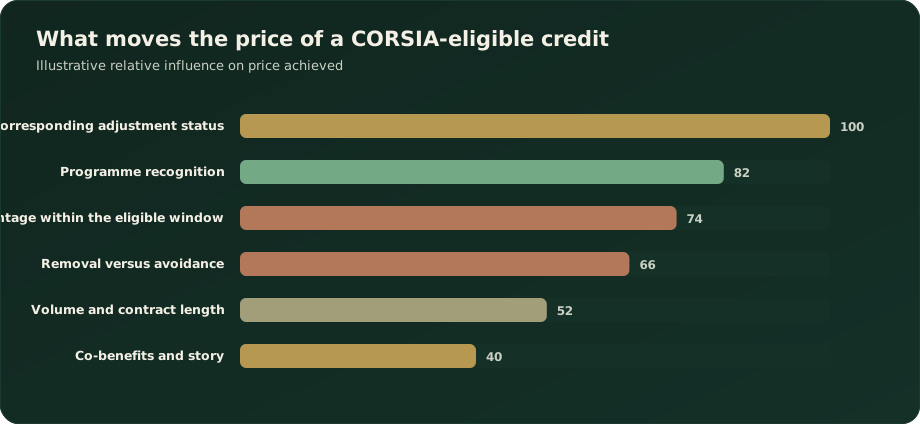
| Driver | Influence |
|---|---|
| Corresponding adjustment status | Decisive — authorised units command a large premium |
| Programme recognition | Very high — approved programme and scope |
| Vintage within the eligible window | High — outside it, the unit is unusable |
| Removal versus avoidance | Moderate — matters more to voluntary buyers |
| Volume and contract length | Moderate — larger offtakes discount per unit |
| Co-benefits and story | Lower for a compliance buyer than a voluntary one |
The ordering is the point. In the voluntary market, story and co-benefits move price substantially. For a compliance buyer discharging a legal obligation, eligibility is close to binary — a unit either counts or it does not — and everything else is secondary.
This is why a developer accustomed to voluntary market selling often mis-pitches CORSIA buyers: leading with community impact when the buyer's first three questions are about authorisation, programme scope and vintage.
The Scarcity Dynamic
Two forces set the market:
Demand is driven by the offsetting requirement across participating operators, which grows as more states participate and as traffic grows relative to the baseline. It is not a matter of sentiment — it is a legal obligation with a deadline.
Supply is constrained by the corresponding adjustment. Many projects exist; far fewer carry authorisation. That constraint is what supports pricing for authorised units, and it is a policy variable rather than a market one.
The practical implication for a developer: an authorised unit is a genuinely scarce product. Price it accordingly, and do not benchmark it against voluntary market credits from the same project type.
For the wider market picture, see CORSIA credits versus voluntary carbon credits and the CORSIA carbon credit price guide.
Building Your Price Position
Before any negotiation, establish four numbers:
- Your cost floor. All-in cost per credit including validation, verification, monitoring, registry fees and development cost amortised over realistic volume.
- Your realistic volume, after the verification haircut. Verifiers trim claimed reductions; model 10-15% below your own estimate.
- Your timing constraint. Do you need revenue by a date? A buyer who senses urgency prices accordingly.
- Your alternative. Can these units go to the voluntary market instead, and at what price? That is your walk-away.
Point 4 is what gives a developer negotiating power. A seller with no alternative accepts what is offered. A seller who can place the units elsewhere — even at a lower price — negotiates from a position.
Contract Structures
| Structure | Price effect | Risk allocation |
|---|---|---|
| Spot sale of issued units | Highest per unit | Seller carried all delivery risk already |
| Forward sale before issuance | Discounted | Buyer takes delivery risk; seller takes price certainty |
| Long-term offtake | Discounted 20-40% | Funds development; caps upside for the period |
| Option / call structure | Premium paid upfront | Buyer secures optionality |
| Floor with upside share | Balanced | Downside protected, upside shared |
| Pending-CA conditional sale | Heavily discounted | Depends entirely on the condition structure |
For a first project, a partial forward sale that funds verification and monitoring, with the balance retained for spot sale, is a reasonable default. It secures cash flow without committing the entire crediting period at today's price.
Negotiating Positions That Hold Up
Lead with eligibility, not with story. Open with authorisation status, programme, vintage and serial ranges. It signals you understand the buyer's problem.
Present the documentation pack immediately. Speed of diligence is itself a negotiating asset when the buyer has a deadline — see the CORSIA project documentation pack.
Disclose weaknesses first. A qualified verification or a contestable baseline assumption will be found. Volunteering it with the remediation costs less than having it discovered.
Quantify the scarcity honestly. If your units are authorised and the buyer's alternatives are not, say so factually. Do not invent competing bids.
Separate price from terms. Delivery risk, revocation risk and payment timing all carry value. A higher headline price with punitive delivery terms may be worth less than a lower price with a cure period.
Know which concessions cost you nothing. Reporting to the buyer on project progress, site visits, and co-benefit updates cost little and are worth real money to a buyer who must report publicly.
What Buyers Push On
| Buyer position | How to respond |
|---|---|
| "Voluntary credits of this type trade lower" | Different product — those cannot discharge a CORSIA obligation |
| "Your authorisation is conditional" | Address the conditions specifically, or price the risk |
| "We need delivery certainty" | Offer a cure period and a substitution right rather than a lower price |
| "We want the full portfolio at one price" | Volume discount, but tie it to payment terms |
| "Our budget is fixed" | Adjust volume or structure, not integrity of the documentation |
| "We may need to cancel by a deadline" | Timing is worth price — a seller who can deliver fast should be paid for it |
That last row is underused by developers. A compliance buyer approaching a cancellation deadline values certainty and speed highly, and a seller with issued units, complete documentation and clean title can price that.
Getting Paid
- Payment against registry transfer, not against invoice
- Escrow for large transactions where neither party wants to move first
- Staged payment on forward contracts, tied to verification milestones
- Clear treatment of taxes and levies, agreed in advance
- Named settlement currency and who bears conversion cost
- Written confirmation of cancellation where the buyer retires immediately
Registry mechanics carry their own timing. Build transfer time into any deadline-driven transaction rather than assuming it is instantaneous.
Worked Example: Pricing a Portfolio
A developer holds 40,000 issued credits from a biogas project, authorised, from an approved programme, within the eligible vintage window. An airline needs units before a cancellation deadline.
Establish the four numbers first:
| Number | Value | How it was derived |
|---|---|---|
| All-in cost per credit | The floor | Development amortised, plus verification, monitoring and registry fees |
| Realistic volume | 40,000 issued | Already verified and issued, so no haircut risk remains |
| Timing constraint | None urgent | Development costs already recovered from a prior tranche |
| Alternative route | Voluntary market | At a materially lower price, but a real fallback |
The negotiating position that follows: the developer has no urgency, holds an authorised and issued product, and has a credible if less attractive alternative. The buyer has a deadline and a legal obligation. That asymmetry is the whole negotiation, and it favours the seller — provided the documentation pack is ready so the buyer's diligence does not become the reason they walk.
Structuring the outcome. Rather than a single price for the full 40,000, split it: a tranche sold now at a firm price for immediate transfer, and the balance held. The buyer secures certainty against their deadline; the seller retains inventory for the next compliance cycle, when scarcity may be greater.
What not to do: invent a competing bid. Compliance buyers in this market are few, they talk to each other, and an invented bid discovered later ends the relationship and follows you into the next negotiation. Scarcity that is real does not need embellishment.
One last point on relationships. The population of compliance buyers is small and repeating, and most airlines have obligations every year rather than once. A developer who delivers cleanly, reports on project progress afterwards and handles a problem transparently will be approached directly for the next cycle — which removes the intermediary margin entirely from the second transaction. That margin is usually worth more than anything won by pressing hard on price in the first one.
Frequently Asked Questions
What price do CORSIA-eligible credits achieve? Materially above comparable voluntary credits, because eligibility — particularly the corresponding adjustment — is scarce. Actual prices move; benchmark at the time of sale.
Why do authorised units cost more? Because a compliance buyer cannot use an unauthorised unit at all. Authorisation is not a quality attribute; it is a usability requirement.
Do co-benefits raise the price? Less than in the voluntary market. Compliance buyers value them, but not above eligibility.
Should I sell forward or spot? A partial forward sale to fund verification and monitoring, with the balance retained for spot, is a reasonable default for a first project.
What discount applies to a long-term offtake? Commonly 20-40% below spot, in exchange for certainty and development funding.
Can I sell units where authorisation is pending? Only with an explicit conditional structure, and at a substantial discount. Never present pending authorisation as granted.
How do I improve my negotiating position? Have a credible alternative buyer or route, a complete documentation pack, and clean title. All three are within your control.
When should I get paid? On registry transfer, with escrow for large transactions and staged payments on forward contracts.
What is the biggest pricing mistake developers make? Benchmarking against voluntary market prices for the same project type, and ignoring that authorised CORSIA-eligible units are a different, scarcer product.
Developing CORSIA-eligible credits in India? DSTechnoverse supports project developers with eligibility screening, methodology selection, monitoring design, documentation packs and buyer due diligence — and advises buyers on whether the units they are offered will actually count. We are based in Indore, Madhya Pradesh and work with clients across India. See our CORSIA carbon credit services, our carbon credit portal at carboncredit.dstechnoverse.com, or talk to our team about your project.
This article is general information, not legal, financial or regulatory advice. CORSIA eligibility criteria, approved programmes and vintage windows change — verify the current position with ICAO and your programme before committing capital.