A supplier-side CORSIA consultant does a different job from an airline-side one, and the failure mode is different too. On the airline side, poor advice produces verification findings. On the supplier side, poor advice produces a project that generates credits nobody with a CORSIA obligation can buy — which is discovered after the money is spent.
What the Role Covers
| Workstream | Deliverable |
|---|---|
| Eligibility screening | A written view on whether CORSIA supply is realistic for this activity |
| Corresponding adjustment assessment | The authorisation route, policy position and realistic timeline |
| Programme and methodology selection | Which approved programme, which methodology, and why |
| Baseline and additionality | The argument, evidenced, before it faces a validator |
| Monitoring design | Parameters, instruments, frequency, data flow, retention |
| Project design document | The document validation assesses |
| Validation and verification support | Evidence, responses, findings closure |
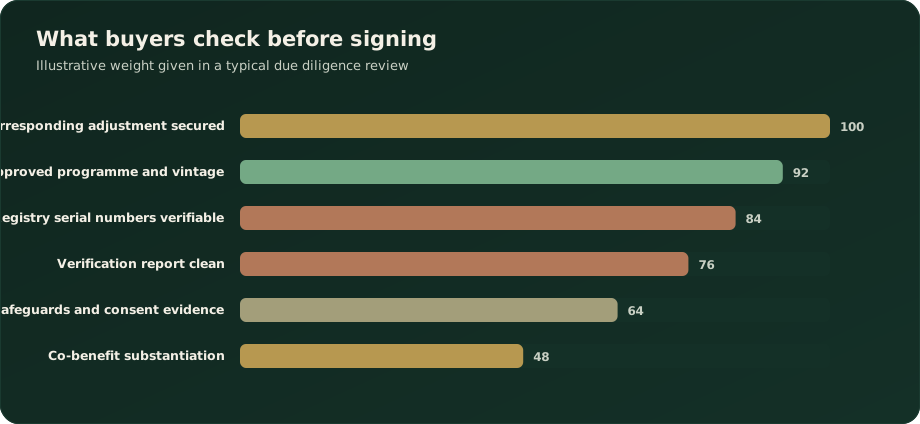
| Buyer documentation pack | What a compliance buyer's diligence will request |
| Commercial support | Price expectations, contract terms, buyer introductions |
Eligibility screening should come first and should be cheap. A competent firm can tell you within a week or two whether the CORSIA route is plausible for your activity — programme approval, methodology availability, additionality prospects and the corresponding adjustment position. A firm that goes straight to a project design document proposal without that screening is selling development work rather than advising you.
The Screening Questions That Matter
Any adviser worth appointing will work through these before quoting for anything larger:
- Is there an approved programme covering this activity type, currently?
- Does an approved methodology exist, and does your activity fit it without stretching?
- What is the corresponding adjustment position for this activity type, and what is the authorisation route?
- Is the activity genuinely additional, and what evidence supports that?
- What annual credit volume is realistic, conservatively estimated?
- Does that volume cover fixed transaction costs — validation, verification, registry fees?
- Can the monitoring be done defensibly with instruments that exist and staff who will use them?
- Who owns the credits, in writing?
Question 8 stops more transactions at diligence than any technical issue. Where the landowner, equipment owner, operator and financier are different parties, credit title must be documented before validation — not renegotiated when a buyer asks.
How to Test a Firm's Experience
"Which projects have you taken to issuance?" Registration is not issuance. Ask specifically how many projects have produced credits that were actually sold.
"Which programmes have you worked with, and on what methodologies?" Names and numbers. Methodology familiarity is specific, not general.
"Have you supported a validation or verification?" And what findings arose? Anyone who has been through it has stories.
"What is your view on the corresponding adjustment position for this activity?" A real answer acknowledges policy uncertainty and describes the route. A firm that says it is "just paperwork" is disqualifying itself.
"Show me a redacted project design document you wrote." The single most informative artefact.
"What projects have you advised clients not to pursue?" A firm that has never talked a client out of a project has not been screening.
"How do you charge, and do you take a share of credits?" Both models exist. A share of credits aligns interests and also creates pressure toward optimistic volume estimates. Understand which you are buying.
Where Supplier-Side Advice Goes Wrong
Optimistic volume estimation. The most common and most damaging error. Verifiers trim claimed reductions, and financial models built on the developer's own upper estimate fail when the verified number arrives 15-20% lower.
Monitoring designed after the project. Retrofitting measurement onto a built asset is expensive and sometimes impossible. Monitoring design belongs in the engineering phase.
Additionality asserted, not evidenced. A barrier analysis needs documents — board papers, financing terms, market data — not a narrative.
Corresponding adjustment assumed. Treated as a later administrative step rather than a gating policy question.
Documentation left until a buyer asks. Diligence then takes months, and buyers move on.
Programme chosen for familiarity, not approval status. The consultant's preferred programme is not necessarily approved for your scope.
What a Good Engagement Produces
By the end of a well-run supplier-side engagement, the developer should hold:
- A written eligibility assessment, including the corresponding adjustment position
- A registered project under an appropriate approved programme
- A monitoring system that produces audit-ready data without heroics
- A clean validation and first verification
- A complete buyer documentation pack, assembled before going to market
- A realistic volume forecast, with the verification haircut already applied
- An internal capability to run the monitoring cycle without paying for it annually
That last point matters as much as it does on the airline side. Monitoring is continuous across the crediting period; a developer who cannot run it internally pays consultant rates for routine data collection for years.
Fee Models
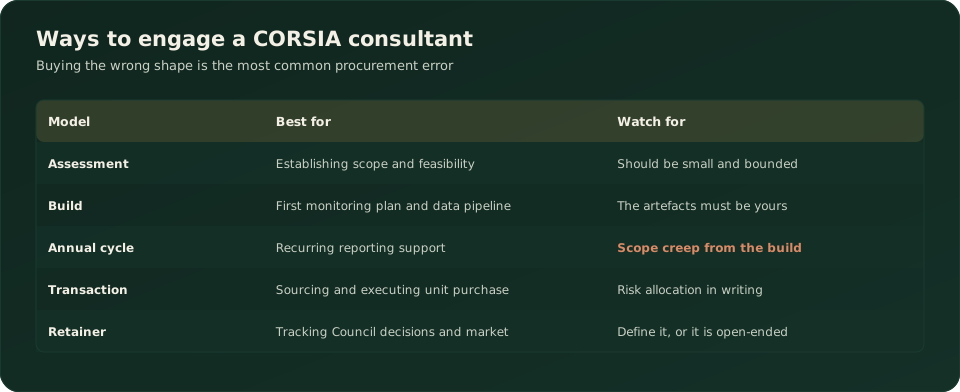
| Model | How it works | Watch for |
|---|---|---|
| Fixed fee per deliverable | Priced per document and stage | Exclusions on validation findings |
| Retainer | Monthly through development | Scope drift, unclear end point |
| Success fee on issuance | Paid when credits are issued | Optimism in volume estimates |
| Share of credits | A percentage of issuance | Same optimism risk; also dilutes your revenue for the whole crediting period |
| Hybrid | Reduced fee plus smaller success element | Usually the most balanced |
A share-of-credits arrangement over a seven-year crediting period is a much larger commitment than it appears at signature. Model it in rupees across the full period before agreeing, not as a percentage in the abstract.
A Realistic Development Timeline
What a consultant should be telling you about elapsed time, before you build a funding plan around it.
| Stage | Typical duration | Who controls it |
|---|---|---|
| Eligibility screening | 1-2 weeks | Consultant |
| Feasibility and financial modelling | 3-6 weeks | Consultant and developer |
| Corresponding adjustment engagement | Opens here, closes when it closes | Government |
| Methodology and programme selection | 2-3 weeks | Consultant |
| Project design document | 8-16 weeks | Consultant and developer |
| Validation | 8-16 weeks | Validation body |
| Registration | 4-12 weeks | Programme |
| First monitoring period | 6-12 months | Physics |
| Verification | 6-12 weeks | Verification body |
| Issuance | 4-8 weeks | Programme and registry |
Adding it up gives roughly 18 to 36 months to first credits, and that assumes nothing stalls. The corresponding adjustment track runs alongside rather than after, which is why it should start at feasibility stage.
Two planning consequences follow. First, the funding requirement is front-loaded across two to three years before any revenue — a consultant who does not walk you through that cash flow is not advising you properly. Second, the monitoring period is irreducible. No amount of consultant effort shortens the time a project must physically operate to generate the reductions being verified.
Be suspicious of any timeline promising credits within a year for a project that does not already exist. It is either describing a project already well into development, or it is describing something that will not survive validation.
One further planning point: the crediting period continues long after issuance begins, and monitoring runs throughout it. A developer who has not budgeted for years of continuing data collection, periodic verification and registry administration has budgeted for a project launch rather than for a project. Ask any prospective consultant what the annual running cost looks like in year four, once development is complete and the asset is simply producing credits. Firms that have taken projects through several verification cycles answer immediately; firms that have only reached registration usually have not thought about it.
Frequently Asked Questions
What does a CORSIA supplier consultant do? Screens eligibility, assesses the corresponding adjustment route, selects programme and methodology, builds the additionality case and monitoring design, writes the project design document, supports validation and verification, and prepares the buyer documentation pack.
How is this different from an airline-side consultant? Entirely different work. Airline-side is data assurance and MRV; supplier-side is carbon project development.
What should the first engagement be? A short, paid eligibility screening. It is cheap and it eliminates most unviable projects before serious spending.
How do I test their experience? Ask how many projects reached issuance, which programmes and methodologies, and what happened at validation. Ask to see a redacted project design document.
Should the consultant take a share of credits? It aligns interests and creates pressure toward optimistic volume estimates. If you use it, model the full crediting period in absolute terms first.
What is the most common mistake in supplier-side advice? Over-estimating credit volume, followed by treating the corresponding adjustment as an administrative step.
Who owns the credits in a project? Whoever the contracts say. Establish it in writing before validation — unclear title is the most common reason a sale stalls at diligence.
How long does development take? Typically 18 to 36 months to first issuance, plus the corresponding adjustment timeline, which is outside your control.
Can the same firm find buyers? Some do. Understand how they are remunerated on the sale, and whether that conflicts with their advice on price.
What if the consultant says CORSIA is not viable for my project? That is useful advice, delivered cheaply. Consider the voluntary market route instead — see CORSIA-eligible projects in India.
Developing CORSIA-eligible credits in India? DSTechnoverse supports project developers with eligibility screening, methodology selection, monitoring design, documentation packs and buyer due diligence — and advises buyers on whether the units they are offered will actually count. We are based in Indore, Madhya Pradesh and work with clients across India. See our CORSIA carbon credit services, our carbon credit portal at carboncredit.dstechnoverse.com, or talk to our team about your project.
This article is general information, not legal, financial or regulatory advice. CORSIA eligibility criteria, approved programmes and vintage windows change — verify the current position with ICAO and your programme before committing capital.