India has been one of the world's largest sources of carbon credits for two decades. CORSIA is one of the few compliance-grade demand sources those credits can reach — but the eligibility bar is higher than the voluntary market's, and most existing Indian credits do not clear it.
Understanding why is the difference between developing a project that sells and one that produces credits nobody with a CORSIA obligation can use.
The Three-Part Eligibility Test
A unit is CORSIA-eligible only if it satisfies all three:
1. It comes from an ICAO-approved programme. ICAO's Technical Advisory Body assesses crediting programmes against the Emissions Unit Eligibility Criteria, and the Council decides which are approved and for what scope. A credit from an unapproved programme is not eligible, regardless of its quality. See ICAO-approved crediting programmes.
2. It falls within the permitted vintage and eligibility window. Approval is granted for specific periods and unit types, not indefinitely. A credit from an approved programme but outside the applicable window does not count.
3. It carries a corresponding adjustment. The host country must authorise the transfer and adjust its own national accounts so that the same tonne is not counted towards its NDC. This is a government decision, not a developer decision, and it is where most projects stop.
All three, or the unit is not usable for CORSIA compliance. Two out of three is worth nothing to an airline with an obligation to discharge.
Why the Corresponding Adjustment Dominates
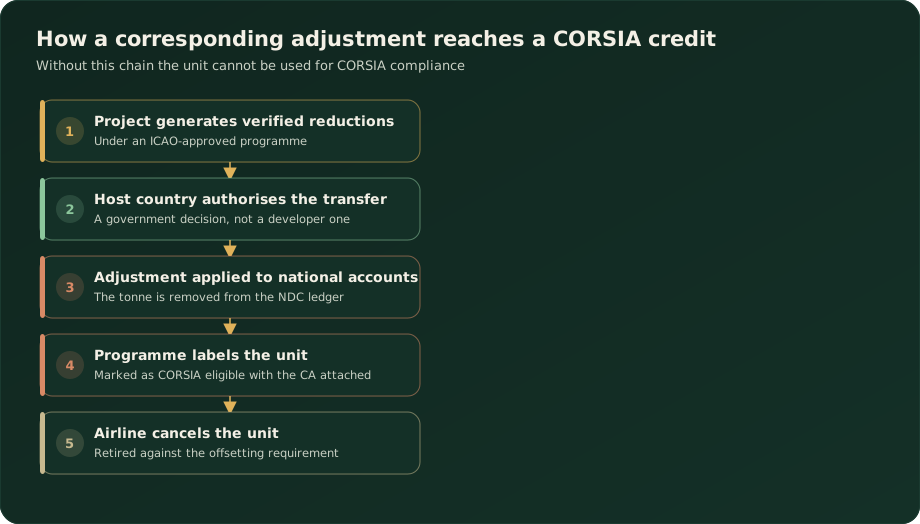
The logic is straightforward once stated plainly. If an Indian project reduces a tonne of emissions and an airline uses that tonne to discharge a CORSIA obligation, that tonne cannot also count towards India's own emissions target. Otherwise it is counted twice.
The corresponding adjustment is the accounting step that prevents that — India removes the tonne from its own ledger. Which means every authorised export of a CORSIA credit slightly increases the effort India must make elsewhere to meet its own commitments.
That is why authorisation is a policy decision taken at government level, why it is granted selectively, and why a developer cannot simply arrange it. Any consultant who describes the corresponding adjustment as a documentation formality has not understood the mechanism. Full treatment in corresponding adjustments for Indian CORSIA projects.
Which Project Types Work
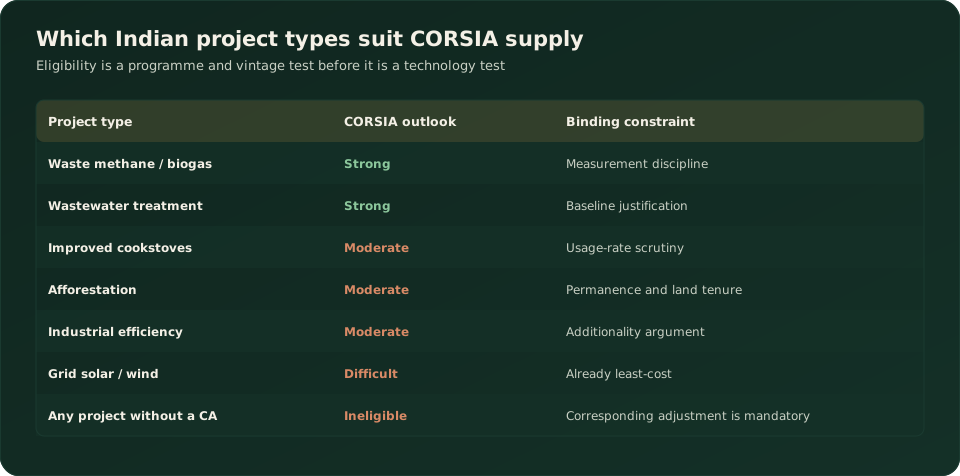
| Project type | CORSIA outlook | Binding constraint |
|---|---|---|
| Waste methane / biogas | Strong | Measurement discipline |
| Wastewater treatment | Strong | Baseline justification |
| Improved cookstoves | Moderate | Usage-rate scrutiny |
| Afforestation | Moderate | Permanence and land tenure |
| Industrial efficiency | Moderate | Additionality argument |
| Grid solar / wind | Difficult | Already least-cost |
| Any project without a CA | Ineligible | Corresponding adjustment is mandatory |
Methane-related projects hold up best. Capturing methane from landfill, distillery effluent, agricultural waste or wastewater is rarely the cheapest option for the operator, which makes the additionality argument straightforward. The methane's high warming potential also means meaningful credit volumes from modest capital.
Grid-connected renewables no longer work. Solar and wind are now the least-cost source of new generation in India. A project that is commercially viable without carbon revenue cannot credibly claim carbon revenue was necessary, and most programmes have restricted crediting in countries where renewables are established.
Cookstoves are viable but scrutinised. Independent research has found systematic over-crediting in parts of this category, and buyers now examine usage rates, non-renewable biomass fractions and field efficiency closely. A project with sensor-monitored usage data and conservative parameters is a good project; one built on survey-based claims is what buyers are screening out.
More detail on the underlying project economics in carbon credit project types in India.
What Buyers Actually Check
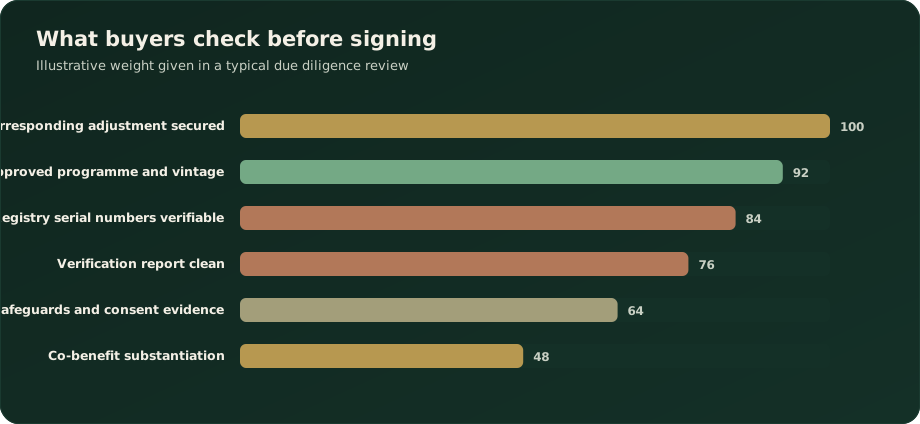
Airlines and their advisers run genuine due diligence, and the weighting is not what developers expect:
| Check | Weight in a typical review |
|---|---|
| Corresponding adjustment secured | Decisive |
| Approved programme and vintage | Very high |
| Registry serial numbers verifiable | High |
| Verification report clean | High |
| Safeguards and consent evidence | Moderate |
| Co-benefit substantiation | Lower for compliance buyers |
Note the last row. A compliance buyer is discharging a legal obligation, and while co-benefits are welcome, they do not make an ineligible unit eligible. Developers coming from the voluntary market often lead with the community story and treat the corresponding adjustment as an afterthought — which is precisely inverted for this buyer.
Sequencing a CORSIA-Targeted Project
- Check programme approval first. Which programmes are currently approved, for what unit types and vintages. If your intended programme is not approved for the relevant scope, nothing else matters.
- Assess the corresponding adjustment position before spending on design. What is the current policy for your activity type? What is the authorisation route? What is the realistic timeline?
- Test additionality honestly. Would this happen anyway? If the answer is uncomfortable, it will be more uncomfortable at validation.
- Confirm the methodology exists for your activity under the chosen programme.
- Design monitoring before designing the project. If you cannot describe how each parameter is measured, logged and audited, the project is not ready.
- Model the economics at conservative volume and price, including verification cycles and any intermediary margin.
- Then commit to the project design document.
Steps 1 and 2 cost very little and eliminate most unviable projects. Reversing the order — developing the project and then discovering the authorisation position — is the expensive path, and it is the common one.
The Voluntary Market Alternative
If the corresponding adjustment route is not available, a project can still serve the voluntary market, where CAs are not universally required. The trade-off:
| CORSIA-eligible | Voluntary market | |
|---|---|---|
| Corresponding adjustment | Required | Often not required |
| Buyer type | Airlines with a compliance obligation | Corporates with voluntary commitments |
| Price driver | Eligibility and scarcity | Quality, story, co-benefits |
| Demand certainty | Tied to the offsetting requirement | Sentiment and corporate budgets |
| Documentation | Heavier | Lighter |
Many Indian projects are better placed in the voluntary market, and saying so early is more useful to a developer than pursuing a CORSIA route that policy will not support. A consultant who never reaches that conclusion for any client is not assessing eligibility, only selling development work.
A Screening Checklist Before You Spend
Run every candidate activity through this before commissioning any design work. Each question costs a phone call or an afternoon; together they eliminate most unviable projects for a fraction of a percent of the development budget.
| # | Question | Fails if |
|---|---|---|
| 1 | Is an ICAO-approved programme currently open to this activity type? | No approved programme covers it |
| 2 | Does an approved methodology fit without stretching? | You would have to argue the fit |
| 3 | What is the corresponding adjustment policy for this activity? | Export is not currently contemplated |
| 4 | Is the activity genuinely additional, with documentary evidence? | The business case works without carbon revenue |
| 5 | What annual volume is realistic, conservatively? | Below the level that covers fixed costs |
| 6 | Can monitoring be done with instruments that exist and staff who will use them? | The plan depends on heroics |
| 7 | Who owns the credits, in writing? | Title is assumed rather than documented |
| 8 | What is the realistic date of first issuance? | Later than your funding runway |
Question 3 is the one to answer first, not last. It is the cheapest question to ask and the most expensive to get wrong, because it can invalidate a project that passes every other test.
Question 5 deserves arithmetic, not an estimate. Validation, verification, registry fees and monitoring are largely fixed, so a project generating a few thousand credits a year bears the same compliance cost as one generating fifty thousand. Divide your realistic annual volume into your expected fixed costs before going further; if the per-credit figure is close to the price you expect to achieve, aggregation with other activities is the only viable route.
Projects that clear all eight are worth a proper feasibility study. Projects that fail question 1 or 3 should be redirected to the voluntary market immediately rather than developed in hope.
Frequently Asked Questions
What makes a carbon credit CORSIA-eligible? Three things together: issuance by an ICAO-approved programme, a vintage within the applicable eligibility window, and a corresponding adjustment by the host country.
Which Indian projects qualify for CORSIA? Waste methane, biogas and wastewater projects are the strongest technically. Eligibility ultimately depends on programme approval and the corresponding adjustment.
What is a corresponding adjustment? The host country's accounting step that removes the transferred tonne from its own national emissions ledger, preventing double counting. It requires government authorisation.
Can existing Indian credits be sold into CORSIA? Only if they meet all three eligibility tests. Most existing voluntary-market credits do not, principally because no corresponding adjustment is attached.
Why don't solar projects qualify? Grid-scale renewables are now the least-cost option in India, so the additionality argument fails. This is a market maturity outcome rather than a rule about technology.
How long does a CORSIA-targeted project take? Typically 18 to 36 months from concept to first issuance, plus the corresponding adjustment timeline, which is outside the developer's control.
Who authorises the corresponding adjustment? The host country government, through its designated authority. Not the programme, and not the developer.
What do airline buyers check? Corresponding adjustment status first, then programme approval and vintage, registry serial numbers, and the verification report.
Should I target CORSIA or the voluntary market? If the corresponding adjustment route is not realistically available for your activity, the voluntary market is the honest answer.
Is a consultant necessary? For the eligibility and corresponding adjustment assessment, specialist input pays for itself quickly. See choosing a CORSIA credit supplier consultant.
Developing CORSIA-eligible credits in India? DSTechnoverse supports project developers with eligibility screening, methodology selection, monitoring design, documentation packs and buyer due diligence — and advises buyers on whether the units they are offered will actually count. We are based in Indore, Madhya Pradesh and work with clients across India. See our CORSIA carbon credit services, our carbon credit portal at carboncredit.dstechnoverse.com, or talk to our team about your project.
This article is general information, not legal, financial or regulatory advice. CORSIA eligibility criteria, approved programmes and vintage windows change — verify the current position with ICAO and your programme before committing capital.