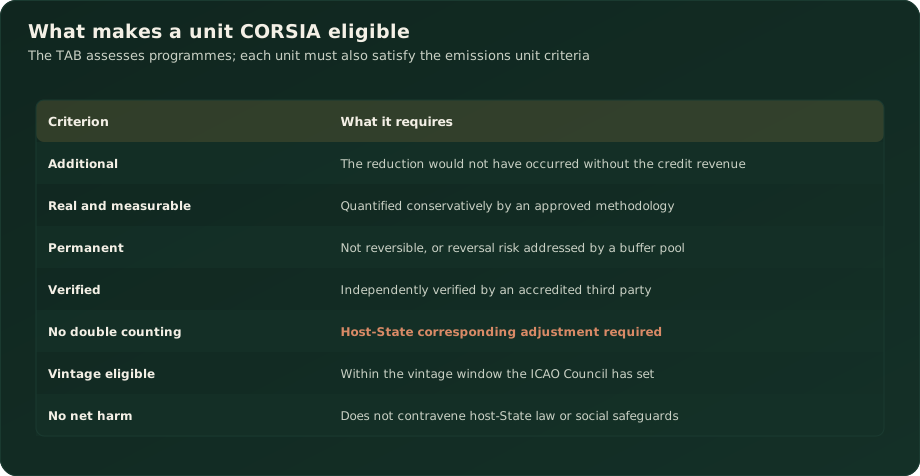
The eight ICAO Emissions Unit Criteria are well documented. What is less documented is how a buyer actually works through them against a specific parcel of units, in what order, and what to do when one of them cannot be answered.
For what each criterion requires and why it exists, see the ICAO Emissions Unit Criteria in the knowledge base. This piece is the verification workflow.
Work Them in This Order
Not the order they are published in. The order that eliminates unusable supply fastest and cheapest.
| Order | Check | Why here |
|---|---|---|
| 1 | Corresponding adjustment | Eliminates the most supply; cheapest to check |
| 2 | Programme approval status | Binary, and quick |
| 3 | Vintage against your period | Binary, and quick |
| 4 | Registry record and holding | Confirms the seller has what they are selling |
| 5 | Verification report | Requires reading a document |
| 6 | Additionality and baseline | Requires judgement |
| 7 | Permanence, where relevant | Requires judgement |
| 8 | Safeguards | Requires searching beyond the file |
Checks one to four take under an hour and remove most of what fails. Checks five to eight take real effort and should only be spent on supply that has passed the first four.
The common mistake is starting with project quality — the interesting part — and discovering at the end that no corresponding adjustment exists.
The First Four, in Practice
Corresponding adjustment. Ask for the authorisation document. Not a statement, not a broker's confirmation, not a project webpage. The document, from the designated national authority, naming your units or a defined volume and vintage. Absent that, stop.
Programme approval. Check the ICAO emissions units page today, not a saved list. Read whether the approval is full or conditional, and if conditional whether the condition touches your methodology.
Vintage. From the registry record, not the seller's description. Note that issuance date is not vintage — a unit issued last year may carry a much older vintage. Compare against the window for your compliance period.
Registry and holding. Confirm unique serialisation, an unbroken chain of custody, no prior retirement, and that the seller actually holds them. Brokered supply the broker does not hold introduces a delivery risk worth knowing about.
The Second Four
These require reading and judgement, and they are where a buyer's own standards matter.
Verification report. Accredited body? Covers the monitoring period your units come from? Carries qualifications, and if so, what do they say? A qualified opinion is not automatically disqualifying — you need to know what was qualified and why.
Additionality and baseline. Is the argument credible for this project, in this market, now? Grid-connected renewables in a market where they are least-cost warrant real scepticism. Avoided-deforestation baselines warrant asking how they were set and when last revised.
Permanence. Only for storage-based reductions. Buffer percentage, how it was sized, when last reassessed.
Safeguards. Impact assessment, consultation records, consent where communities are affected, grievance mechanism. And search publicly — contested projects are usually documented outside the registry before they are documented inside it.
When a Check Cannot Be Answered
This is the part most guidance omits, and it is where judgement actually gets applied.
| Situation | Reasonable response |
|---|---|
| Authorisation pending | Price the sovereign risk, contract for it, or decline |
| Approval conditional, condition unclear | Get clarity before transacting, not after |
| Vintage near a boundary | Discount, and cancel early rather than holding |
| Verification qualified | Understand the qualification; may be acceptable |
| Additionality arguable | A judgement call — document your reasoning |
| Safeguards documentation thin | Treat as a red flag; this is where reputational risk lives |
| Seller withholds evidence until signature | Decline |
That last row is worth being firm about. Eligibility evidence is the substance of what you are buying, and a seller asking you to commit before seeing it is asking you to buy blind.
Recording the Assessment
The file has to answer a question asked three years later by someone who was not involved: why did we accept these units?
Record per tranche: what evidence was obtained for each of the eight checks, what was captured rather than linked, which risks were identified and accepted deliberately, who approved and under what authority, and the price basis.
Capture, do not link. Programme approval status, participation lists and vintage windows all change. Save the page as at the date you relied on it.
Proportionality
Not every purchase warrants identical depth, and applying the full workflow to a small repeat tranche wastes effort that could go elsewhere.
Always, regardless of size: checks one to three. They determine eligibility, take minutes, and failure makes the unit worthless for the purpose.
Scale with value: checks five to eight. A large first purchase from an unfamiliar developer deserves real scrutiny. A small repeat tranche from a project already assessed, under the same authorisation, does not need it repeated.
Never scale down: the evidence file. Small purchases generate audit questions exactly as large ones do, and filing properly at the time costs almost nothing.
A practical shortcut for repeat buying: maintain a standing file per project and per authorisation, and record only what is transaction-specific each time — serials, volume, price, transfer and cancellation.
Building a Repeatable Check
Buyers who assess each parcel from scratch are slower and less consistent than those who work from a standing checklist. The checklist is worth writing once.
A workable structure has three columns: the check, the evidence that satisfies it, and where that evidence was filed. Completing it becomes the transaction file rather than a separate exercise.
Make the first four checks a gate. No further work proceeds until all four pass. This is what stops diligence effort going into supply that was never going to be usable, and it is the single biggest efficiency gain available.
Pre-agree what an acceptable answer looks like for checks five to eight, so the judgement is made once as policy rather than repeatedly under time pressure. Which verification qualifications you will accept, how close to a vintage boundary you will go, which project categories you exclude outright.
Record the exceptions. Where you accept something outside policy, note who approved it and why. Exceptions are legitimate; undocumented exceptions are what make a portfolio impossible to defend later.
Review the checklist annually. Programme approval conditions change, vintage windows move, and categories fall in and out of favour as scrutiny shifts. A checklist written two years ago and never revisited encodes assumptions that may no longer hold.
Who Should Perform Each Check
Splitting the work by capability rather than doing it all in one function produces better results and is easier to resource.
Checks one to four — administrative verification. Programme status, vintage, registry record, authorisation document. These are lookups against defined sources and can sit with procurement or a carbon analyst, provided they know what a valid authorisation document looks like.
Checks five to seven — technical assessment. Verification reports, additionality arguments, permanence arrangements. These need someone who understands methodologies, and for most organisations that means external support at least for the first transactions.
Check eight — reputational. Safeguards and public disputes. This is closer to a due diligence search than a technical review, and it is worth involving whoever owns reputational risk.
The approval decision should sit with whoever owns the obligation, and must include the authority to decline. Diligence that cannot stop a transaction is not diligence.
Frequently Asked Questions
How much of this can be delegated? The first four checks are lookups and can sit with procurement once they know what a valid authorisation document looks like. The technical assessment usually needs external support for the first few transactions. The approval decision cannot be delegated at all.
Does the workflow change for voluntary purchases? The corresponding adjustment becomes a preference rather than a requirement, and the project quality checks carry proportionally more weight because no regulator is setting a floor.
Which check eliminates the most supply? The corresponding adjustment, by a wide margin. Check it first.
Is programme approval enough? No. It is necessary and not sufficient — vintage and adjustment apply at unit level regardless.
How long should verification take? One to three weeks per tranche for a first-time buyer, less with a process and a known counterparty.
Can I rely on a broker's checks? Review their work; do not substitute it for your own. Your authority holds you accountable, not your broker.
What if the vintage is close to a boundary? Discount for the risk and cancel early rather than holding. Windows have moved before.
Should I re-check before cancelling? Yes, if significant time has passed since purchase. It is minutes of work against a material risk.
What is the single strongest signal a parcel is not worth pursuing? A seller who will not provide the authorisation document before commitment.