An operator that does not know its offsetting requirement until ICAO hands over the number has already lost its options. By then the compliance period is closing, the whole sector is buying in the same window, and there is no room to spread the purchase.
Modelling the requirement in advance is therefore not an accounting nicety. It is what makes a procurement strategy possible. This article sets out the calculation and how to forecast it.
The Shape of the Calculation
At its simplest, an operator's annual offsetting requirement is:
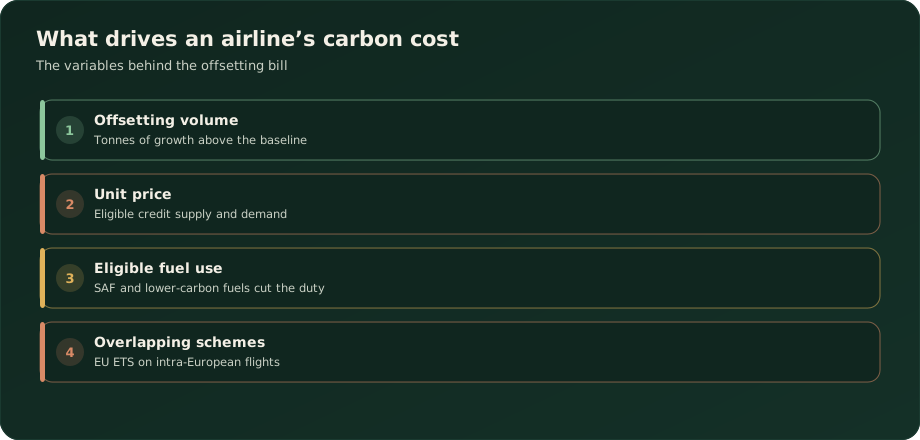
Covered emissions × applicable growth factor − CORSIA Eligible Fuels reduction
Each of those three terms carries more complexity than the formula suggests.
Term One: Covered Emissions
Not all your emissions count, and the filtering happens in stages.
Start with international flights. Domestic flights are entirely outside CORSIA. For a carrier with a large domestic operation, this can remove most of total emissions immediately.
Apply the aircraft threshold. Aeroplanes with a maximum certificated take-off mass at or below 5,700 kg are excluded.
Apply the exclusions. Humanitarian, medical and firefighting flights, and State aircraft including military, are outside scope.
Filter to covered route pairs. This is the step that most affects the number. An offsetting obligation arises only where both the origin State and the destination State are participating in CORSIA for that year. A flight from a participating State to a non-participating one is monitored and reported, but generates no offsetting obligation.
Confirm the operator entity. Wet leases, code shares, franchise arrangements and multi-certificate group structures all raise the question of which legal entity is the operator for CORSIA purposes. Getting this wrong misallocates emissions between entities.
The route-pair filter is where forecasts most often go wrong, because State participation changes. A route that generates no obligation this year may do so next year, and from 2027 the mandatory second phase expands coverage substantially.
Term Two: The Growth Factor
The growth factor converts covered emissions into an offsetting obligation. It reflects how much aviation has grown relative to the baseline.
The baseline is 2019 international aviation CO2 emissions. It was originally specified as the 2019–2020 average, but the pandemic collapse in 2020 traffic would have produced an artificially low reference and correspondingly inflated obligations, so the ICAO Council reset it to 2019 alone.
The sectoral growth factor measures growth across all covered aviation, not your growth. In the early phases, obligations are calculated entirely on this basis. The consequence is counterintuitive and worth stating plainly: an operator that shrank can still owe offsets, if the sector as a whole grew. Your emissions determine your share of the sector's burden; the sector's growth determines the size of that burden.
The 2021 sectoral growth factor was zero, because sector emissions that year remained below the 2019 baseline. Factors became positive as traffic recovered.
The individual growth factor measures your own growth relative to the baseline. From 2030, the design shifts weight progressively toward it, so a carrier expanding faster than the sector carries proportionally more of its own burden. The intent is to remove the free ride that a purely sectoral approach gives to fast growers.
For operators with aggressive fleet and network plans, this connects growth decisions directly to a future CORSIA cost. That connection deserves to be visible in the fleet planning model rather than discovered later.
Term Three: CORSIA Eligible Fuels
Qualifying sustainable aviation fuel and lower-carbon aviation fuel reduce the offsetting requirement directly. The reduction reflects the lifecycle emissions saving relative to conventional jet fuel.
Three conditions apply, and all three are administrative rather than physical:
- The fuel must meet the sustainability criteria defined for CORSIA Eligible Fuels.
- It must be certified under an approved sustainability certification scheme.
- The chain of custody must be documented from production through to uplift.
Operators sometimes assume that using SAF automatically produces a claim. It does not. Without the certification and chain-of-custody documentation, the fuel is environmentally beneficial and administratively invisible.
Compliance Periods, Not Years
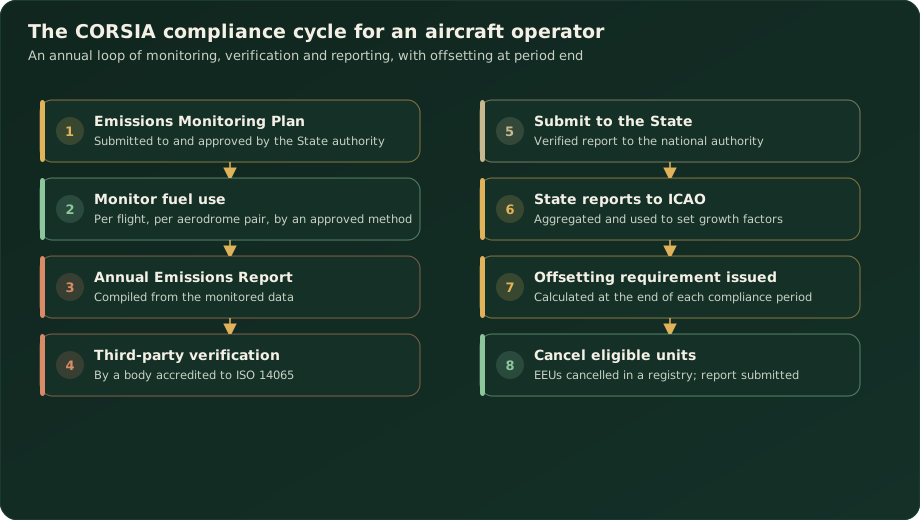
Obligations are calculated annually but settled per three-year compliance period. The 2024–2026 period is a single block: obligations accumulate across the three years, and the total is discharged by cancelling units and reporting by the deadline following the period's close.
Two consequences follow.
Flexibility on timing. You are not required to buy each year. This is genuinely useful for managing cash and price exposure.
Synchronised deadlines. Every operator in the scheme reaches its purchasing decision in the same window. In a market where eligible supply is constrained, that synchronisation is exactly the wrong dynamic for a late buyer.
There is also no carry-forward. Cancelling more than you owe does not build a balance against a future period. Precision in the calculation therefore has direct financial value — over-cancellation is simply spent money.
Building a Forecast
Step 1: Establish your covered emissions base. From your verified reporting, isolate international flights on covered route pairs. Maintain this as a live figure through the year rather than reconstructing it annually.
Step 2: Model route coverage scenarios. Current participation, plus a second-phase scenario in which States above the activity thresholds participate mandatorily from 2027. Run both against your actual network. The delta is often the single largest number in the forecast.
Step 3: Estimate the sectoral growth factor. Published industry traffic and emissions data supports a reasonable estimate ahead of ICAO confirmation. Build a range rather than a point.
Step 4: Layer in individual growth from 2030. Using your own fleet and network plans, and the progressive weighting schedule.
Step 5: Model the CORSIA Eligible Fuels reduction realistically. Based on fuel you can actually obtain, with the certification and documentation you can actually produce — not on a target.
Step 6: Produce a range, with assumptions stated. Low, central and high. A single number will be treated as a forecast and will be wrong.
Step 7: Re-run annually. Participation changes, factors are confirmed, your network changes, and the ICAO Council periodically adjusts parameters.
A Worked Illustration
Numbers here are illustrative, chosen to show the mechanics rather than to predict anyone's actual obligation.
An operator reports 900,000 tonnes of CO2 from all flights in a year. Of that, 400,000 tonnes come from domestic operations, leaving 500,000 tonnes international. Of the international total, 180,000 tonnes are on routes where the far-end State does not participate, leaving 320,000 tonnes of covered emissions.
Suppose the applicable sectoral growth factor for that year is 6 per cent. The gross obligation is 320,000 multiplied by 0.06, which is 19,200 tonnes.
The operator uplifted qualifying CORSIA Eligible Fuel producing a certified lifecycle saving of 1,200 tonnes, fully documented through the chain of custody. The net obligation is 18,000 tonnes for that year.
Two observations follow from a small example.
First, the covered emissions filter did most of the work. Total emissions were 900,000 tonnes; the figure that drives the obligation was 320,000. An operator budgeting from total emissions would have overstated the requirement by nearly threefold.
Second, the growth factor is small but applies to a large base, so modest changes matter. A shift from 6 per cent to 9 per cent adds 9,600 tonnes — a fifty per cent increase in the obligation from a three-point move in a factor the operator does not control.
Now apply the second-phase change. If mandatory participation from 2027 brings the previously uncovered 180,000 tonnes into scope, covered emissions rise to 500,000 and the same 6 per cent factor produces 30,000 tonnes rather than 19,200. That is the step change that generic percentage uplifts fail to capture, and it is why the modelling has to run against your actual network.
Where Forecasts Go Wrong
Assuming current participation persists. It has changed before, and changes structurally in 2027.
Applying a generic uplift for the second phase. The change is network-specific. A carrier flying predominantly to already-participating States sees a small change; one with heavy traffic to currently non-participating States sees a large one.
Confusing total emissions with covered emissions. Domestic and non-covered international flights inflate the base substantially if not filtered out.
Ignoring the entity question. Reporting under the wrong legal entity in a group structure is not a trivial correction.
Assuming SAF claims will be available. Without certification and chain of custody, they are not.
Treating the sectoral factor as your growth. It is not, and an operator that shrank can still owe.
Documenting the Calculation
Whatever you calculate will be examined — by a verifier, possibly by an auditor, quite likely by someone who was not present when the decisions were made. The calculation must therefore be reproducible from your records alone.
Retain the covered emissions derivation with its route filtering logic, the participation list as at the date relied on, the growth factors applied and their source, the CORSIA Eligible Fuels claim with supporting certification, and the resulting figure. Capture the participation list rather than linking to it; the published list changes and a URL is not evidence of what it said on the day.
Frequently Asked Questions
Can I owe offsets if my emissions fell? Yes. In the phases where the sectoral growth factor applies, your obligation reflects sector-wide growth applied to your emissions, not your own trajectory.
Do domestic flights count? No. CORSIA covers international flights only.
What if only one end of a route participates? No offsetting obligation for that route, though emissions are still monitored and reported.
How accurate can a forecast be before factors are confirmed? Reasonably accurate on the emissions base, much less so on the growth factor. A range is the honest output.
Does using SAF automatically reduce my requirement? Only if it meets the CORSIA Eligible Fuels criteria, is certified under an approved scheme, and the chain of custody is documented.
Can I carry surplus cancellations forward? No. Cancellation discharges the obligation for the period reported against; surplus is not banked.
Who signs off the calculation? The operator. A consultant can prepare it and a verifier will test the underlying emissions, but accountability sits with you.
Buying or selling CORSIA units? DSTechnoverse provides specialist CORSIA carbon credit services — offsetting requirement calculation and unit sourcing for operators, and eligibility screening, host-State authorisation support and buyer matching for project developers. We are based in Indore, Madhya Pradesh and work with clients across India and internationally.
Apply as a CORSIA buyer or seller
Talk to our carbon markets team about your position.