A forward agreement for CORSIA units is not a purchase order with a future date on it. It is a risk allocation document, and every risk it fails to mention lands on the buyer.
Why Forward Agreements Exist Here
In a liquid market, a buyer who waits pays the market price. In the CORSIA-eligible segment there is no exchange, volumes are thin, and supply is constrained by host-State authorisation decisions nobody can forecast.
A buyer who waits may find that the supply available for their compliance period has already been contracted. So a forward agreement secures existence, not merely price — and that is usually the more valuable property.
For the seller, it de-risks project financing and provides an anchor buyer. Both sides have a genuine reason to be there, which is what makes the negotiation constructive rather than adversarial.
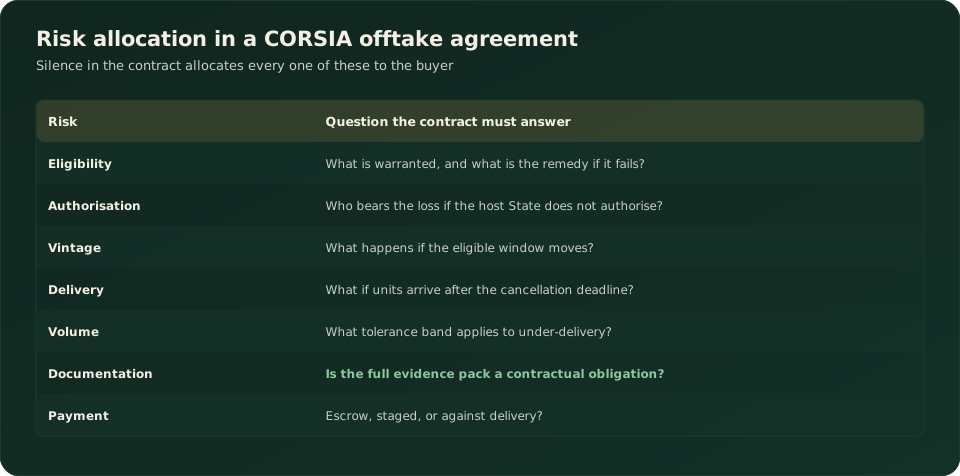
The Six Risks the Contract Must Allocate
1. Eligibility
The question: What does the seller warrant, and what is the remedy if a unit proves ineligible?
A warranty that units will be "CORSIA eligible" is a start and is not sufficient on its own. Eligible when — at delivery, or at cancellation? Those can differ if a programme's approval lapses in between.
Specify the remedy: replacement with equivalent eligible units, refund, or price adjustment. Replacement is usually more valuable than a refund, because a refund leaves you needing units in a market where you have just discovered supply is unreliable.
2. Authorisation
The question: Who bears the loss if the host State does not authorise, or authorises late?
This is the largest single risk in a forward deal on units not yet authorised, and it is a sovereign decision neither party controls.
Options, in descending order of buyer protection: seller bears it entirely with termination and refund; a long-stop date after which the buyer may terminate; price adjustment reflecting the delay; buyer accepts non-eligible delivery at a reduced price.
Whatever is agreed, name a date. "As soon as reasonably practicable" is not a mechanism.
3. Vintage
The question: What happens if the eligible window shifts between contracting and delivery?
Windows are set by ICAO Council decision and have been adjusted before. A unit eligible for your compliance period when you contract may not be by the time you cancel.
Address it explicitly, particularly for agreements settling more than a few months out. Silence allocates it to the buyer.
4. Delivery
The question: What if units arrive after your cancellation deadline?
A unit delivered late is, for compliance purposes, a unit not delivered. Define the delivery date by reference to your deadline with margin, not to the seller's issuance schedule, and specify the remedy — liquidated damages, replacement sourcing at the seller's cost, or termination.
5. Volume
The question: What tolerance applies to under-delivery?
Projects under-deliver against projection routinely — monitoring produces less than modelled, verification reduces the issuance, or a period is disallowed.
Agree a tolerance band, and specify what happens outside it. A fixed volume with no band produces a dispute the first time a project delivers 92%.
6. Documentation
The question: Is delivery of the full evidence pack a contractual obligation?
Make it one, and list what it contains: the host-State authorisation document, programme approval evidence, verification report, registry records showing chain of custody, and the project design documentation.
A seller who delivers serial numbers and a certificate has met a purchase order and not met your audit requirement.
Commercial Terms
Price. Fixed, indexed or a collar. Fixed is simplest and allocates market risk entirely; there is no reliable index for the eligible segment, so indexation is difficult to construct here.
Payment. Staged against milestones — contracting, issuance, authorisation, delivery — rather than in full upfront. Escrow where the counterparty is unfamiliar.
Exclusivity. Whether the seller may sell the same output elsewhere. Relevant where a project's issuance is uncertain.
Right of first refusal on future issuance, which can be valuable as second-phase demand builds.
Structural Points
Governing law and dispute resolution. Choose something practically usable given where the counterparty sits. A clause naming a forum you cannot realistically access is decorative.
Assignment. Can either party assign? Relevant if the project changes hands.
Change in law. CORSIA parameters change by ICAO Council decision — programme approvals, vintage windows, phase design. Address what happens if a change materially affects the bargain.
Termination rights, and what happens to payments already made.
Confidentiality, noting that you will need to disclose transaction details to your verifier and authority. Carve that out explicitly.
Negotiating Position
A buyer's leverage is strongest where the seller needs the offtake for financing, and weakest where eligible supply is genuinely scarce and other buyers are available.
A seller's leverage is strongest where authorisation is already secured, because that is the scarce element.
The practical consequence: authorised units command better terms as well as better prices. A buyer offered already-authorised supply should expect to pay more and should also expect a shorter negotiation, because most of the risk clauses become moot.
Where authorisation is pending, the negotiation is essentially about who carries sovereign risk, and that should be priced explicitly rather than assumed away.
Security and Credit Support
Where the counterparty is a small project developer or a newly formed special purpose vehicle, an unsecured forward commitment carries real credit risk that the commercial terms alone do not address.
A parent company guarantee is the simplest protection where the seller is part of a larger group. Establish that the guarantor has substance rather than being another thinly capitalised entity in the same structure.
Advance payment security — a bank guarantee or standby letter of credit — matters where staged payments run ahead of delivery. The cost is real and it is usually smaller than the exposure.
Escrow for the delivery payment protects both sides and is often easier to agree than either party expects, because it removes a symmetrical concern.
Step-in rights over the project registration allow a buyer to preserve value if the developer fails mid-project. These are complex to draft and worth it only on substantial commitments.
Security over the units themselves, once issued and held in a registry account. Registry mechanics for this vary by programme and need checking rather than assuming.
The proportionate question is what the exposure actually is. A modest tranche from an established developer with a track record needs little. A multi-year commitment with staged payments to a first-time developer in a jurisdiction where authorisation is unproven needs several of the above, and the negotiation should reflect that rather than treating credit support as an insult.
Getting Advice
An offtake agreement sits across carbon market expertise and contract law, and few advisers cover both well.
The workable arrangement is a carbon adviser who identifies the risks and the market-standard positions, and a lawyer who drafts. A lawyer without carbon market context will produce a well-drafted agreement that does not address authorisation risk; a carbon adviser without legal input will produce a term sheet that is not enforceable.
What Happens When Things Go Wrong
Offtake agreements are tested by failure, and it is worth thinking through the realistic scenarios before signing rather than after.
Authorisation never comes. The most likely failure on units not yet authorised. If the contract has a long-stop date with termination and refund, this is disappointing and manageable. Without one, the buyer is holding a commitment to units that cannot be used and may have no exit.
The project under-delivers. Common and usually partial. A tolerance band handles it; a fixed volume with no band produces a dispute over a 92% delivery.
The programme's approval lapses. Units issued under a programme that subsequently loses ICAO approval raise a question the contract should address, because neither party caused it.
The vintage window moves. A Council decision, outside anyone's control, that can render contracted units unusable for the intended period.
The seller becomes insolvent. Where staged payments have run ahead of delivery, an unsecured buyer is an unsecured creditor. This is what the credit support section addresses.
The buyer no longer needs the units. A network change reduces the obligation. Can the units be resold, and does the contract permit assignment?
The common thread: each of these is foreseeable, and each is cheap to address at drafting and expensive to argue about afterwards. A contract that names the scenario and states the remedy converts a dispute into an administrative step.
Frequently Asked Questions
Is an offtake agreement necessary for spot purchases? No, though even a spot purchase needs an eligibility warranty and a documentation obligation. A bare purchase order is inadequate.
How long are these agreements? Anywhere from a single delivery to multi-year arrangements covering several compliance periods.
Should we pay upfront? Prefer staged payment against milestones. Full upfront payment to an unfamiliar counterparty is exposure with no mitigation.
What if the project fails entirely? Termination and refund provisions, and ideally security or a parent guarantee where the counterparty is small.
Can we contract for units not yet issued? Yes, and that is what a forward agreement is. Price the delivery and authorisation risk explicitly.
Who typically drafts? The seller usually offers a template. Expect to negotiate the risk clauses substantially — templates allocate risk to the buyer.
What is most often missing from a first agreement? Authorisation risk allocation with a named long-stop date, and documentation as a contractual obligation. See buying CORSIA units.
Sourcing or cancelling CORSIA units? DSTechnoverse handles registry setup, pre-transaction due diligence, procurement support and cancellation reporting for Indian operators. See our CORSIA carbon credit services. We are based in Indore, Madhya Pradesh and work across India.
Apply as a CORSIA buyer or seller
Talk to our carbon markets team about your position.