CORSIA procurement looks like ordinary buying and behaves like a scarce-commodity negotiation in an illiquid market with regulatory risk attached. Operators who run it as standard procurement — three quotes, lowest price, purchase order — routinely end up with units that cannot be used.
What You Are Actually Buying
Not a carbon credit. Regulatory discharge — a unit that, when cancelled and reported, reduces your obligation by one tonne in the eyes of your national authority.
That reframing changes what matters. Project narrative, co-benefits, photographs and geography — the things that sell voluntary credits — are irrelevant to whether the unit works for you. What matters is whether it satisfies every element of the ICAO eligibility criteria, and whether you can prove that to a verifier in three years.
Step 1: Model the Requirement
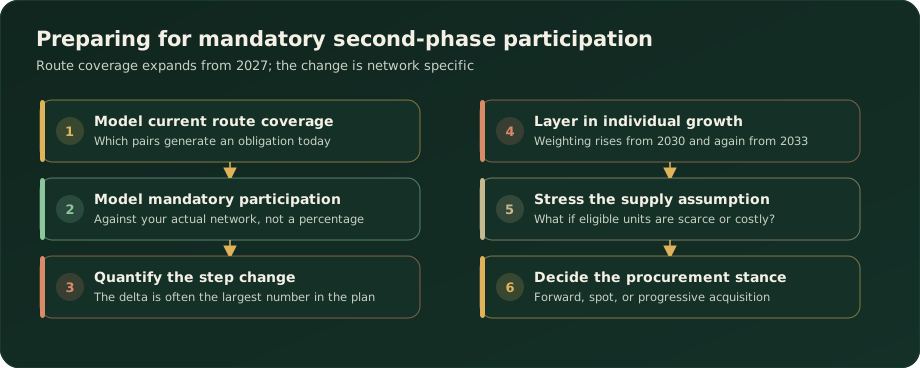
You cannot buy sensibly without knowing roughly what you owe.
Model annually rather than waiting for ICAO to confirm growth factors. Estimate from published sector data, refine as factors are published, and produce a range rather than a point. Re-run for second-phase route coverage from 2027.
Operators who wait for a confirmed number find the compliance period closing with no time to spread the purchase, competing with the entire sector in one window.
Step 2: Set a Strategy
The decisions that determine what you pay:
Timing. Progressive acquisition across the compliance period, or a single purchase near the deadline. Progressive averages price exposure and avoids competing with everyone simultaneously; the cost is committing before the final figure is confirmed. Most operators are better served by acquiring a conservative portion early and reserving the final window for reconciliation.
Forward or spot. Forwards secure supply and typically price below spot, because you absorb delivery and authorisation risk. In an illiquid market, forwards secure existence, not merely price — which is often the more valuable property.
Diversification. Across programmes, project types, host States and vintages. Concentration in any one is concentration of regulatory risk, and programme approvals have lapsed while vintage windows have moved.
Risk appetite. Whether you will consider supply where host-State authorisation is pending, and at what discount.
Step 3: Identify Supply
There is no exchange and no reliable public price. Supply reaches buyers by four routes:
| Route | Advantage | Cost |
|---|---|---|
| Direct from developers | Best pricing, best documentation access | Full diligence and counterparty risk on you |
| Brokers and intermediaries | Faster access, aggregation of small parcels | Margin; understanding varies widely |
| Programme or platform matching | Useful for discovery | Diligence obligation does not transfer |
| Forward agreements | Secures supply, better pricing | Delivery, authorisation and vintage risk |
Screen the language early. "CORSIA-ready", "CORSIA-aligned" and "eligible pending authorisation" all describe units that are not currently eligible. Filtering on that phrase alone removes a large share of what gets offered and saves diligence effort on supply that cannot work.
Step 4: Due Diligence
Verify against evidence, not description. The core checks:
- Is the issuing programme currently ICAO approved, and is that approval full or conditional?
- If conditional, does the condition touch these units?
- Is the vintage inside the window for your compliance period?
- Is there a host-State authorisation document naming these specific units?
- Is there evidence the corresponding adjustment has been or will be applied?
- Is the verification report from an accredited body, and does it carry qualifications?
- Does the registry record show a clean chain of custody with no prior retirement?
- Can you assemble all of this into a package that survives audit years later?
Check 4 is the one that eliminates most supply. A seller's assurance is not evidence — the authorisation document from the designated national authority, naming the units, is.
Capture the evidence rather than linking to it. Programme approval status changes, and a URL in your compliance file is not proof of what a page said on the transaction date.
Step 5: Contract
Terms that matter more than price:
- Eligibility warranty, and the remedy if a unit proves ineligible
- Authorisation risk allocation on forward deals
- Vintage protection if the eligible window shifts
- Delivery timing relative to your cancellation deadline, and the remedy for late delivery
- Volume tolerance bands, since projects under-deliver routinely
- Documentation as a contractual obligation, not a courtesy
- Payment structure — escrow, staged, or against delivery
Silence on any of these allocates the risk to you by default. This is the most common and most expensive omission in first purchases.
Step 6: Transfer and Cancel
Payment, transfer into your registry account, then cancellation designated for CORSIA, then the cancellation report to your authority.
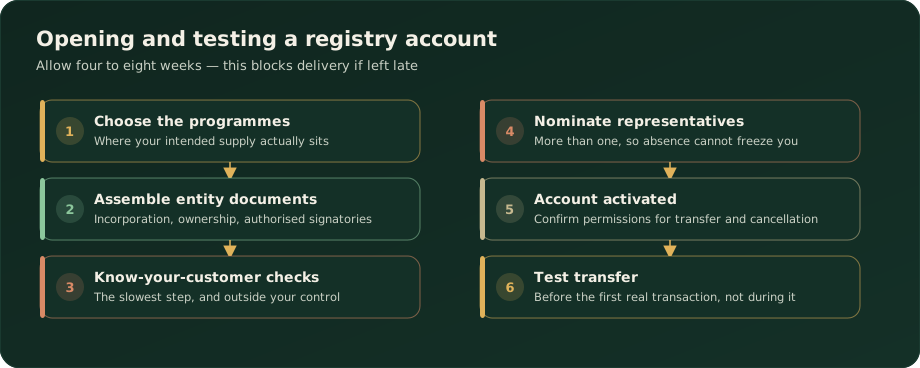
Purchase does not discharge the obligation. Cancellation does, and the report closes the loop. See registry account setup.
A Realistic Timeline
For a first purchase, working backwards from the cancellation deadline:
| Activity | Allow |
|---|---|
| Registry account opening | 4-8 weeks |
| Supply identification | 2-6 weeks |
| Due diligence per tranche | 1-3 weeks |
| Contract negotiation | 2-6 weeks |
| Payment and transfer | 1-3 weeks |
| Cancellation and reporting | 1-2 weeks |
Three to six months for a first cycle, assuming nothing goes wrong. Subsequent cycles compress once accounts and processes exist — but diligence does not compress much, because it is evidence gathering rather than administration.
Working With Intermediaries
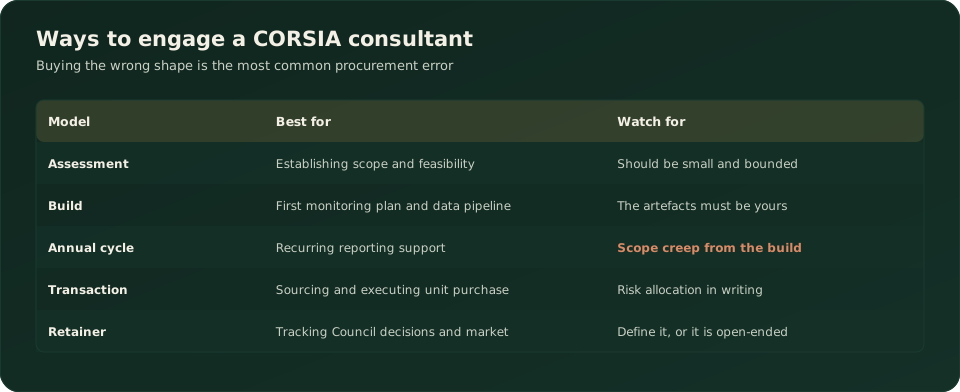
Most first-time buyers reach supply through an intermediary, and the relationship is worth setting up deliberately rather than by default.
Establish what they actually are. A broker introducing buyer to seller has different obligations and incentives from a trader selling units from their own book. Ask which, and how they are paid — a commission on volume and a margin on a proprietary position pull in different directions.
Test their understanding with one question: how do you establish that a unit carries a corresponding adjustment? An answer naming the designated national authority, the authorisation document, the unit identifiers and the national reporting shows genuine command of the market. "The project confirms it" does not.
Ask what they verify and ask to see it. Some intermediaries conduct real diligence and will show their work. Others pass through the seller's description. Both are legitimate businesses; you need to know which, so you can size your own effort accordingly.
Confirm who holds the units. If the intermediary does not hold them, delivery depends on a counterparty you have not assessed. Ask whether you can verify the holding in the registry directly.
Keep your own diligence file. Evidence held only by an intermediary disappears when the relationship does.
None of this argues against using intermediaries — in a market with no exchange, they are how supply gets found. It argues for treating them as a supplier to be assessed rather than as an extension of your own team.
Who Should Own It Internally
CORSIA procurement falls between functions, and organisations that handle it badly usually do so because nobody clearly owns it.
Procurement brings contracting discipline and typically lacks the technical judgement to distinguish an eligible unit from one described as eligible. Sustainability brings the market understanding and often cannot negotiate a supply agreement. Finance owns the budget and cross-border payment mechanics. Legal needs to see the eligibility warranty and rarely has a template.
The workable pattern is a single accountable owner — usually in sustainability or a dedicated carbon role — with defined input from the others and, critically, the authority to decline a transaction. Diligence that cannot stop a deal is not diligence.
Documenting the Purchase Decision
The transaction file is what defends the purchase years later, and it needs to record reasoning as well as outcome.
Why this supply. What was considered, what was rejected and on what grounds. A file showing three options assessed and one chosen is far stronger than one showing a single purchase with no alternatives examined.
The eligibility evidence, captured rather than linked — the authorisation document, programme approval status as at the transaction date, verification report, registry records.
Who approved it, and against what delegated authority. Purchases of this size normally sit within a defined approval framework, and CORSIA units should not be an exception to it.
The price basis. What quotes were obtained, from whom, and why the accepted price was reasonable. In a market with no public index, this is the only defence against a later question about value.
The risk acceptance. Where supply was bought with authorisation pending or a vintage close to a boundary, record that the risk was identified, priced and accepted deliberately — not overlooked.
Three years later, the people involved will have moved and the market conditions will be forgotten. A file that records only what was bought, and not why, cannot answer the questions that actually get asked.
Frequently Asked Questions
How much do CORSIA units cost? Substantially more than comparable non-eligible supply, and highly variable by project type, vintage, volume and authorisation status. Voluntary market averages are the wrong benchmark.
Can we buy directly from a project? Yes, and it usually gives better pricing and documentation access. You carry the full diligence and counterparty burden.
What if a unit proves ineligible after cancellation? Your contract determines the remedy. Address it before signing — after cancellation the unit is consumed regardless.
Should we use a broker? Brokers speed access to supply. They do not transfer your diligence obligation, and their understanding of eligibility varies. Test it with one question: how do you establish that a unit carries a corresponding adjustment?
Can we over-purchase and carry the surplus forward? No. Cancellation discharges the obligation for the period reported against; surplus is not banked. Accuracy in the requirement calculation has direct financial value.
When should we start buying for the second phase? Modelling now. Purchasing depends on your forward-versus-spot view, but arriving in 2027 without a strategy is the position to avoid.
What is the single most common mistake? Buying against a description rather than evidence, and leaving registry account opening until after a purchase is agreed.
Sourcing or cancelling CORSIA units? DSTechnoverse handles registry setup, pre-transaction due diligence, procurement support and cancellation reporting for Indian operators. See our CORSIA carbon credit services. We are based in Indore, Madhya Pradesh and work across India.
Apply as a CORSIA buyer or seller
Talk to our carbon markets team about your position.