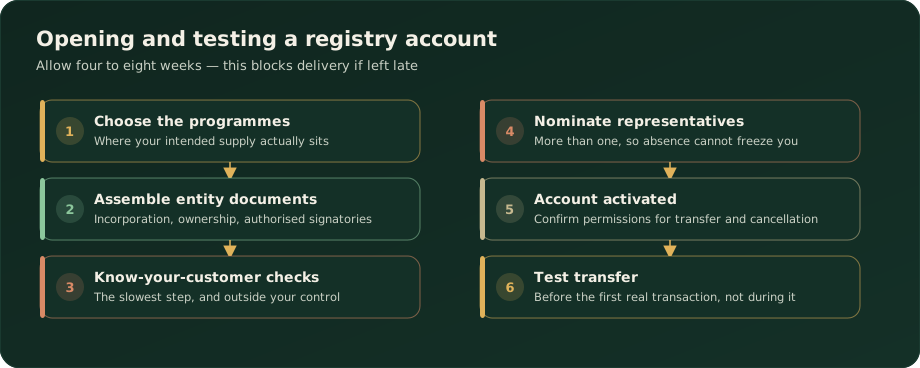
An operator agrees a purchase, then discovers its registry account will take six weeks to open. The units cannot be delivered, the cancellation deadline does not move, and a routine transaction becomes a compliance problem.
This is entirely avoidable and it happens constantly.
There Is No Single CORSIA Registry
The first thing to understand, because it shapes everything else.
ICAO does not operate a registry. Units live in the registries of the individual crediting programmes — the American Carbon Registry, the Climate Action Reserve, Verra, Gold Standard, the Global Carbon Council and others that have held ICAO approval.
Each operates its own system with its own account structure, documentation requirements, fee schedule, transfer mechanics and processing times. There is no consolidated view across them.
Which means the question "which registry do we need an account with" has no general answer. It depends entirely on where the supply you intend to buy actually sits.
Deciding Which Registries
Two approaches, with a real trade-off.
Consolidate. Open accounts with one or two programmes and buy only from them. Simpler administratively, fewer relationships, less documentation. The cost is concentration — if that programme's ICAO approval lapses or is conditioned in a way that affects your units, you have no alternative ready.
Diversify. Accounts with three or four programmes. More administration, but you can source across a wider pool and you are not exposed to a single programme's approval status.
For a first-time buyer with a modest obligation, consolidating is usually reasonable. As the obligation grows — particularly heading into the second phase — the concentration risk becomes the more significant consideration.
Whichever you choose, verify the programme's current ICAO approval status before opening the account, not just before transacting. Opening an account with a programme whose approval has lapsed is wasted effort.
What the Documentation Involves
Registry onboarding is a know-your-customer process, and it is the slowest part.
Typically required:
| Document | Note |
|---|---|
| Certificate of incorporation | Certified copy usually required |
| Memorandum and articles | Or equivalent constitutional documents |
| Beneficial ownership disclosure | Often to a defined percentage threshold |
| Board resolution authorising the account | Naming who may act |
| Identification for each authorised representative | Passport, address proof |
| Proof of registered address | Recent utility bill or equivalent |
| Bank reference | Not always, but common |
| Tax registration | GST and PAN for Indian entities |
For Indian entities, two things regularly extend the timeline: notarisation and apostille requirements for documents used internationally, and beneficial ownership disclosure where the shareholding structure involves holding companies. Start both early.
The Authorised Representative Decision
More consequential than it appears.
Nominate more than one. A single named representative means one resignation, one period of leave or one lost credential freezes your ability to transact — against deadlines you do not control. This is the most common operational failure in registry management.
Separate agreeing from executing. The person who negotiates a purchase should not be the only one able to execute the transfer and the cancellation. This is ordinary financial control applied to an asset that is functionally money, and cancellation in particular is irreversible.
Document the procedure. Who is authorised, what approval a cancellation requires, how the purpose designation is confirmed before execution, and what is recorded afterwards.
Review access on role change. Registry access routinely outlives the job that justified it. Add it to your joiners, movers and leavers process.
Test Before You Need It
Once the account is live, complete a small test transfer if the programme permits, or at minimum walk through the interface with the representatives.
The first real transfer should not be the first time anyone has used the system. Registry interfaces vary considerably, terminology differs between programmes, and the cancellation screen in particular is one you want to have seen before using it under deadline pressure.
Cancellation: The Step That Counts
Worth stating plainly because operators get this wrong.
Purchasing units does not discharge your obligation. Holding them does not discharge your obligation. Cancellation does.
Cancellation permanently removes the units from circulation and records the purpose. For CORSIA the cancellation must be designated for CORSIA compliance — programmes provide a specific purpose field. A generic retirement of the kind used for voluntary claims may not satisfy your national authority.
Getting the designation wrong is difficult or impossible to reverse, and the units are consumed either way. This is the single strongest argument for a documented procedure with a second pair of eyes before execution.
Record everything: serial numbers, cancellation reference, date, quantity, purpose designation, and the account from which cancellation occurred.
Timing and the Administrative Tail
Working backwards from a cancellation deadline:
| Step | Allow |
|---|---|
| Registry account opening | 4-8 weeks |
| Due diligence per tranche | 1-3 weeks |
| Contract negotiation | 2-6 weeks |
| Payment and transfer | 1-3 weeks |
| Cancellation | days, plus processing |
| Cancellation report and acknowledgement | 1-2 weeks |
Registry systems also have maintenance windows and load spikes near common deadlines — which is precisely when everyone else is cancelling. Leaving cancellation to the final days assumes processing time you do not control.
Keeping the Records Straight
Registry activity generates the evidence that closes your compliance loop, and it needs holding in your own systems rather than only in the registry.
Record serial numbers at every stage. Contract, transfer confirmation, cancellation. A compliance file that references volumes without serials cannot be reconciled against a registry, and reconciliation is the first thing anyone auditing it will attempt.
Keep the transfer confirmations, not just the resulting balance. The balance shows where you ended; the confirmations show how you got there.
Store the cancellation reference with the report. When the authority queries a submission, the reference is the answer.
Maintain a live reconciliation of obligation against cancellations, per compliance period. Reconstructing it at period end means discovering discrepancies with no time to investigate them.
Do not rely on an intermediary's records. Where a broker or adviser executes on your behalf, your own files must still contain the serials, confirmations and references. When that relationship ends, your compliance record must not end with it.
Retain for the long term. Verification and audit reach back further than people expect. Plan for ten years, and make sure the records survive a system migration — an export sitting in a decommissioned platform is not retained.
Cross-Border and Treasury Considerations
Purchasing units involves cross-border payment, which for Indian entities raises questions worth resolving before a transaction rather than during one.
Foreign exchange, the applicable regulatory route for the payment, documentation your bank will require, and the tax treatment of the purchase all need answers. Involve finance and treasury at account setup rather than at first purchase — a transaction held up in banking compliance consumes the same schedule contingency as one held up in the registry.
Managing Several Registries at Once
Once you hold accounts with more than one programme, a small amount of structure prevents avoidable errors.
Keep one consolidated ledger. No registry shows your total position across programmes. Maintain your own record of holdings and cancellations by programme, reconciled against each registry monthly. Without it, nobody can answer "how much have we cancelled this period" without logging into three systems.
Standardise the naming. Registries use different terms for the same concepts — retirement versus cancellation, account versus holding. Map them to one internal vocabulary so your records stay comparable.
Track approval status per programme. ICAO approval can be full, conditional or lapsed, and it changes by Council decision. Note the status and the date you checked it, per programme, and re-check before cancelling if time has passed.
Watch the fee structures. They differ, and a programme cheap to hold may be expensive to transact in. Include this in the consolidate-versus-diversify decision.
Keep the representatives consistent. Different authorised representatives across programmes multiplies the key-person risk rather than reducing it. Use the same two or three people wherever the documentation permits.
The administrative overhead of multiple registries is real but modest. The concentration risk of a single one is occasional and material. For an operator with a growing obligation, the trade generally favours holding at least two.
Frequently Asked Questions
How long does registry account opening take? Four to eight weeks typically, longer where notarisation, apostille or complex ownership disclosure is involved. Start well before you need it.
Do we need accounts with every programme? No, only where your supply sits. Consolidating simplifies administration; diversifying reduces exposure to a single programme's approval status.
Can a broker hold units on our behalf? Practice varies by registry, but a cancellation reported for your compliance should be traceable to you. Confirm the mechanism with your national authority before relying on it.
What do registry accounts cost? Programmes charge account maintenance, transfer and cancellation fees. Modest relative to unit cost, but include them in the budget.
How long do transfers take? Days for intra-registry. Inter-registry transfers are slower and are not supported by every programme.
Can a cancellation be reversed? Generally no. It is designed to be permanent, which is why the purpose designation must be confirmed before execution.
What if we cancel under the wrong purpose? Treat it as unrecoverable and plan accordingly. This is the argument for a documented procedure with a second check.
What comes next after cancellation? The Emissions Unit Cancellation Report to the DGCA. Cancellation without reporting does not close the loop. See CORSIA reporting deadlines.
Sourcing or cancelling CORSIA units? DSTechnoverse handles registry setup, pre-transaction due diligence, procurement support and cancellation reporting for Indian operators. See our CORSIA carbon credit services. We are based in Indore, Madhya Pradesh and work across India.
Apply as a CORSIA buyer or seller
Talk to our carbon markets team about your position.