CORSIA has one external deadline that matters and a dozen internal ones that determine whether you meet it comfortably. Operators who miss the external date almost never do so because it arrived unexpectedly; they do so because an internal milestone slipped in February and nobody noticed until March.
The Shape of the Year
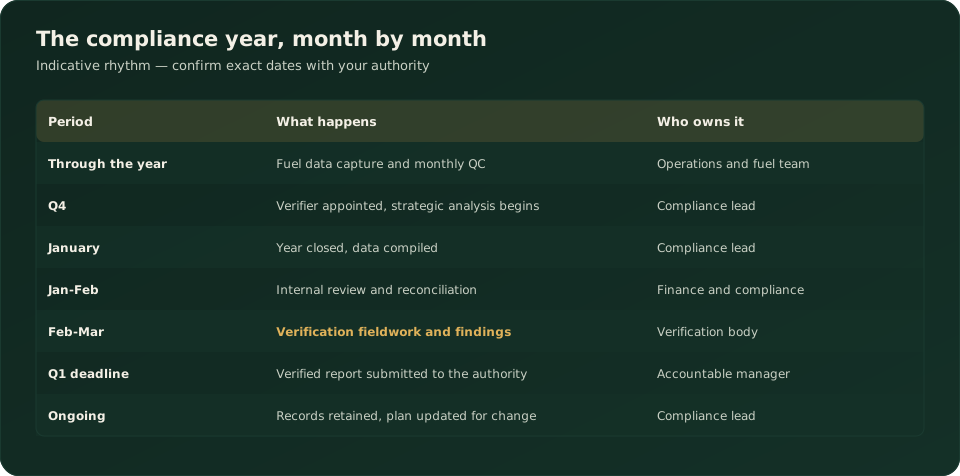
| Period | What happens | Who owns it |
|---|---|---|
| Through the year | Fuel data capture and monthly quality control | Operations and fuel team |
| Q4 | Verifier appointed, strategic analysis begins | Compliance lead |
| January | Year closed, data compiled | Compliance lead |
| Jan-Feb | Internal review and reconciliation | Finance and compliance |
| Feb-Mar | Verification fieldwork and findings | Verification body |
| Q1 deadline | Verified report submitted to the authority | Accountable manager |
| Ongoing | Records retained, plan updated for change | Compliance lead |
Confirm the actual dates with the DGCA. The rhythm above is indicative; the operative deadlines for Indian operators are published by the DGCA in the applicable Civil Aviation Requirement, and they are what your calendar should carry.
Working Backwards From the Deadline
Set internal milestones by counting back from the submission date:
| Milestone | Timing before deadline |
|---|---|
| Verified report submitted | Deadline |
| Verification report issued | 1-2 weeks before |
| All findings closed | 3-4 weeks before |
| Verification fieldwork complete | 5-6 weeks before |
| Fieldwork starts | 7-8 weeks before |
| Evidence pack complete | 8 weeks before |
| Internal review complete | 9 weeks before |
| Data compiled and reconciled | 10 weeks before |
| Compliance year closed in systems | 11-12 weeks before |
That sequence shows why January matters so much. If the year is not closed and reconciled by late January, everything downstream compresses into the same fixed window — and the compression lands on findings closure, which is the stage least able to absorb it.
The Fourth Quarter: The Most Useful Month Is October
Work done in Q4, before the year closes, disproportionately reduces stress in Q1:
Appoint the verifier. Capacity is finite near deadlines and fees are better earlier. Early appointment also lets strategic analysis begin before the data lands.
Run a pre-close data review. Nine or ten months of data is enough to see whether completeness, gaps and outstation records are in acceptable shape. Problems found in October are fixable; the same problems found in February are findings.
Confirm the monitoring plan is current. Any fleet, route, system or entity change during the year should already be reflected. If not, update now.
Confirm scope for the year. Which route pairs attracted an offsetting requirement, and on what basis — documented while the reasoning is fresh.
Check retention. Are source documents actually retrievable for the whole year, including from outstations?
Book internal resource. The compliance lead, finance contact and data owners will all be needed in a narrow window. Get it in diaries before year-end planning fills them.
The Monthly Rhythm Underneath
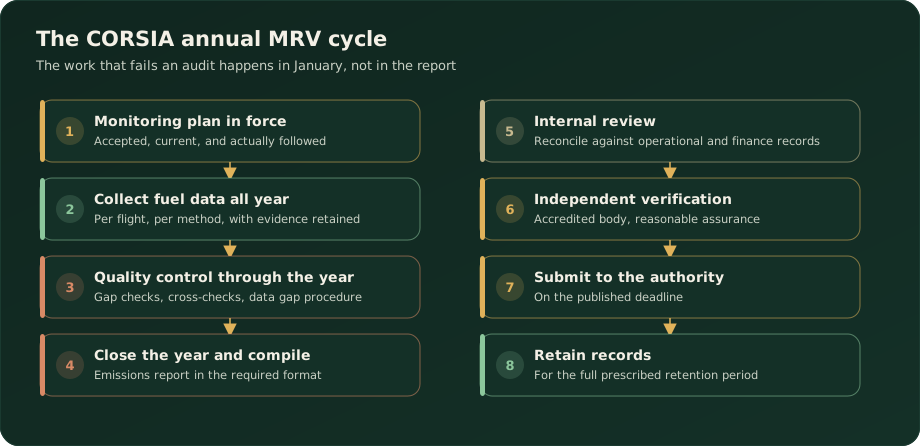
The calendar only works if the monthly routine runs all year:
- Completeness check against sectors flown
- Anomaly review by aircraft type
- Unit and duplicate checks
- Reconciliation against fuel purchase records
- Gap log updated with substitutions and approvals
- Any plan-relevant change noted for the quarterly review
Six checks, roughly a morning, evidenced. Skipping them does not save time — it defers the same work to a month when there is none available, and adds findings.
Detail in CORSIA fuel data quality management.
When Offsetting Enters the Calendar
Where an offsetting requirement applies, a second track runs alongside the MRV cycle:
| Activity | Timing |
|---|---|
| Estimate the offsetting requirement | As soon as the emissions position is clear |
| Market assessment and budget approval | Well ahead of the cancellation deadline |
| Unit due diligence | Before contracting, not after |
| Procurement and contracting | Allowing time for registry transfer |
| Registry account readiness | Before any transfer is needed |
| Cancellation and evidence | By the applicable deadline |
Registry account setup is the item that catches operators out. Opening and activating an account takes longer than expected, involves documentation and approvals, and cannot be compressed at the last moment. Do it before you need it.
Unit due diligence also takes real time — eligibility, vintage, corresponding adjustment and registry status all need checking. See the CORSIA credit due diligence checklist and how to buy CORSIA carbon credits.
Keeping the Plan Current Through the Year
Changes that should trigger a plan review, logged as they happen rather than remembered in January:
- Aircraft added, removed, or changed lease status
- New station, particularly a new outstation with a new handling agent
- Change to a source system or reporting extract
- Corporate change — new AOC, merger, restructure
- Change to the applicable requirements or participating-state list
- A process change made in response to an earlier finding
A quarterly review with a named owner catches almost all of these. The alternative — reconstructing the year's changes during report preparation — is how discrepancies between plan and practice reach a verifier.
A One-Page Calendar to Maintain
Keep a single document containing:
- The external submission deadline for the current cycle
- Every internal milestone with an owner and date
- The verifier's name, contact and appointed dates
- The monthly check schedule and who performs it
- Plan change log for the year
- Offsetting track dates, where applicable
- Retention location and responsible owner
Hold it centrally, not in one person's inbox. The continuity value alone justifies it — see consultant, in-house or hybrid on why single-person capability is fragile.
A Worked Twelve-Month Calendar
An indicative layout for an operator with a calendar-year compliance period. Adjust the external dates to whatever the DGCA publishes.
| Month | Primary activity | Owner |
|---|---|---|
| January | Prior year closed; data compiled; current-year monitoring begins | Compliance lead |
| February | Internal review, reconciliation, evidence pack assembled | Compliance and finance |
| March | Verification fieldwork; findings raised and closed | Verification body |
| April | Prior-year report submitted; findings actions implemented | Accountable manager |
| May | Plan updated for anything verification exposed | Compliance lead |
| June | Half-year data health check; outstation audit | Compliance lead |
| July | Quarterly plan review; fleet and route changes captured | Compliance lead |
| August | Offsetting position estimated for the current year | Compliance and finance |
| September | Unit market assessment; registry account confirmed active | Commercial |
| October | Verifier appointed for next cycle; pre-close data review | Compliance lead |
| November | Remediation of anything the pre-close review found | Data owners |
| December | Year-end preparation; internal resource booked for Q1 | Compliance lead |
The two rows that carry the most value are October and June. A mid-year health check and a pre-close review together mean that by the time the year ends, you already know the shape of your data — and January becomes a compilation exercise rather than a discovery exercise.
Multi-Entity Groups
Where a group holds several AOCs or operating entities, the calendar multiplies rather than merges:
- Each entity may need its own monitoring plan, report and verification opinion
- Internal milestones stagger — verification bodies cannot field all entities simultaneously
- A group-level tracker is essential, showing each entity's position against each milestone
- Shared services complicate evidence — if one fuel accounting team serves several entities, the data flow must show clearly which figures belong to which entity
- Intra-group aircraft transfers need documenting on both sides
Groups that manage this well run one central calendar with an entity column, and one compliance lead with entity-level deputies. Groups that manage it badly discover in February that two entities were relying on the same person in the same fortnight.
Frequently Asked Questions
When is the CORSIA reporting deadline? The verified emissions report is submitted to the national authority in the first quarter following the compliance year. Confirm the operative date with the DGCA.
When should we appoint the verifier? In the fourth quarter, before the compliance year closes — for availability, fee and early sight of any plan-versus-practice mismatch.
What happens in January? The compliance year is closed in systems, data is compiled, and internal review and reconciliation begin. Slippage here compresses everything downstream.
How long does verification take? Typically several weeks from fieldwork to report, longer where findings need closing. Build seven to eight weeks before the deadline.
What if we miss the deadline? That is a compliance failure with consequences set by the national authority. If a deadline is at risk, engage the authority early rather than late.
What monthly work is required? Completeness, anomaly, unit and duplicate checks, reconciliation against fuel purchase records, and gap log maintenance.
When do we buy emissions units? Where an offsetting requirement applies, allow time for due diligence, contracting, registry transfer and cancellation ahead of the applicable deadline.
How long does a registry account take to open? Longer than most operators expect. Set it up before it is needed rather than during the cancellation window.
Who owns the calendar? The compliance lead, with the accountable manager sighted on it. Hold it centrally so it survives staff change.
Running your first CORSIA compliance cycle? DSTechnoverse supports Indian aircraft operators with applicability assessment, emissions monitoring plans, fuel data quality management and verification readiness — and hands the annual cycle back to your team. We are based in Indore, Madhya Pradesh and work with clients across India. See our CORSIA carbon credit services, our carbon credit portal at carboncredit.dstechnoverse.com, or talk to our team about your reporting year.
This article is general information, not legal or regulatory advice. CORSIA rules, thresholds and participating-state lists change — verify the current position with ICAO and the DGCA before acting.