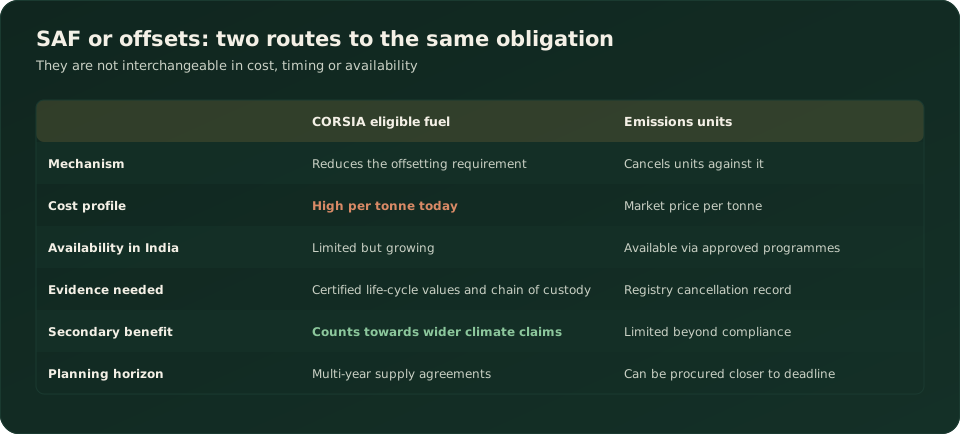
CORSIA gives an operator two routes to discharge an offsetting obligation. Buy emissions units and cancel them, or use CORSIA eligible fuel and reduce the requirement itself.
They are not interchangeable. They differ in cost, in availability, in the evidence required, and in what else they deliver.
The Two Routes Compared
| CORSIA eligible fuel | Emissions units | |
|---|---|---|
| Mechanism | Reduces the offsetting requirement | Cancels units against it |
| Cost profile | High per tonne today | Market price per tonne |
| Availability in India | Limited but growing | Available via approved programmes |
| Evidence needed | Certified life-cycle values and chain of custody | Registry cancellation record |
| Secondary benefit | Counts towards wider climate claims | Limited beyond compliance |
| Planning horizon | Multi-year supply agreements | Can be procured closer to the deadline |
How Eligible Fuel Reduces the Requirement
CORSIA recognises certain fuels — sustainable aviation fuels and lower carbon aviation fuels meeting the scheme's sustainability criteria — and allows the emissions reduction they deliver to reduce the offsetting requirement.
The reduction depends on the life-cycle emissions value of the specific fuel, certified under an approved sustainability certification scheme, compared against the baseline value for conventional jet fuel. Different feedstocks and production pathways deliver very different life-cycle values, so the reduction claimable per tonne of fuel varies substantially between batches.
Three practical requirements follow, and each has caught operators out:
1. The fuel must qualify under the scheme's criteria, certified by an approved certification body. Not every fuel marketed as sustainable qualifies for a CORSIA claim.
2. The chain of custody must be documented from production through to uplift, in a form a verifier can trace. This is a supply chain documentation problem as much as a fuel problem.
3. The claim must be evidenced in your emissions report and stand up at verification. Using eligible fuel and failing to evidence the claim means paying for the fuel and buying the units — the worst of both.
See CORSIA eligible fuels and our knowledge base at carboncredit.dstechnoverse.com for the certification detail.
The Honest Cost Comparison
On a pure cost-per-tonne-of-CO₂ basis today, eligible fuel is generally the more expensive route. SAF carries a substantial price premium over conventional jet fuel, and the resulting cost per tonne of CO₂ abated typically exceeds emissions unit prices by a wide margin.
That comparison is real and it is also incomplete, for four reasons:
Availability. SAF supply is constrained. An operator cannot simply buy its way out of an obligation with fuel if the fuel is not physically available at its stations.
Scope of benefit. Emissions units discharge a CORSIA obligation and little else. Eligible fuel reduces actual emissions, which supports corporate climate commitments, customer and investor reporting, and increasingly corporate travel procurement requirements. One is compliance; the other is compliance plus positioning.
Trajectory. Unit prices and SAF prices move in different directions over time — SAF costs are expected to fall with production scale while high-integrity unit prices face constrained supply. A five-year view differs from a one-year view.
Infrastructure. SAF uptake requires supply agreements, blending arrangements and documentation systems. Those take time to build, which means the decision to start is separate from the decision to scale.
The India Position
For an Indian operator, three factors shape the calculation:
SAF availability is developing. Domestic production capacity and blending mandates are evolving, and the practical question is whether qualifying fuel is available at your operating stations in meaningful volume — not whether it exists somewhere.
Certification matters as much as supply. Fuel that is sustainable in a general sense but not certified under an approved scheme cannot support a CORSIA claim. Confirm the certification position before contracting.
Both routes need lead time. SAF requires supply agreements; units require diligence, contracting and registry transfer. Neither is a last-quarter decision.
A Multi-Year Framework
Rather than treating this as an either/or, most operators land on a sequence:
| Horizon | Typical position |
|---|---|
| Immediate | Units for the current obligation; diligence and staged procurement |
| 1-2 years | Small SAF volumes where available, to build the documentation capability |
| 3-5 years | Scaled SAF where supply and price allow; units for the balance |
| Throughout | Fuel efficiency programme, which reduces both routes' requirement |
The efficiency row underpins everything and is often overlooked in a discussion framed as "fuel versus offsets". Every tonne of fuel not burned reduces the emissions, the offsetting requirement, the fuel bill and the SAF volume needed — it is the only lever that improves every line simultaneously.
Building the SAF Documentation Capability Early
Even at small volumes, running an eligible fuel claim through a compliance cycle once is disproportionately valuable:
- It tests whether your fuel supply documentation can actually support a claim
- It exposes chain-of-custody gaps while the volume is small
- It gives the verifier a precedent to work from
- It tells you what scaling would require operationally
Discovering a documentation gap on a small claim is a lesson. Discovering it on a large one is a material cost, because the fuel premium is already spent and the claim cannot be made.
Chain of Custody and the Claim
The practical obstacle to claiming a fuel reduction is rarely the fuel itself. It is proving, to a verifier's satisfaction, that the specific fuel with the specific certified life-cycle value reached your aircraft.
| Link in the chain | Evidence typically required |
|---|---|
| Production | Certification under an approved sustainability scheme |
| Life-cycle value | The certified value for that batch or pathway |
| Blending | Records showing the blend ratio and volumes |
| Transport and storage | Custody documentation through the supply chain |
| Uplift | Delivery documentation identifying the fuel supplied |
| Claim | Reconciliation of claimed volume against uplift records |
Where fuel is physically blended and commingled in shared infrastructure — which is normal — the accounting relies on documented custody rather than on physical segregation. That makes the paperwork the asset, and it means the supply agreement is where a claimable SAF position is created or lost. Negotiate the documentation obligations into the fuel contract rather than requesting them afterwards.
Questions a Board Will Ask
Before committing to either route at scale, expect these, and have the answers:
- What is our forecast offsetting requirement over the next three years, as a range?
- What is the cost per tonne of CO₂ under each route, at today's prices?
- What volume of qualifying fuel is actually available at our stations?
- What happens to our position if unit prices double? If they halve?
- What claims can we make publicly under each route, and what evidence supports them?
- What does our fuel efficiency programme contribute, and what would accelerating it cost?
- What is the downside if a SAF claim fails verification?
Question 7 is the one most often unprepared for. The answer is that you pay the fuel premium and still buy the units — which is why the documentation capability, not the fuel supply, is the thing to build first.
What Not to Assume
Three assumptions that cost operators money in this area:
That any sustainable fuel supports a claim. It must meet the scheme's criteria and be certified under an approved scheme. Marketing language is not certification.
That the supplier will provide what a verifier needs. They will provide what the contract requires. If chain-of-custody documentation is not in the supply agreement, expect to negotiate for it after the fuel has been burned.
That the SAF decision can wait until the offsetting obligation bites. Supply agreements, blending arrangements and documentation systems take years to build. The operators who will be able to use fuel at scale when it matters are the ones running small claims through verification now.
Frequently Asked Questions
Does SAF reduce a CORSIA obligation? Yes. CORSIA eligible fuels reduce the offsetting requirement based on their certified life-cycle emissions value.
Which fuels qualify? Sustainable aviation fuels and lower carbon aviation fuels meeting the scheme's sustainability criteria, certified under an approved certification scheme.
Is SAF cheaper than buying units? Generally not on cost per tonne of CO₂ today. SAF's advantages are actual emissions reduction, wider climate claims and a different cost trajectory.
What evidence is needed to claim a SAF reduction? Certified life-cycle values and a documented chain of custody from production to uplift, traceable at verification.
What happens if we use SAF but cannot evidence it? You pay the fuel premium and still buy the units. Evidence the claim or do not rely on it.
Is SAF available in India? Availability is developing. The practical test is whether certified qualifying fuel is available in volume at your operating stations.
Should we do both? Most operators do — units for the immediate obligation, small SAF volumes to build the capability, scaling as supply and price allow.
What about fuel efficiency? It reduces emissions, the offsetting requirement and the fuel bill simultaneously. It is the lever that improves every line.
How far ahead should we plan? SAF supply agreements are multi-year. Unit procurement can be closer in but still needs diligence and transfer time.
Planning your CORSIA position? DSTechnoverse advises Indian operators and project developers on CORSIA compliance strategy — offsetting requirement forecasting, unit procurement due diligence, SAF and efficiency trade-offs, and readiness assessment before the compliance year begins. We are based in Indore, Madhya Pradesh and work with clients across India. See our CORSIA carbon credit services, our carbon credit portal at carboncredit.dstechnoverse.com, or talk to our team.
This article is general information, not legal, financial or regulatory advice. CORSIA rules, participating-state lists and eligibility criteria change — verify the current position with ICAO and the DGCA before acting.