A verifier asks a fuel data analyst why a particular discrepancy was resolved the way it was. The analyst has attended a two-hour CORSIA overview covering the phases, the growth factors and the eligibility criteria. None of it helps.
Training that does not connect to what someone actually does is a compliance cost with no compliance benefit.
Train by Role, on Your Own Data
The two principles that make training effective here.
By role, because a flight operations coordinator and a treasury analyst need entirely different things and share almost nothing beyond the fact that CORSIA exists.
On your own data, because the questions that arise in verification are about your pipeline, your reconciliation rules and your judgement calls — not about the scheme in general.
A single all-hands session covering the scheme satisfies neither.
What Each Role Needs
The compliance owner
Needs the whole picture: scope determination logic, the monitoring plan, the annual cycle, verification, the requirement calculation, procurement and cancellation.
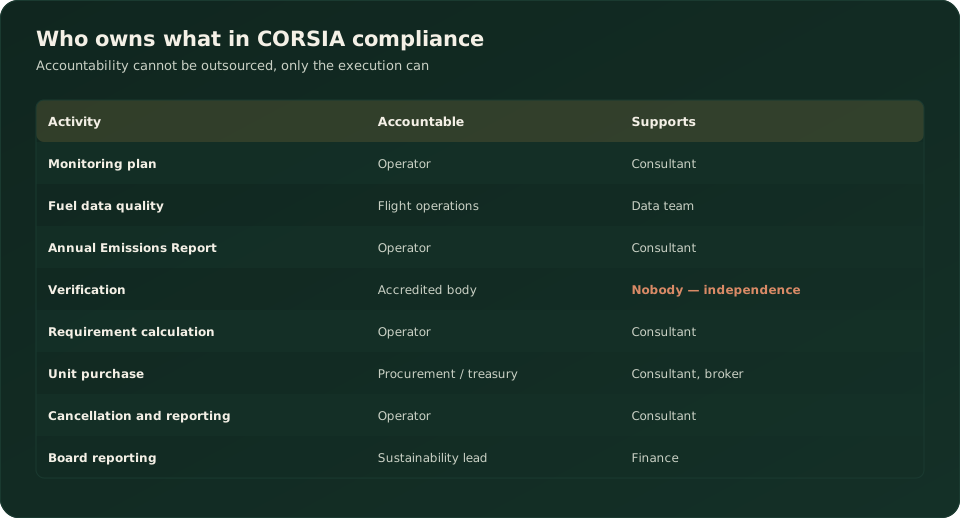
Also needs to know what they are accountable for and cannot delegate — the obligation sits with the operator regardless of who executes the work.
Flight operations
Needs to know why the flight list must be complete, including positioning and ferry legs that generate no revenue and are the ones most often missing.
Needs to understand scope classification well enough to answer questions about specific flights: which certificate covered this charter, was this genuinely a medical flight, why is this sector international.
Does not need growth factors, eligibility criteria or market structure.
Fuel and data analysts
The most important group, and the most often under-trained.
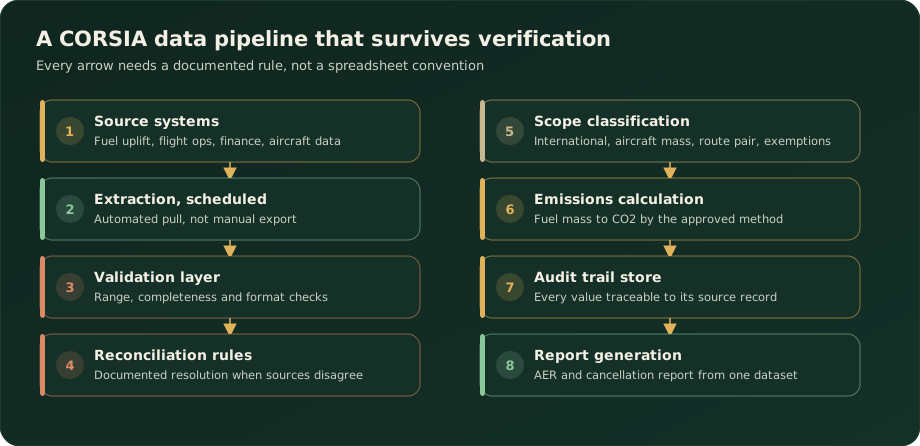
Needs deep knowledge of the reconciliation rules, the escalation thresholds, the gap-filling procedure, and — critically — how to explain a figure to someone who was not there. Verifier questions are almost entirely about data provenance.
Should be trained by walking through the actual pipeline with real records, not by slides.
Finance and treasury
Needs the budget structure, the timing of the obligation, cross-border payment and foreign exchange considerations for unit purchase, and registry fee handling.
Needs to understand that purchase does not discharge the obligation — cancellation does — because that distinction affects when cost is recognised and what "complete" means.
Procurement
Needs the eligibility criteria at a practical level: what documents must be obtained before transacting, what "CORSIA-ready" actually means, and why the usual lowest-price approach can produce unusable units.
Leadership and the board
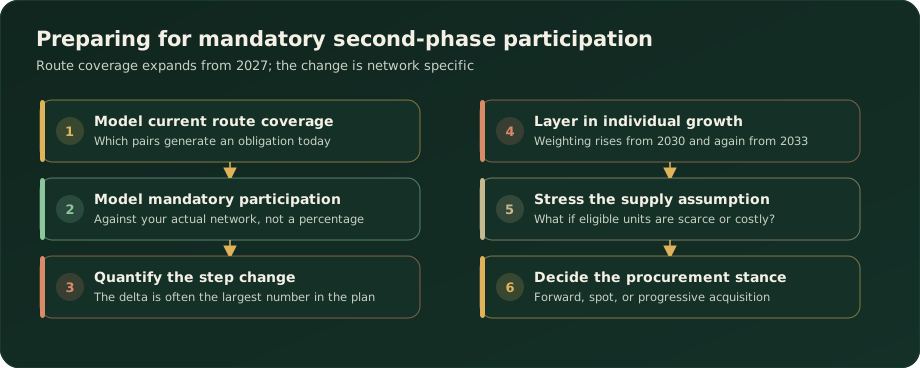
Needs materiality, trajectory and risk. What is the obligation now, what does it become in 2027 and 2030, what is the supply and price exposure, and what happens if the organisation does not comply.
Does not need the monitoring method.
Formats That Work
Walkthroughs beat presentations. Sit with the team and trace a real flight from source record to reported figure. It takes an hour and teaches more than a day of slides.
Written reference beats memory. A one-page role card — what you do, when, what to escalate, who to ask — outlasts any session.
Record the sessions. Someone joins in month four and needs the same material. Re-running a session for one person rarely happens; a recording is always available.
Refresh annually, before the reporting cycle rather than after it.
Include the new joiner path. Training that exists only as a one-off event decays as people move.
A Practical Training Plan
For an operator running its first cycle, this covers the ground without over-investing.
Session 1 — Compliance owner, half a day. Scope determination and its reasoning, the monitoring plan in detail, the annual cycle and its deadlines, verification and what it tests, the requirement calculation, procurement and cancellation. Accountability that cannot be delegated.
Session 2 — Data and fuel analysts, half a day, at a screen. Walk the actual pipeline end to end with real records. Every reconciliation rule, the escalation threshold, the gap procedure, and the decision log. Finish by having each person trace a figure they did not prepare.
Session 3 — Flight operations, one hour. Why completeness matters, which flights are easily missed, how scope classification works, and what to escalate. Concrete examples from your own operation.
Session 4 — Finance, procurement and treasury, one hour. Budget structure, obligation timing, why cancellation rather than purchase discharges it, registry and cross-border payment mechanics, and what documents procurement must obtain before transacting.
Session 5 — Leadership, thirty minutes. Current obligation, trajectory through 2027 and 2030, supply and price exposure, consequence of non-compliance.
Artefacts, not just sessions. One role card per group, the recorded walkthrough, and the written rules. These are what survive; the sessions themselves fade.
Total investment is roughly two days of facilitation. Compare that against the cost of a single verification finding caused by nobody being able to explain a figure.
The Knowledge Concentration Risk
The most common structural risk in CORSIA compliance is that one person understands the pipeline.
They wrote the reconciliation logic, they know why the March figures were adjusted, and they can answer any verifier question. When they leave — and eventually they will — the organisation cannot explain its own reported figures.
Three mitigations:
Document rather than train. Written rules and a decision log survive turnover; knowledge in a head does not.
Cross-train a second person. Not to run the process, but to be able to explain it.
Test the documentation. Ask someone uninvolved to reproduce a figure from the files alone. If they cannot, the process depends on a person rather than on a record — and that is the finding waiting to happen.
Measuring Whether Training Worked
Attendance is not evidence of capability, and it is the only thing most training programmes measure.
Three checks that actually tell you something, all cheap:
The reconstruction test. Give someone a reported figure they did not prepare and ask them to explain it from the files. This is precisely what a verifier does, and it tests documentation and understanding together.
The escalation test. Present a realistic edge case — a discrepancy above the threshold, a flight that might be exempt, a gap in an outstation feed — and ask what they would do and who they would tell. Wrong answers here are cheap to correct now and expensive during a reporting year.
The absence test. Ask who else could do this if the primary person were unavailable for a month. If the honest answer is nobody, the training has not addressed the actual risk, however well it was received.
Run these a few weeks after training rather than immediately, when the retention question is real.
Where results are poor, the fix is usually not more training. It is more documentation — a written rule that can be consulted beats a remembered rule every time, and it survives the person leaving.
What Training Cannot Fix
Being clear about this saves money.
Training does not fix a monitoring method your data cannot support. It does not fix undocumented reconciliation rules — writing them down is the fix, and training on them comes after. It does not create accountability where nobody owns the obligation. And it does not substitute for a pipeline; a well-trained team running a manual process is still running a manual process.
Train after the process exists, on the process that exists.
Training External Parties
Some of the people whose behaviour affects your compliance do not work for you, and nobody trains them.
Handling agents supply fuel dockets. If they do not know the docket must be per flight, must reach you within an agreed period, and must be retained, you will find out at verification. A one-page brief attached to the handling agreement costs nothing.
Fuel suppliers at outstations may report by volume, by day, or in formats that vary by country. Establishing the requirement in writing before the first uplift is far easier than reconstructing afterwards.
Charter brokers and lessors, where they influence which certificate a flight operates under, need to understand that the operator determination has compliance consequences.
New station openings are the moment this most often fails. A route launches, the data requirement is never communicated to the local handler, and three months of dockets are missing before anyone notices. Add the CORSIA data requirement to the station opening checklist alongside the operational items.
This is not training in the classroom sense. It is a written requirement, a named contact and a monthly check that the records are arriving.
Frequently Asked Questions
How much training does a team need? Less than most programmes deliver, and better targeted. A half-day for the compliance owner, an hour-long walkthrough for the data team, and a short briefing for flight operations covers most operators.
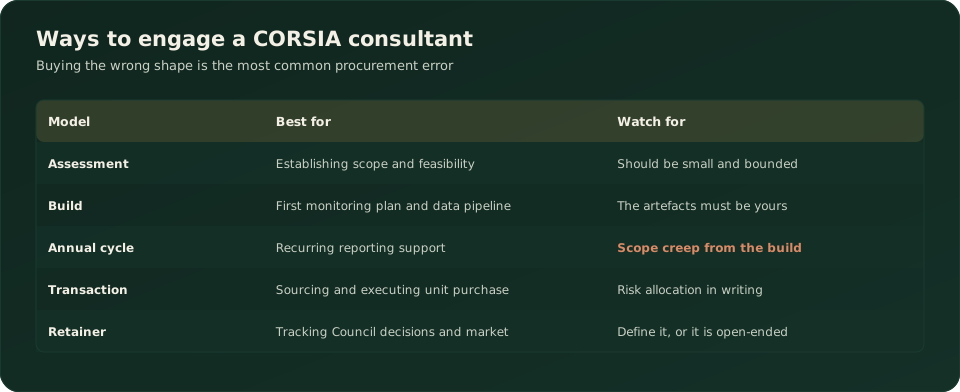
Should training be external or internal? External for the first build, because the scheme is unfamiliar. Internal thereafter, on your own pipeline, because that is what people actually need.
Do we need certified training? There is no ICAO-recognised CORSIA training certification for operator staff. Be wary of anything presented as an official credential — see consultant due diligence red flags.
How do we train new joiners? Recorded walkthroughs plus role cards, then a session with whoever owns the process. Do not rely on re-running the original programme.
What if our data analyst leaves? If the rules and decision log are documented, this is manageable. If they are not, this is the problem to fix now rather than after the resignation.
Who should train the board? Whoever owns the obligation, with materiality and trajectory rather than mechanics. See board reporting and governance.
When should training happen? After the pipeline and rules exist, before the reporting year starts. Training on a process that has not been built teaches nothing durable.
Need CORSIA compliance that survives verification? DSTechnoverse builds monitoring plans, data pipelines and reporting processes for Indian operators, and supports project developers through eligibility and placement. See our CORSIA carbon credit services. We are based in Indore, Madhya Pradesh and work across India.
Apply as a CORSIA buyer or seller
Talk to our carbon markets team about your position.