Carbon markets attract advisers faster than they build genuine expertise, and CORSIA — technical, regulated, and newly relevant to Indian operators — attracts more than most. The distinction that matters is between firms that know the market and firms that have delivered a compliance cycle.
These are the signals that separate them.
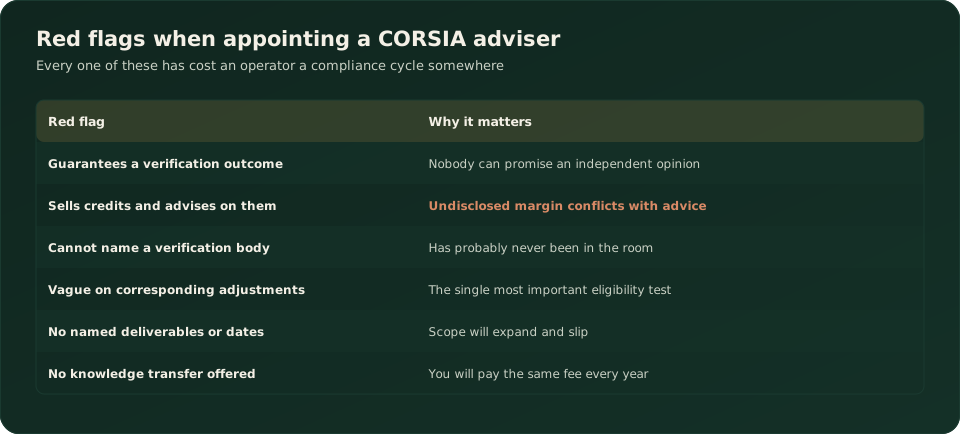
The Six Serious Red Flags
| Red flag | Why it matters |
|---|---|
| Guarantees a verification outcome | Nobody can promise an independent opinion |
| Sells credits and advises on them | Undisclosed margin conflicts with the advice |
| Cannot name a verification body | Has probably never been in the room |
| Vague on corresponding adjustments | The single most important eligibility test |
| No named deliverables or dates | Scope will expand and slip |
| No knowledge transfer offered | You will pay the same fee every year |
"We guarantee your verification will pass"
Verification is an independent assurance engagement. The verifier forms their own opinion based on evidence, and no consultant can commit to that outcome. A firm offering this is either misunderstanding the process or misrepresenting it, and neither is a good start.
What a competent firm says instead: "We will prepare the plan and evidence so that verification is straightforward, we will support you through findings, and findings on our deliverables are closed at our cost." That is a commitment they can actually make.
Advising and selling
A firm that advises how many units you need and also sells those units has an interest in the answer. It is not automatically disqualifying — some firms manage this properly with disclosure and separation — but undisclosed, it is a serious problem.
Ask directly: do you sell emissions units, hold an interest in a firm that does, or receive any commission on units we purchase? Then ask for it in writing.
Cannot name a verification body
Verification bodies are a small, identifiable community. Anyone who has delivered a CORSIA cycle has worked alongside one and will have views on how different verifiers approach sampling and findings. Vagueness here is the clearest single signal of inexperience.
Vague on corresponding adjustments
For any conversation about credit supply or procurement, the corresponding adjustment is the decisive eligibility test. A firm that treats it as a documentation step, or is unclear about who authorises it, has not worked on a CORSIA transaction. See corresponding adjustments for Indian CORSIA projects.
Softer Signals Worth Noticing
They present without asking questions. A firm with delivery experience wants to know your entity structure, fuel data systems, outstations and existing reporting obligations. One that presents for an hour is selling.
They conflate MRV and offsetting. The two obligations are separate tests. Confusing them in a pitch predicts confusing them in a deliverable.
They talk strategy but not data. CORSIA compliance is largely data assurance. An hour of market outlook with no discussion of fuel records has avoided the actual work.
Everything is certain. Participating states, phase parameters and eligibility criteria change. A firm stating all of it as settled is out of date or overconfident.
The pitch team is not the delivery team. Common across consulting, and worth pinning down: names, grades, availability, and whether substitution requires your consent.
No stated limits. "We handle everything" from a small firm covering airline MRV, project development, unit trading and policy engagement is a claim worth testing hard.
Reluctance to provide references. Particularly a reference where something went wrong and was handled well.
Practical Diligence Steps
- Check the entity. Registration, how long it has traded, who owns it.
- Check the individuals. Named team, their track record, whether their claimed experience is with this firm or a previous one.
- Ask for a redacted deliverable. A monitoring plan excerpt or project design document tells you more than any credential.
- Take a reference call and ask specifically what went wrong and how it was handled.
- Request the independence declaration in writing.
- Test with a small paid piece of work before a full engagement.
- Read the contract's exclusions before the scope description.
Step 6 is the most reliable filter available. A paid gap analysis or a two-page scoping exercise costs little, reveals working style, and gives you a deliverable to judge rather than a presentation.
What Good Looks Like
For balance, the positive signals:
- Asks detailed questions about your operation before quoting
- Distinguishes clearly between MRV, offsetting, and credit supply work
- Names deliverables, dates and acceptance criteria without prompting
- Raises the corresponding adjustment early in any supply discussion
- States what they do not do, and who they would bring in for it
- Explains what is uncertain and why
- Offers knowledge transfer as a deliverable rather than a promise
- Prices year two lower, and explains why
- Discloses any commercial interest before being asked
The last point is worth weighting heavily. A firm that volunteers a potential conflict before you ask is telling you something reliable about how they will behave when a difficult question arises mid-engagement.
Our companion pieces cover the selection process in 25 questions to ask a CORSIA consultant and the contract in CORSIA consultant scope of work.
Contractual Protections
Diligence tells you who you are appointing. The contract determines what happens when something goes wrong. Six clauses worth insisting on:
| Clause | What it should say |
|---|---|
| Findings attribution | Findings on consultant-produced deliverables are closed at their cost |
| Named staffing | Named individuals, with substitution requiring your consent |
| Independence declaration | Any interest in credit sales, disclosed and updated if it changes |
| Deliverable ownership | All documents and working files belong to you, in editable format |
| Authority queries | Responses to authority questions on their deliverables are included |
| Termination and handover | What you receive if the engagement ends early |
The deliverable ownership clause is quietly the most important of the six. A monitoring plan supplied only as a locked PDF, with the underlying working files retained by the consultant, guarantees a return engagement next year regardless of how well the knowledge transfer session went. Ask for editable files as a contractual deliverable, not a courtesy.
The independence declaration should be a live obligation rather than a one-off statement. A firm with no credit sales interest at appointment may acquire one during a multi-year engagement, and the contract should require them to tell you.
One test that reveals a great deal: ask a prospective firm to review these six clauses and tell you which they object to and why. A firm confident in its delivery has no difficulty with any of them. A firm that pushes back on findings attribution and deliverable ownership together is telling you what its business model actually is.
When to Walk Away Mid-Engagement
Occasionally the warning signs appear after appointment. Signals that justify stopping rather than persevering:
- Deliverables arrive late and thin, with the named senior staff no longer involved
- The gap analysis identified nothing, and problems emerge later that it should have caught
- A commercial interest in credit sales is disclosed only when questioned
- Advice changes materially between meetings without new information
- The firm is unwilling to put a position in writing that it stated verbally
The cost of changing adviser mid-cycle is real, and it is usually smaller than the cost of a failed verification or an unaccepted monitoring plan. The deliverable ownership clause is what makes leaving possible — with editable working files in your hands, a replacement firm starts from your position rather than from nothing.
Frequently Asked Questions
What are the main red flags in a CORSIA consultant? Guaranteeing verification outcomes, undisclosed credit sales interests, inability to name a verification body, vagueness on corresponding adjustments, no named deliverables and no knowledge transfer.
Can a consultant guarantee verification will pass? No. Verification is an independent opinion. They can commit to preparing well and closing findings on their own deliverables at their cost.
Is it a problem if they also sell credits? Only if it is undisclosed or the roles are not separated. Ask directly and get the answer in writing.
How do I test their experience? Ask for a redacted monitoring plan or project design document, ask which verification bodies they have worked alongside, and ask what findings arose.
Should I take references? Yes, and ask specifically about a situation that went wrong and how it was handled.
What is the cheapest way to test a firm? A small paid piece of work — a gap analysis or scoping exercise — before committing to a full engagement.
What if they seem certain about everything? Ask what they consider uncertain. CORSIA has genuinely moving parts, and total certainty is itself a warning sign.
Does firm size matter? Less than delivery evidence. Small specialist firms often have deeper CORSIA delivery experience than large generalist ones.
What should be in writing before we start? Named deliverables with dates and acceptance criteria, the staffing schedule, the findings attribution rule, exclusions, an independence declaration and the year-two price.
Planning your CORSIA position? DSTechnoverse advises Indian operators and project developers on CORSIA compliance strategy — offsetting requirement forecasting, unit procurement due diligence, SAF and efficiency trade-offs, and readiness assessment before the compliance year begins. We are based in Indore, Madhya Pradesh and work with clients across India. See our CORSIA carbon credit services, our carbon credit portal at carboncredit.dstechnoverse.com, or talk to our team.
This article is general information, not legal, financial or regulatory advice. CORSIA rules, participating-state lists and eligibility criteria change — verify the current position with ICAO and the DGCA before acting.