A verification report arrives with findings. This is normal — a first verification with none is rarer than one with several. What matters is how they are classified and what you do about them.
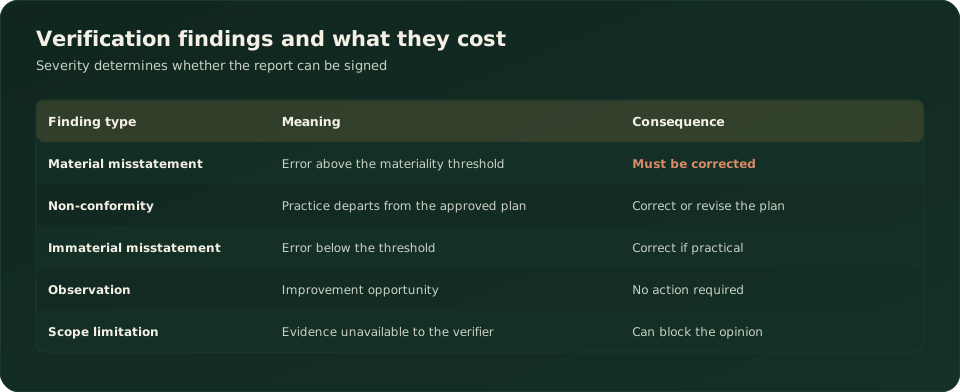
The Severity Levels
| Finding | Meaning | What must happen |
|---|---|---|
| Material misstatement | Error above the materiality threshold | Must be corrected; affected work re-verified |
| Non-conformity | Practice departed from the approved plan | Correct the practice, or revise the plan |
| Immaterial misstatement | Error below the threshold | Correct if practical; note otherwise |
| Observation | Improvement opportunity | No mandatory action |
| Scope limitation | Evidence unavailable to the verifier | Can block the opinion entirely |
The last row is the most serious and the least understood. A scope limitation is not a finding about your data being wrong — it is the verifier saying they could not obtain the evidence needed to form an opinion at all. That is worse than a material misstatement, because a misstatement can be corrected while a limitation may prevent the report being signed.
Handling Each Type
Material misstatement
Correct the underlying figure, restate the affected portion of the report, and have the verifier re-examine it.
Do not argue about materiality unless you have a genuine basis. The threshold is defined; a figure is above it or below it.
Then ask the more important question: how did an error of this size reach the report? A material misstatement almost always indicates a control failure rather than a one-off slip.
Non-conformity
Two legitimate routes, and choosing correctly matters.
Correct the practice where the plan describes what you should be doing and you drifted. This is the usual case.
Revise the plan where practice evolved for good reason and the plan is now out of date. A plan describing a system you replaced eighteen months ago should be updated, not worked around.
What is not legitimate is leaving both unchanged and hoping. The same non-conformity will recur next year, and a repeat is treated far more seriously.
Immaterial misstatement
Correct where practical. Where not, note it and address the cause.
Watch for accumulation. Several immaterial errors of the same type suggest a systematic problem, and in aggregate they can exceed the threshold.
Observation
No mandatory action, and worth reading carefully anyway. Observations are frequently a verifier signalling something that will become a finding if left — a process that works but depends on one person, or documentation that is adequate now and will not be after a change.
Scope limitation
Address urgently. Establish exactly what evidence was unavailable and why, then either produce it or fix the process so it exists next year.
Common causes: source records not retained, a system decommissioned without exporting its data, or third-party records — a handling agent's dockets — that the operator never obtained.
Root Cause, Not Just Correction
The distinction that separates operators who improve from those who repeat.
The correction fixes this year's number. The root cause fix stops it happening again.
A worked example. Finding: fuel figures for three flights could not be traced to source records.
Correction: obtain the records, confirm the figures, restate if needed.
Root cause options: the handling agent does not send dockets for ad hoc destinations; the extraction drops records without a matching schedule entry; nobody reconciles monthly so absences are invisible until year end.
Each root cause implies a different fix — a contract clause, a pipeline change, or an operational habit. Correcting only the three flights guarantees the same finding next year with different flights.
A simple discipline: for each finding, write the correction and the root cause fix as separate lines, with separate owners and dates.
The Repeat Finding Problem
A finding raised, reported closed, and raised again is regarded very differently from a first occurrence.
It suggests either that the corrective action was cosmetic, or that the organisation cannot sustain a fix. Both raise questions about everything else in the report, because the verifier now has reason to doubt the control environment generally.
Avoiding it requires closing findings on cause rather than symptom, and verifying the closure yourself before the next cycle. Closing a finding on paper and closing it in practice are different things, and the difference surfaces at the next verification.
Working With the Verifier
Understand before responding. Ask for the specific evidence and reasoning. A finding that seems wrong is often a finding you have misread.
Do not dispute a valid finding. It costs credibility that matters in subsequent years, and verifiers document disputes.
Do present a reasoned position where you genuinely believe a finding rests on a misunderstanding of your operation. Verifiers are professionals and will engage with evidence.
Respond promptly and completely. Partial responses extend the process and consume the schedule contingency you need.
Keep the correspondence. It becomes part of the record supporting the closure.
Recording and Tracking Findings
Findings need managing as a small portfolio rather than as a list of tasks, because the closure evidence matters as much as the closure.
Track per finding: the reference and severity as the verifier stated it, the correction with its owner and date, the root cause with a separate owner and date, the evidence that the fix is in place, and the check that confirms it held.
That last column is the one usually missing. A finding marked closed in April, never revisited, and raised again the following February was never actually closed — it was recorded as closed.
Verify closures before the next cycle. Three months before the next verification, take each of last year's findings and test whether the fix is still operating. Fixes decay: a manual step that someone was doing stops when they change role, a rule gets bypassed under time pressure, a system change reverts a configuration.
Distinguish quick corrections from structural fixes in the tracker. Correcting three flights is a task. Changing a handling agreement so the dockets arrive is a project with a different timescale, and merging them into one line means the structural work quietly does not happen.
Report progress to whoever owns the obligation, not only to the project team. Findings that sit with a data analyst with no visibility upward are the ones that recur.
Building Contingency
Assume findings and schedule accordingly. Verification finishing the week before the national submission deadline leaves no room for a material finding to be corrected and re-verified.
A workable pattern is to target completion four to six weeks ahead of the deadline. The contingency is rarely wasted, and when it is needed it is the difference between a technical issue and a compliance failure.
Findings That Point at Something Larger
Certain findings are worth reading as symptoms rather than as isolated issues, because the underlying cause usually affects more than the finding names.
Several unrelated traceability findings suggest the audit trail is inadequate generally, not that three specific records were mislaid. Expect more next year unless the trail is fixed.
A completeness finding — flights missing from the report — usually indicates the flight list is assembled from a commercial rather than an operational source. That will keep dropping positioning legs and ad hoc sectors regardless of how carefully this year's gap is patched.
Repeated reconciliation findings mean the rules are absent or not followed, which is a governance issue rather than a data one.
A plan conformity finding raises the question of what else has drifted. If practice diverged in one area without anyone noticing, the plan has probably not been read against practice for some time.
Any finding attributed to one person's absence is a key-person risk finding wearing different clothes.
The useful discipline is to ask, for each finding, whether it is a one-off or an instance of a pattern. Treating a pattern as a one-off is how a first-year finding becomes a repeat finding, and repeats are what damage credibility with the verifier and the authority.
Frequently Asked Questions
Are findings normal? Yes, especially in a first verification. Their absence is less common than their presence.
Which finding is most serious? A scope limitation, because it can prevent an opinion being issued. Material misstatements are serious but correctable.
How long do we have to respond? Set by the verifier's process and by your submission deadline. Agree the timetable at engagement rather than during.
Can a finding be withdrawn? If it rests on a factual misunderstanding and you provide evidence, yes. Verifiers correct findings that turn out to be wrong.
What if we disagree and the verifier maintains the finding? Escalation routes exist through the verifier's own process and their accreditation body. Use them only where the disagreement is substantive.
Does a finding mean we are non-compliant? Not necessarily. Findings corrected before the opinion is issued are part of a normal verification. Unresolved material issues are a different matter.
How do we get fewer findings next year? Fix root causes, run an internal dry run, and check that last year's closures actually held. See preparing for a CORSIA audit.
Need CORSIA compliance that survives verification? DSTechnoverse builds monitoring plans, data pipelines and reporting processes for Indian operators, and supports project developers through eligibility and placement. See our CORSIA carbon credit services. We are based in Indore, Madhya Pradesh and work across India.
Apply as a CORSIA buyer or seller
Talk to our carbon markets team about your position.