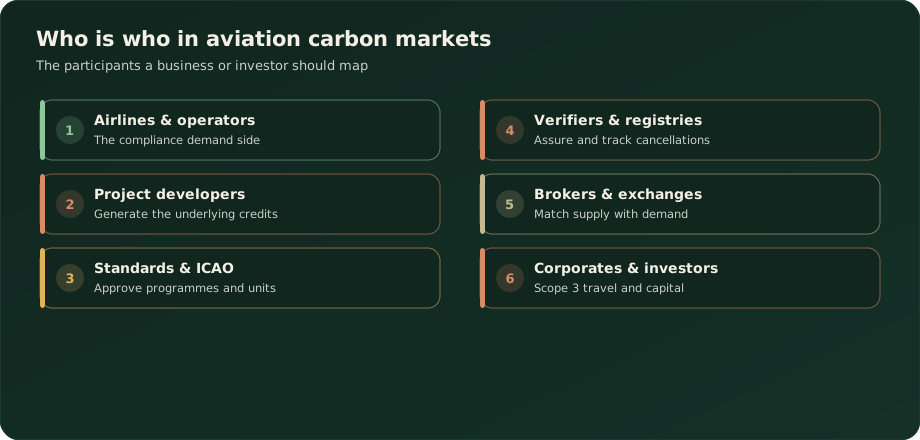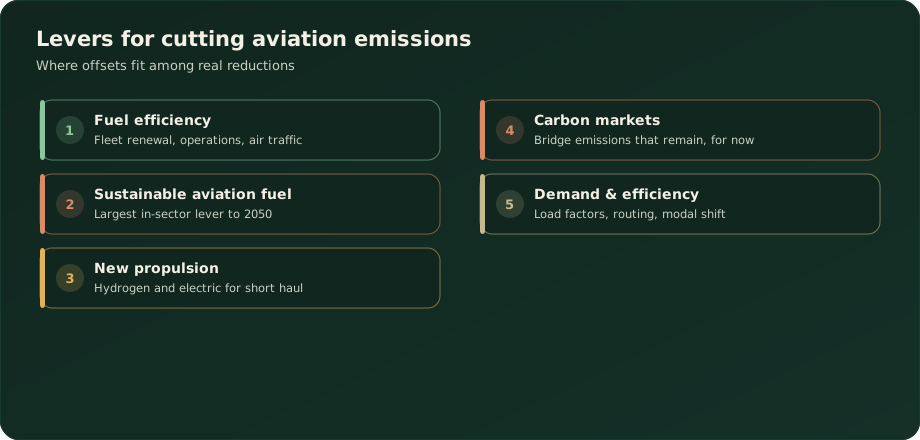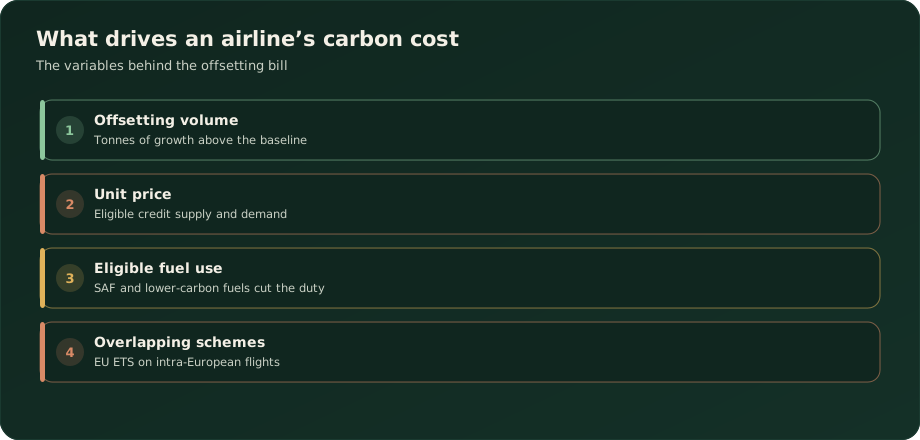
CORSIA — the Carbon Offsetting and Reduction Scheme for International Aviation — is the first global market-based measure applied to a single industry. It requires aircraft operators to offset the growth in carbon dioxide emissions from international flights above an agreed baseline, using a narrowly defined class of carbon credit that most of the voluntary market cannot supply.
This guide covers what the scheme actually is, who it binds, how the arithmetic works, what makes a credit acceptable under it, and — the part most introductions skip — which parts of it remain genuinely unresolved.
Why CORSIA Exists
International aviation sits in an awkward gap in climate governance. Emissions from a flight between two countries do not obviously belong to either country's national inventory, and the Kyoto Protocol explicitly handed the problem to the International Civil Aviation Organization rather than resolving it. Two decades of slow progress followed, punctuated by the European Union's attempt to bring all flights touching EU airports into its own Emissions Trading System — an attempt that provoked enough diplomatic resistance that the EU narrowed its scope to intra-European flights while ICAO worked on a global answer.
That answer, agreed at the ICAO Assembly in 2016, is CORSIA. Its stated objective is carbon-neutral growth: the sector may continue to expand, but the emissions growth above a reference baseline must be neutralised by purchasing and cancelling carbon credits.
It is worth being clear about what this does and does not do. CORSIA does not reduce aviation emissions. It requires the sector to pay for reductions elsewhere in the economy that would not otherwise have happened. Whether that is an adequate response is a legitimate policy debate; whether it is a legal obligation for operators in participating States is not — it is.
Who CORSIA Applies To
The scheme applies to aeroplane operators conducting international flights, where the operator produces more than 10,000 tonnes of CO2 per year from those flights, using aeroplanes with a maximum certificated take-off mass above 5,700 kg.
Several categories sit outside it:
- Domestic flights — these fall under national policy, not CORSIA.
- Humanitarian, medical and firefighting flights.
- State aircraft, including military.
- Operators below the 10,000-tonne threshold, which are exempt from offsetting though not always from reporting.
The critical nuance is that offsetting obligations attach to routes between two participating States. A flight from a participating State to a non-participating State does not generate an offsetting requirement, even though its emissions are still monitored and reported. This is why the participation list matters so much commercially — an operator's obligation can shift materially when a State joins or leaves.
Monitoring, reporting and verification, by contrast, apply far more broadly. If you are above the threshold, you report, regardless of whether you owe offsets this year.
How the Arithmetic Works
The offsetting requirement for an operator in a given year is derived from its reported emissions on covered routes, multiplied by a growth factor.
The scheme originally set the baseline as the average of 2019 and 2020 emissions. The pandemic collapse in 2020 traffic would have made that baseline artificially low, dramatically inflating every future obligation, so the ICAO Council adjusted it to 2019 levels alone. This was a pragmatic decision and a good illustration of a general point: CORSIA parameters are not immutable.
Two growth factors combine:
- The sectoral growth factor reflects how much the whole covered sector has grown relative to the baseline. In the early phases, obligations are calculated entirely on this basis, meaning every operator shares the sector-wide burden proportionally to its own emissions.
- The individual growth factor reflects an operator's own growth. From 2030 the design shifts weight progressively toward individual growth, so a fast-growing carrier eventually carries more of its own burden.
There is also a CORSIA Eligible Fuels adjustment. Operators using qualifying sustainable aviation fuel or lower-carbon aviation fuel can claim an emissions reduction that lowers the offsetting requirement, provided the fuel meets the sustainability criteria and is properly documented through the chain of custody.
The Compliance Cycle
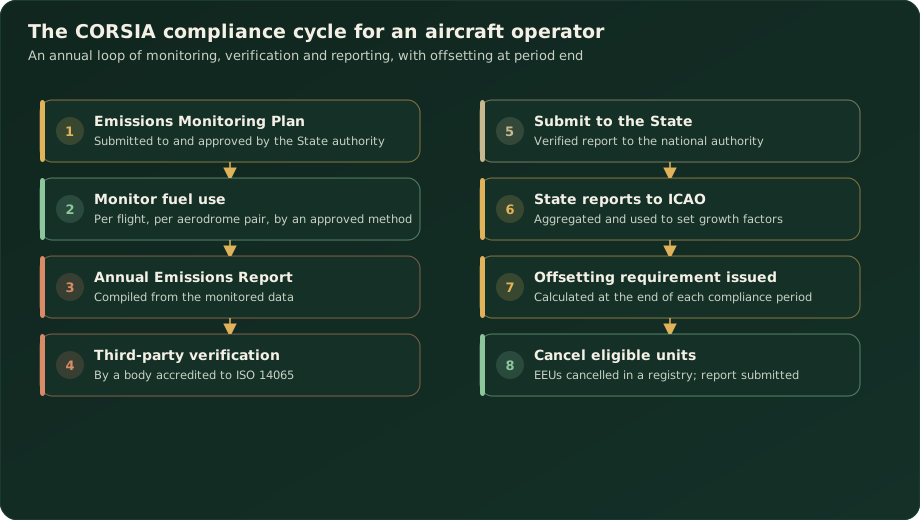
For an operator, each year follows the same shape:
- Monitor. An approved Emissions Monitoring Plan, submitted to and approved by the national authority, sets out how fuel use is tracked. ICAO permits several fuel use monitoring methods, and the choice matters — some demand data granularity that older fleet systems simply do not produce.
- Report. An annual Emissions Report covering the previous calendar year is submitted to the authority.
- Verify. An accredited independent verification body checks the report against the ICAO Annex 16 Volume IV requirements. Verification is not optional and not a formality.
- Calculate. Once ICAO publishes the growth factors, the operator's offsetting requirement for the compliance period is determined.
- Acquire and cancel. The operator obtains CORSIA Eligible Emissions Units and cancels them in a registry — cancellation, not merely purchase, is what discharges the obligation.
- Report cancellation. An Emissions Unit Cancellation Report goes to the authority, closing the loop.
Compliance periods run in three-year blocks, which gives operators some flexibility on timing but also some temptation to defer purchasing to the end — a strategy that has burned buyers when eligible supply proved thinner than expected.
What Counts as a CORSIA Credit
This is where most confusion sits. A carbon credit and a CORSIA credit are not the same thing.
A CORSIA Eligible Emissions Unit must satisfy all of the following:
- Issued by a crediting programme the ICAO Council has approved, following assessment by its Technical Advisory Body against the Emissions Unit Criteria.
- Generated by a project meeting an approved methodology, with additionality demonstrated and reductions conservatively quantified.
- Independently verified by an accredited third party.
- Within a vintage window eligible for the relevant compliance period.
- Covered by a corresponding adjustment from the host State — the government where the reduction occurred must add the tonnes back into its own national accounting so the same reduction is not counted twice.
- Free of net harm, meaning it does not breach host-State law or social and environmental safeguards.
- Uniquely serialised in a registry with a transparent cancellation record.
The corresponding adjustment is the binding constraint in practice. A project can be immaculately designed, fully verified, issuing credits and selling happily into the voluntary market, and still be unable to supply CORSIA because its host government will not authorise. Governments are frequently reluctant, because authorising means making their own Nationally Determined Contribution harder to hit.
The consequence is a two-tier market. CORSIA-eligible supply is much scarcer than general voluntary supply and trades at a substantial premium. Anyone benchmarking CORSIA prices against published voluntary market averages is reading the wrong number.
Approved Crediting Programmes
ICAO assesses programmes rather than individual projects. Approval can be full or conditional, is reviewed periodically, and has lapsed for programmes that failed to maintain the criteria — notably on corresponding adjustment handling.
Programmes that have held approval include the American Carbon Registry, Architecture for REDD+ Transactions, the Climate Action Reserve, the Global Carbon Council, Verra and Gold Standard. Because the position changes, the only reliable source is the ICAO emissions units page itself.
Note carefully: programme approval is necessary but not sufficient. An approved programme issues plenty of units that are not CORSIA eligible, because the unit-level criteria — vintage, corresponding adjustment, and the rest — still have to be met individually.
India and CORSIA
India participates, and Indian carriers operating international routes fall within scope. The Directorate General of Civil Aviation acts as national authority for monitoring plan approval, annual reporting and verification oversight.
For Indian project developers the position is more layered. India has been building its domestic Carbon Credit Trading Scheme under the Energy Conservation Act framework, and the relationship between that scheme, Article 6 authorisation under the Paris Agreement, and CORSIA eligibility is still being worked through. A developer intending to sell internationally should establish which pathway their credits will follow before committing to a methodology, because retrofitting a project onto a different standard later is expensive and sometimes impossible.
What Is Still Unsettled
An honest guide has to say this plainly. CORSIA is a scheme under construction.
- Participation is voluntary until the second phase and States have joined and left.
- Eligible supply volume is uncertain. Analyses have repeatedly projected a shortfall of corresponding-adjusted units against demand, and price risk follows directly from that.
- Vintage windows are set by Council decision and have been extended before.
- Programme approvals change.
- The relationship with Article 6 continues to evolve as Paris Agreement mechanisms mature.
- Second phase design details, including exemption thresholds and review outcomes, remain subject to negotiation.
None of this makes the obligation less real. It does mean that a compliance strategy built on the assumption that today's parameters hold unchanged through 2035 is a strategy with unpriced risk in it.
Practical Starting Points
If you are an operator: confirm your threshold status, get the monitoring plan right before worrying about credits, and model your requirement across the compliance period rather than year by year. Understand your exposure to route participation changes.
If you are a developer: test the corresponding adjustment question with your host State before you spend anything else. It is the gate, and everything downstream depends on it.
If you are either: document the reasoning behind every decision. Verification and audit happen years after the choice was made, and undocumented judgement is very hard to defend retrospectively.
Frequently Asked Questions
Is CORSIA mandatory? Monitoring and reporting are mandatory for operators above the threshold from the outset. Offsetting is mandatory on routes between participating States, and States' participation becomes mandatory in the second phase from 2027 for those meeting defined aviation activity thresholds.
Does CORSIA cover domestic flights? No. Only international flights fall within scope.
What happens if an operator does not comply? Enforcement is by the national authority under domestic law, not by ICAO directly. Penalties therefore vary by State but are real.
Can any carbon credit be used? No. Only CORSIA Eligible Emissions Units, which is a much narrower category than the voluntary market generally.
How does sustainable aviation fuel interact with CORSIA? Qualifying CORSIA Eligible Fuels reduce the offsetting requirement, subject to sustainability criteria and chain-of-custody documentation.
Where can I check the current rules? ICAO publishes the authoritative documents. Treat any secondary summary, including this one, as a starting point rather than a compliance reference.
Ready to act on CORSIA? DSTechnoverse provides specialist CORSIA carbon credit services for aircraft operators, project developers and traders — eligibility screening, offsetting requirement calculation, unit sourcing and due diligence, corresponding adjustment support and registry execution. We are based in Indore, Madhya Pradesh and work with clients across India and internationally.
Apply as a CORSIA buyer or seller
Talk to our carbon markets team about your specific position.