"How much does a carbon credit cost?" is the first question everyone asks and the one with the least useful general answer. Quoted prices span more than an order of magnitude, and the spread is not noise — it reflects genuinely different products.
Why There Is No Single Price
A carbon credit is not a commodity in the way wheat is. Two units both representing one tonne of CO2 equivalent can differ in:
- Whether the host State has given up the reduction in its own accounting
- Whether the tonne was avoided or physically removed
- How credible the additionality argument is
- Whether the storage can reverse
- When the reduction occurred
- Which standard issued it, and whether that standard is currently approved for your purpose
- What co-benefits accompany it
A buyer paying more is generally buying a different risk profile, not being overcharged. And a buyer paying much less is generally accepting risk they may not have priced.
The Seven Drivers
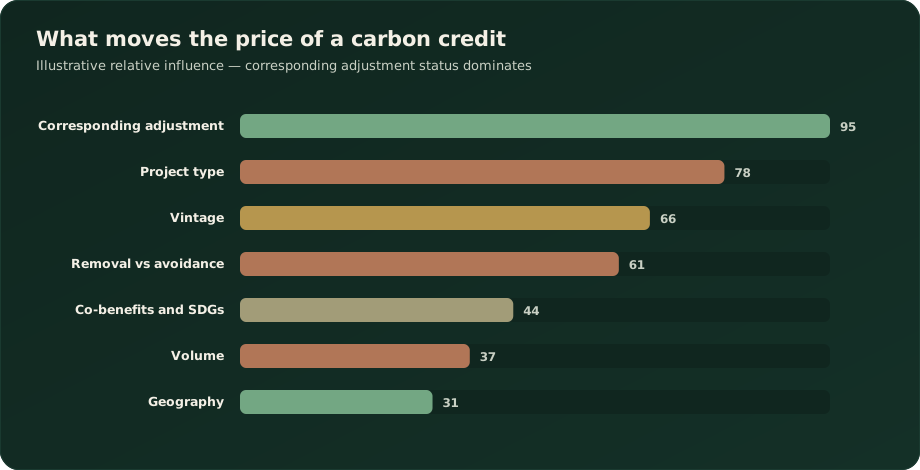
1. Corresponding adjustment status. The largest single determinant. Identical units from the same project, differing only in whether the host State has authorised transfer and applied an adjustment, trade at materially different prices.
The premium is not a physical quality difference — the tonnes are the same tonnes. It is the price of a sovereign concession plus scarcity. Governments authorising must add those tonnes back into their own national accounting, forgoing them against their own targets, and many decline.
2. Project type. In descending order of typical price:
| Type | Position | Why |
|---|---|---|
| Engineered removals | Highest | High production cost, strong permanence |
| Nature-based removals | High | Removal claim, permanence risk discounts it |
| Methane avoidance | Moderate | Clean additionality, no permanence issue |
| Cookstoves and household energy | Lower | Cheap to produce, methodological scrutiny |
| Grid renewables | Lowest | Contested additionality in competitive markets |
3. Removal versus avoidance. Increasingly the sharpest divide in the voluntary market. Buyers with net zero claims to defend pay more for removals, because avoidance credits are harder to reconcile with a residual-emissions framing.
4. Vintage. For compliance use, vintage determines eligibility outright. For voluntary use, recent vintages are generally preferred as a proxy for current methodological standards.
5. Standard and reputation. Some standards carry a premium. Some project categories carry a discount following public criticism, regardless of the individual project's merits.
6. Co-benefits. SDG-linked outcomes — health, employment, biodiversity, gender — support higher prices in the voluntary market. For compliance buyers who need discharge rather than narrative, they buy considerably less.
7. Volume and structure. Volume attracts a discount, though illiquidity limits how far — a seller with a small parcel of genuinely adjusted units has little pressure to discount. Forward contracts price below spot because the buyer absorbs delivery and authorisation risk.
Why Published Averages Mislead
Market reports publish average prices, and they are widely quoted in budgets. They should not be.
The average blends products that are not substitutes. It is heavily weighted by whatever category transacted in volume that period, which shifts. And it says nothing about the specific vintage, type, standard and authorisation status you would actually be buying.
A budget anchored on a published average will be wrong, usually low, and the error surfaces when procurement discovers that nothing at that price meets the quality bar.
Anchoring a Real Budget
Get actual quotes. For the vintage, project type, volume and authorisation status you would genuinely buy. Obtaining them is work, and it is precisely the work that makes the budget defensible when it is challenged.
Build a range, not a point. Low, central and high, each tied to a stated assumption. A single number in a board paper will be treated as a forecast and will be wrong.
Model volume before price. A requirement estimate 30% wrong swamps a price estimate 15% wrong. For CORSIA that means filtering to covered emissions properly rather than budgeting from total emissions.
Include transaction costs. Due diligence, legal, registry fees, treasury and foreign exchange. On a first purchase these are not trivial relative to the unit cost.
Run sensitivities. Price doubling, requirement above the central case, a programme losing approval, a vintage window shifting. Two of those four have close precedents.
Where Prices Are Heading
Honest answer: nobody knows, and anyone presenting a confident forecast is selling something. What can be said about direction:
Demand rises on a known schedule. CORSIA's second phase from 2027 expands route coverage; the individual growth factor from 2030 increases obligations for faster-growing operators. Corporate demand for adjusted units is growing independently.
Supply depends on unforecastable government decisions. How many host States authorise corresponding adjustments, for which project types, on what timeline.
The risk is asymmetric. If supply improves faster than expected, a buyer who contracted forward has slightly overpaid. If it falls short, a buyer who waited faces high prices, thin availability and — for compliance buyers — an unmet legal obligation.
Those outcomes are not equally bad. That asymmetry, rather than a price prediction, is the argument for acting early.
Reducing What You Pay
Buy progressively rather than at a deadline. Averaging into a market beats competing with everyone in one window.
Contract forward selectively, where you are confident in your volume.
Diversify across programmes, types, host States and vintages, so a single regulatory change does not hit everything.
Reduce the obligation itself. For aviation, fuel efficiency and qualifying SAF both lower the requirement. A tonne not owed is a tonne never bought, at any price.
Get the requirement calculation right. Over-purchasing does not bank credit for future periods.
Invest in due diligence. A cheap unit that proves ineligible is the most expensive unit you can buy.
What a Quote Should Contain
A price quoted without its attributes is not information. A usable quote states:
| Attribute | Why it matters |
|---|---|
| Project and registry ID | Lets you look it up independently |
| Standard and methodology version | Determines the rules the project operates under |
| Vintage | Determines eligibility for a compliance period |
| Volume available | Whether it covers your need |
| Corresponding adjustment status | The largest single price determinant |
| Removal or avoidance | Affects what you can defensibly claim |
| Delivery timing | Spot, or forward against future issuance |
| What documentation comes with it | Whether you can evidence the purchase later |
If a seller cannot supply all eight, that is itself informative — it usually means either they do not hold the units or they have not examined them.
Compare like with like. Two quotes that differ by a factor of three are frequently not competing offers at all; they are different products. Normalising them onto the attributes above turns an apparent bargain into an informed comparison, and it is common for the cheaper quote to be cheaper for a reason you would not accept.
Budgeting Across Several Years
A single-year price assumption extended forward will drift, because two of the inputs move on known schedules and one does not.
Volume moves on a schedule. For CORSIA, coverage expands in 2027 and the individual growth factor weights in from 2030. Model those as steps, not as a trend line.
Price does not move on a schedule. It depends on how many governments authorise corresponding adjustments and how quickly, which is unforecastable. Use a widening range in later years rather than a point extended forward — a forecast that gets more precise the further out it goes is describing confidence nobody has.
Transaction costs amortise. First-cycle diligence, legal and registry setup are largely one-off. Later years carry the recurring elements only.
Present the result as a range with the assumptions stated, and revisit it whenever growth factors are published or a participation list changes.
Frequently Asked Questions
How much does one carbon credit cost? There is no single answer. The range spans more than an order of magnitude depending on type, vintage, standard and authorisation status. Anyone quoting a figure without those is not describing something you can buy.
Why are CORSIA-eligible credits more expensive? The corresponding adjustment requirement makes them scarce. The premium reflects a sovereign concession plus scarcity.
Are removal credits worth the premium? For net zero claims, generally yes — they are more defensible. For a compliance obligation that accepts avoidance, the premium buys nothing extra.
Will prices rise? Demand rises on a known schedule; supply depends on government decisions nobody can forecast. The risk is skewed toward higher prices, which is a risk assessment rather than a prediction.
Is there a carbon credit index? Indices exist for parts of the voluntary market. None reliably tracks the corresponding-adjusted segment, and using a broad index for that purpose will mislead.
Should I wait for prices to fall? Waiting concentrates your purchase into the window when everyone else is buying. Progressive acquisition is usually the better risk position.
How do I budget without quotes? You cannot, defensibly. Getting quotes is the work that makes the number stand up.
Working out what to buy and what it should cost? DSTechnoverse provides CORSIA carbon credit services — requirement modelling, supply sourcing, pre-transaction due diligence and registry execution. We are based in Indore, Madhya Pradesh and work across India and internationally.
Apply as a CORSIA buyer or seller
Talk to our carbon markets team, or start with the complete carbon credits guide.