When a company says its climate goal is "science-based," it is making a specific, checkable claim — not a slogan. A science-based target commits the company to cut its emissions at the pace and depth that climate science says is needed to limit warming. The body that defines and validates these targets, the Science Based Targets initiative (SBTi), has become the reference for serious corporate climate goals — and understanding it clears up a lot of confusion about where carbon credits do, and do not, fit.
What "Science-Based" Actually Means
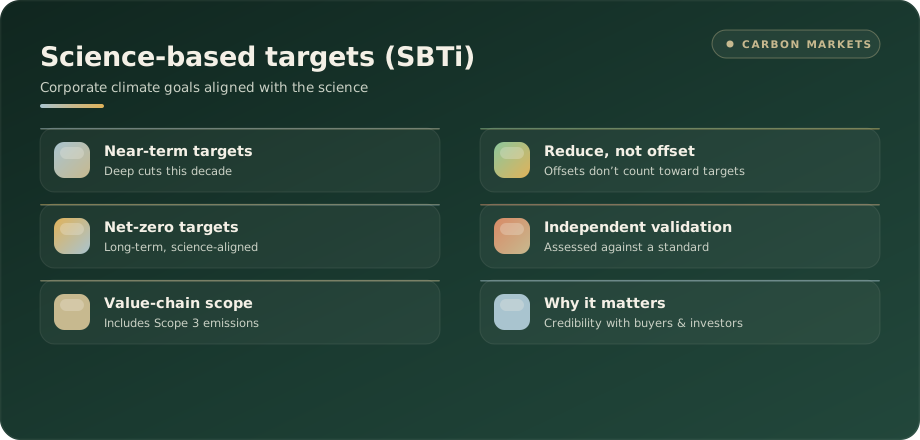
A target is science-based if it aligns a company's emissions cuts with what would be required to keep warming well below 2°C, ideally 1.5°C. Instead of a company inventing its own goal ("we'll cut 20% by 2030 because it sounds good"), the target is derived from a global carbon budget and the company's fair share of it. The SBTi provides the methods and then independently validates whether a submitted target meets the bar.
Near-Term and Net-Zero Targets
The framework works on two horizons:
| Target | Horizon | What it requires |
|---|---|---|
| Near-term | ~5–10 years | Deep, absolute cuts this decade |
| Net-zero | By ~2050 | Cut ~90%+, neutralise the residual |
A company sets near-term targets to force action now, and a long-term net-zero target for the destination. Critically, net zero under this framework is not a rebranding of "carbon neutral" — it demands real reductions first, a distinction covered in carbon neutral vs net zero.
The Part Everyone Gets Wrong: Offsets
Here is the point that trips up most companies. Carbon credits (offsets) do not count toward a science-based target. The target is about reducing the company's own emissions across its operations and value chain; buying credits to compensate does not reduce those emissions, so it does not move the target. Offsets have a role — neutralising the small residual on the path to net zero, or funding climate action beyond the value chain — but they are not a substitute for the cuts the target requires. This is exactly why the difference between insetting and offsetting matters for target-setters.
Why Scope 3 Is the Hard Part
Science-based targets include Scope 3 — the emissions of a company's value chain, which for most businesses dwarf their direct emissions. That is what makes them demanding: you cannot hit a real target by only greening your own office and electricity; you have to influence suppliers and products. It is also why measurement discipline matters so much — you cannot manage what you have not credibly counted.
Why It Matters Commercially
Beyond the climate case, a validated science-based target is increasingly a commercial credential. Large customers, tender processes and investors ask for it; a credible, validated target signals that a company's climate claims will survive scrutiny, while a vague self-declared goal invites the opposite. For any business whose clients care about ESG, it is becoming table stakes.
Frequently Asked Questions
What is a science-based target? A corporate emissions-reduction target aligned with what climate science says is needed to limit warming, defined and validated using the SBTi's methods.
What is the SBTi? The Science Based Targets initiative — the body that provides methods for setting science-based targets and independently validates companies' targets against them.
Do carbon offsets count toward a science-based target? No. The target is about reducing your own value-chain emissions; offsets compensate rather than reduce, so they do not count toward it.
What is the difference between a near-term and net-zero target? Near-term targets require deep cuts within about a decade; net-zero targets require cutting roughly 90%+ by around 2050 and neutralising the residual.
Why are Scope 3 emissions important for these targets? Because value-chain emissions usually make up most of a company's footprint, so a credible target must address them, not just direct emissions.
Working with carbon credits or a climate target? DSTechnoverse works on the data and integrity side of carbon — project screening, registry and eligibility verification, MRV and monitoring-data analysis, reconciliation and defensible reporting. See our CORSIA carbon credit services and data analytics. We are based in Indore, Madhya Pradesh and work across India and internationally.
Apply as a carbon credit buyer or seller
Talk to our team, or start with the complete carbon credits guide.