Most carbon credit guides explain what a credit is and stop. That leaves the reader knowing a definition and still unable to answer the questions that actually arise: is this particular unit usable for my purpose, what should it cost, what could go wrong, and what am I allowed to say about it afterwards.
This guide answers those. It is written for people who have to make a decision, not for people browsing.
Contents
- What a carbon credit is
- How a credit comes into existence
- Voluntary and compliance markets
- CORSIA explained
- What makes a unit CORSIA eligible
- Who buys CORSIA credits
- Judging credit quality
- Standards and certification
- What credits cost
- How to buy properly
- Reporting and claims
- Frequently asked questions
What a Carbon Credit Actually Is
A carbon credit is a tradable instrument representing one tonne of carbon dioxide equivalent either not emitted or removed from the atmosphere, relative to what would otherwise have happened.
Three parts of that sentence carry the weight.
One tonne of CO2 equivalent. Not carbon dioxide alone. Methane, nitrous oxide and industrial gases are converted to a CO2-equivalent figure using global warming potentials, which is why a methane project can generate large volumes from a modest physical intervention.
Not emitted, or removed. These are different things, and the distinction matters increasingly. An avoidance credit means a tonne that would have been emitted was not. A removal credit means a tonne already in the atmosphere was taken out and stored. Buyers with serious claims to defend increasingly distinguish between them, and they price differently.
Relative to what would otherwise have happened. This counterfactual — the baseline — is where nearly every dispute about credit integrity originates. It is unobservable by definition, which means it is modelled, and models can be optimistic.
The single most useful mental correction for someone new to this market: a carbon credit is not a physical thing. It is a claim about a counterfactual, evidenced by documentation. Its value depends entirely on how credible that evidence is.
How a Credit Comes Into Existence
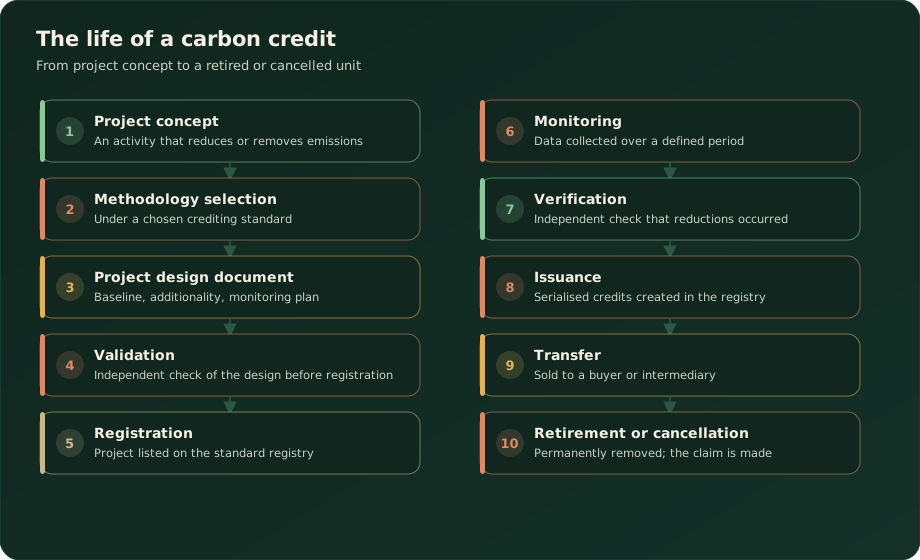
The sequence is broadly the same across every standard:
- Project concept. An activity that reduces or removes emissions.
- Methodology selection. Under a chosen crediting standard. If no methodology exists for your activity, no credits can be issued, however good the activity.
- Project design document. Baseline, additionality argument, monitoring plan, safeguards.
- Validation. An accredited body independently checks the design before registration.
- Registration. The project is listed on the standard's registry.
- Monitoring. Data collected over a defined period per the plan.
- Verification. An accredited body independently checks that the reductions actually occurred.
- Issuance. Serialised credits are created in the registry.
- Transfer. Sold to a buyer, directly or through an intermediary.
- Retirement or cancellation. Permanently removed from circulation. This is the step that makes the claim — holding a credit achieves nothing.
Timeline for a new project: eighteen months to three years from concept to first issuance, longer where host-State authorisation is involved.
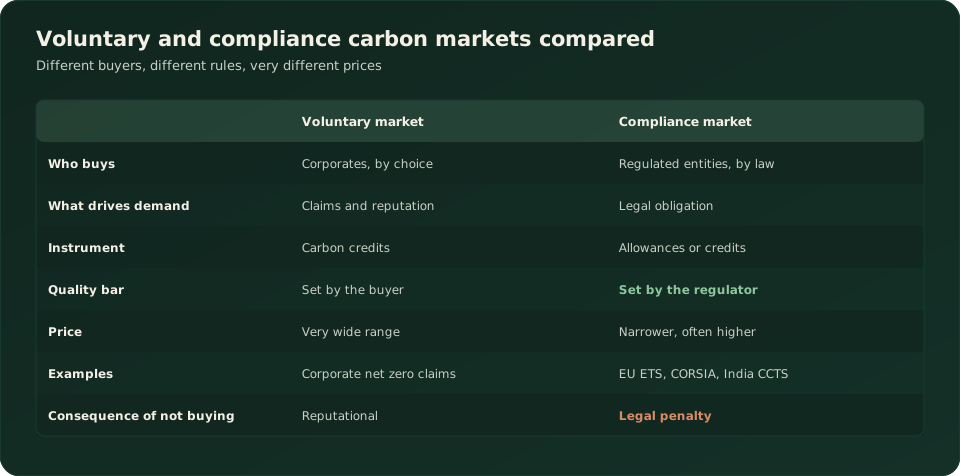
Voluntary and Compliance Markets
| Voluntary market | Compliance market | |
|---|---|---|
| Who buys | Corporates, by choice | Regulated entities, by law |
| What drives demand | Claims and reputation | Legal obligation |
| Instrument | Carbon credits | Allowances or credits |
| Quality bar | Set by the buyer | Set by the regulator |
| Price | Very wide range | Narrower, often higher |
| Examples | Corporate net zero claims | EU ETS, CORSIA, India's CCTS |
| Consequence of not buying | Reputational | Legal penalty |
The distinction that trips people up: a credit can be perfectly valid in the voluntary market and unusable in a compliance market. The reverse is rarely true. Compliance eligibility is a strict subset.
This matters commercially because it creates a two-tier market where the same project can produce units at materially different prices depending on whether they carry compliance eligibility.
See voluntary versus compliance carbon markets for the full treatment.
CORSIA: What It Is and Who It Binds
CORSIA — the Carbon Offsetting and Reduction Scheme for International Aviation — is the ICAO mechanism requiring aircraft operators to offset the growth in CO2 emissions from international flights above a 2019 baseline.
It is the first global market-based measure applied to a single industry sector.
Who is in scope:
| Test | Threshold |
|---|---|
| Flight type | International only; domestic entirely excluded |
| Aircraft | Above 5,700 kg maximum certificated take-off mass |
| Operator | Above 10,000 tonnes CO2/year from international flights |
| Flight category | Not humanitarian, medical, firefighting or State aircraft |
| Route | Offsetting applies where both States participate |
The phases:
| Period | Years | Participation | Basis |
|---|---|---|---|
| Baseline | 2019 | — | Reference emissions level |
| Pilot | 2021-2023 | Voluntary | Sectoral growth factor only |
| First | 2024-2026 | Voluntary | Sectoral growth factor only |
| Second | 2027-2035 | Mandatory for most States | Sectoral, then blended with individual growth |
Two dates matter more than the rest. From 2027, participation becomes mandatory for States above defined aviation activity thresholds, which expands route coverage substantially. From 2030, an operator's own growth enters the calculation at 15% weight, rising to 30% from 2033.
The baseline was originally the 2019-2020 average. The pandemic collapse in 2020 traffic would have produced an artificially low reference, so the ICAO Council reset it to 2019 alone — useful evidence that the scheme's parameters respond to circumstances rather than being fixed.
What Makes a Unit CORSIA Eligible
This is the part that most guides get wrong, usually by implying that any reputable credit qualifies.
Eligibility operates at two levels, and both must be satisfied:
Programme level. The ICAO Technical Advisory Body assesses crediting programmes against the Emissions Unit Criteria and the ICAO Council decides. Approval may be full, conditional, or may lapse.
Unit level. Even from an approved programme, the individual unit must independently satisfy the criteria.
The eight criteria:
| Criterion | Requires |
|---|---|
| Additional | Would not have occurred without credit revenue |
| Real and measurable | Quantified conservatively under an approved methodology |
| Permanent | Not reversible, or reversal risk buffered |
| Verified | Independently checked by an accredited body |
| No double counting | Host-State corresponding adjustment applied |
| Eligible vintage | Within the window set for the compliance period |
| No net harm | No breach of host law or social and environmental safeguards |
| Traceable | Uniquely serialised, clear registry record |
The fifth criterion eliminates more supply than the other seven combined.
Under Article 6 of the Paris Agreement, when a host State authorises a credit for international use, it must apply a corresponding adjustment — adding those tonnes back into its own national accounting, forgoing them against its own climate target.
Many governments decline, because it makes their own targets harder to meet. Many others have no designated authority and no process at all, which functionally means no.
The practical consequence: most of the world's carbon credits, including a great deal of genuinely high-quality supply, cannot be used for CORSIA. This is not a quality judgement on those projects. It is a sovereignty and accounting constraint operating above them — and it is why eligible supply is scarce and trades at a substantial premium.
Three phrases you will encounter that all mean not currently eligible: "CORSIA-ready", "CORSIA-aligned", and "eligible pending authorisation". None is a standard.
Who Buys CORSIA Credits
Aircraft operators with an offsetting obligation. This is the primary demand and it is a legal requirement rather than a choice.
Corporate voluntary buyers, increasingly — because a corresponding-adjusted unit is the strongest available answer to double-counting criticism of corporate claims. Some will pay a premium for the adjustment with no aviation obligation at all.
Intermediaries and traders, holding inventory against expected demand.
That second group is frequently omitted from supply forecasts and it matters: operators are competing with corporate demand for the same scarce adjusted pool.
Judging Credit Quality
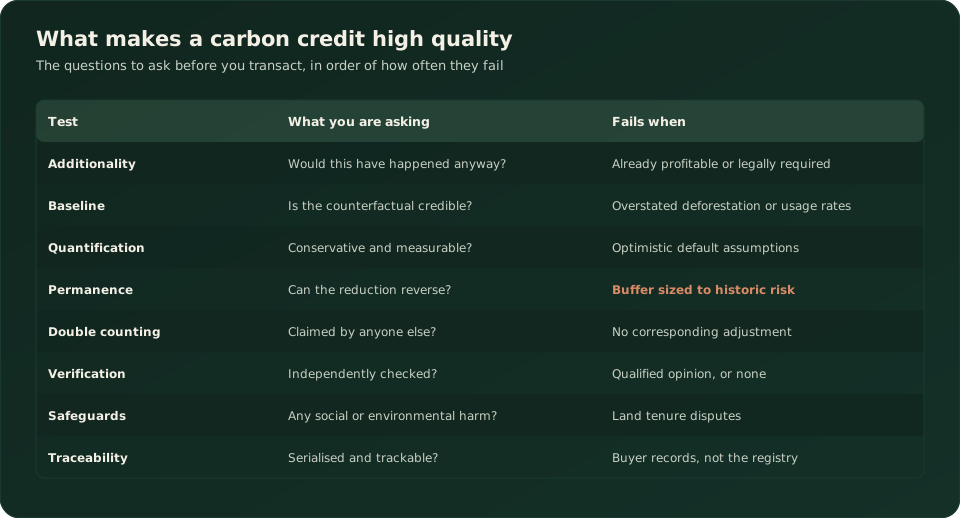
Quality is not a rating you can look up. It is a set of questions, and the answers live in documents.
| Test | What you are asking | Fails when |
|---|---|---|
| Additionality | Would this have happened anyway? | Already profitable or legally required |
| Baseline | Is the counterfactual credible? | Overstated deforestation or usage rates |
| Quantification | Conservative and measurable? | Optimistic default assumptions |
| Permanence | Can the reduction reverse? | Buffer sized to historic rather than current risk |
| Double counting | Claimed by anyone else? | No corresponding adjustment |
| Verification | Independently checked? | Qualified opinion, or none |
| Safeguards | Any social or environmental harm? | Land tenure disputes |
| Traceability | Serialised and trackable? | Evidence held only by the seller |
Ratings agencies exist and are useful for triage. They are not a substitute for reading the documents, and — importantly — a highly rated project without a corresponding adjustment is still ineligible for CORSIA. Rating measures quality; eligibility is a separate question.
See carbon credit quality assessment for the full method.
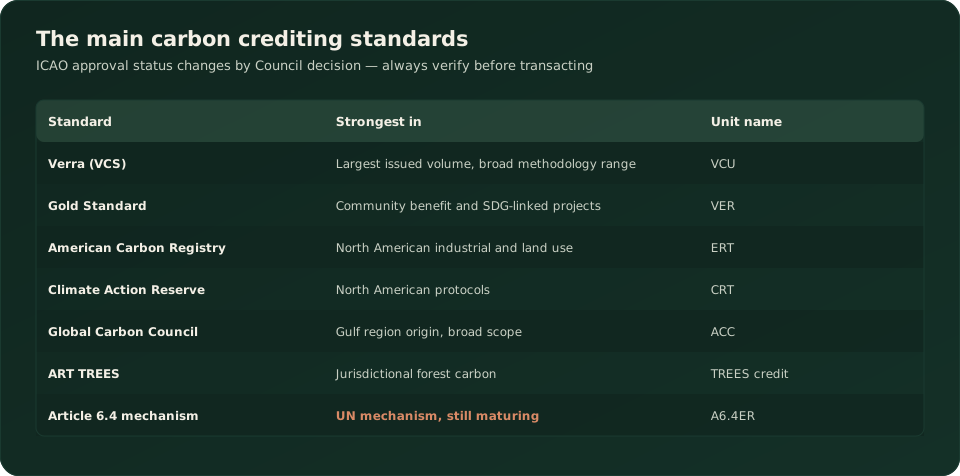
Standards and Certification
| Standard | Strongest in | Unit |
|---|---|---|
| Verra (VCS) | Largest issued volume, broad methodologies | VCU |
| Gold Standard | Community benefit, SDG-linked projects | VER |
| American Carbon Registry | North American industrial and land use | ERT |
| Climate Action Reserve | North American protocols | CRT |
| Global Carbon Council | Gulf region origin, broad scope | ACC |
| ART TREES | Jurisdictional forest carbon | TREES credit |
| Article 6.4 mechanism | UN mechanism, still maturing | A6.4ER |
Programme approval for CORSIA changes by ICAO Council decision. Any list published in an article — including this one — is a snapshot. Verify against the ICAO emissions units page at the point of transaction, and capture what it says on the day, because a URL is not evidence of what a page said when you relied on it.
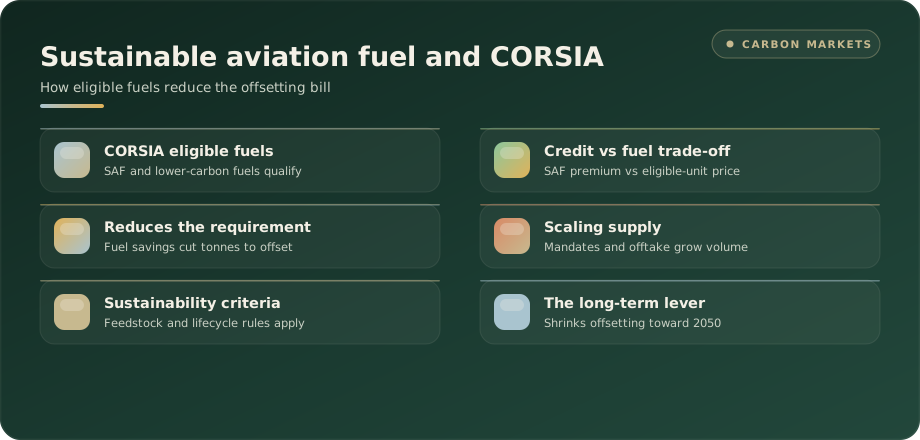
A frequent point of confusion worth settling: ISCC certifies fuel, not credits. ISCC CORSIA certifies CORSIA Eligible Fuels — sustainable aviation fuel that reduces an operator's offsetting requirement. It is not a carbon credit standard. See ISCC CORSIA certification and ISCC CORSIA vs ISCC PLUS.
What Credits Cost, and Why
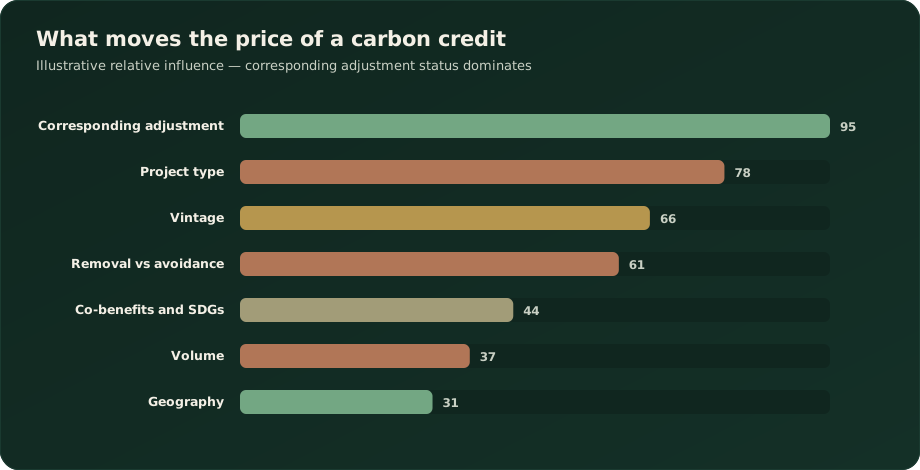
Published "average carbon credit prices" are close to meaningless, because they blend fundamentally incompatible products across a range spanning more than an order of magnitude. An old renewable energy credit with contested additionality and a verified engineered removal are both "carbon credits" and are not the same product.
What actually moves price, in descending order of influence:
Corresponding adjustment status. The largest single determinant. Identical units from the same project, differing only in whether they carry an adjustment, trade at materially different prices. The premium is the price of a sovereign concession plus scarcity — not a physical quality difference.
Project type. Engineered removals highest, then nature-based removals, then methane avoidance, then cookstoves, with grid renewables lowest.
Vintage. Units near an eligibility window boundary discount; units comfortably inside a high-demand window carry a premium.
Removal versus avoidance. Buyers with claims to defend increasingly pay more for removals.
Co-benefits. Matter in the voluntary market, matter much less for compliance buyers who need discharge rather than narrative.
Volume and structure. Volume attracts a discount, though illiquidity limits how far. Forward contracts price below spot because the buyer absorbs delivery and authorisation risk.
Anchor a budget in actual quotes for the vintage, type and volume you would buy — not in a published index. Getting those quotes is itself work, and it is what makes the budget defensible.
How to Buy Properly
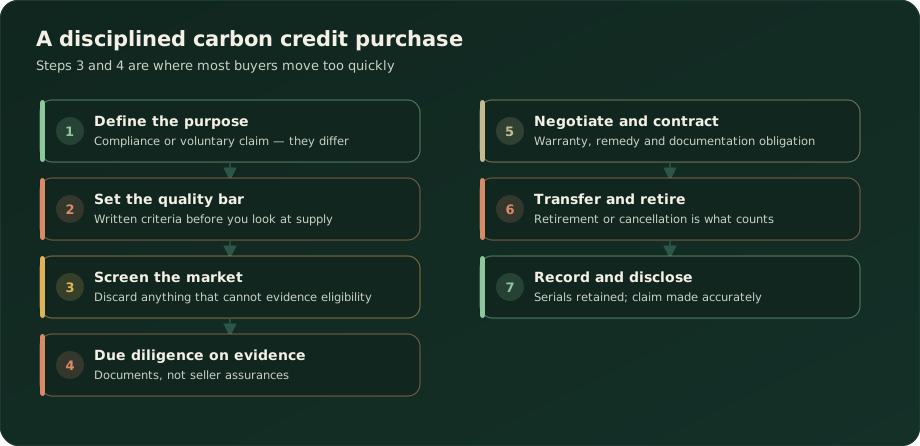
1. Define the purpose. Compliance or voluntary claim. They have different eligibility requirements and different price points, and buying for the wrong one is expensive.
2. Set the quality bar in writing, before looking at supply. Otherwise the available supply sets your standard.
3. Screen the market. Discard anything that cannot evidence eligibility. Screening on the phrase "CORSIA-ready" alone removes a large share of what gets offered.
4. Due diligence on evidence, not assurances. For CORSIA: current programme approval status, vintage against your compliance period, a host-State authorisation document naming the specific units, evidence of the corresponding adjustment, the verification report and its qualifications, and a clean registry chain of custody.
5. Negotiate and contract. The terms that matter more than price: eligibility warranty and remedy, authorisation risk allocation, vintage protection, delivery timing against your deadline, volume tolerance, and documentation as a contractual obligation. Silence allocates every one of these to you.
6. Transfer and retire. Retirement or cancellation is what makes the claim. Holding achieves nothing. For CORSIA the cancellation must be designated for CORSIA, and it is irreversible.
7. Record and disclose. Serials retained, evidence captured, claim made accurately.
See how to buy carbon credits for the full process.
Reporting, ESG and What You May Claim
This is where organisations most often create a problem for themselves.
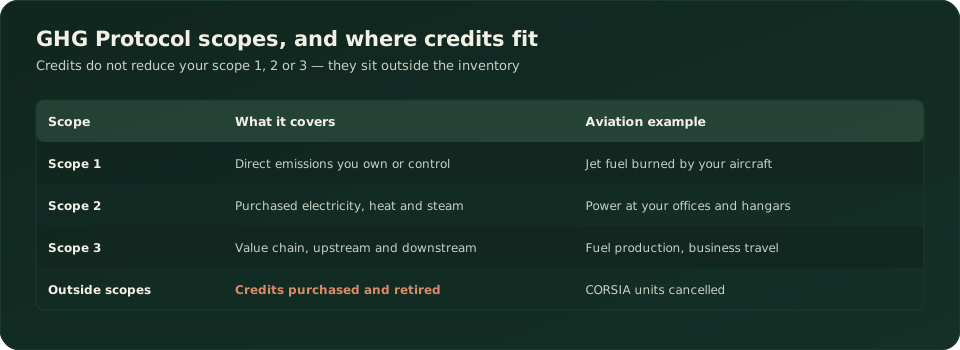
Credits sit outside your emissions inventory. Under the GHG Protocol, scope 1, 2 and 3 emissions are reported as they are. Credits purchased and retired are disclosed separately and are never netted against the scopes. An organisation reporting "net" scope 1 after offsets is misreporting.
| Framework | Treatment of credits |
|---|---|
| GHG Protocol | Outside the scopes; never netted against them |
| SBTi | Cannot substitute for required reductions |
| ISSB / IFRS S2 | Disclosure of use, type and quality expected |
| CDP | Separate disclosure of credits purchased and retired |
| India BRSR | Disclosed under environmental attributes |
| CORSIA | A compliance obligation, not a voluntary claim |
A critical distinction: units cancelled for CORSIA compliance discharge a legal obligation. Claiming them again as a voluntary carbon neutrality achievement is a double claim of a different kind, and disclosure regulators are increasingly alert to it.
Claim language has also tightened considerably. "Carbon neutral" claims based on avoidance credits have attracted regulatory attention in several jurisdictions. Describing what you actually did — "we retired X credits of type Y" — is more defensible than a summary label.
See ESG reporting and carbon credits and GHG accounting scopes explained.
The Criticisms, Stated Honestly
Any guide that presents carbon markets without their controversies is selling something. These objections are substantive, they shape where the market is heading, and a buyer who does not understand them will be caught out.
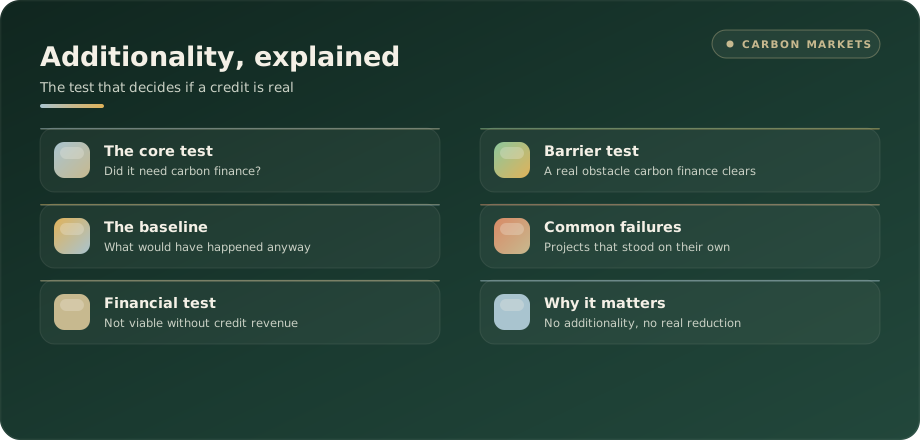
Additionality is genuinely hard to prove. It requires demonstrating a counterfactual that by definition did not happen. Investigative reporting and academic work have repeatedly found projects where the reduction would likely have occurred anyway — particularly grid-connected renewables in markets where they became the cheapest option. Several standards have narrowed or retired methodologies as a result.
Baselines have been overstated. Avoided-deforestation projects in particular have faced sustained criticism for projecting rates of loss higher than materialised, producing more credits than the intervention justified. Jurisdictional baselines are the structural response.
Permanence is not guaranteed. Carbon stored in trees can be released by fire, drought, disease or a change of ownership. Buffer pools exist to cover reversals, and their adequacy is under active scrutiny as climate-driven losses accumulate faster than the historic risk they were sized against.
Cookstove crediting has been challenged over usage rates and non-renewable biomass fractions, with independent studies finding real-world reductions below crediting estimates for some methodologies.
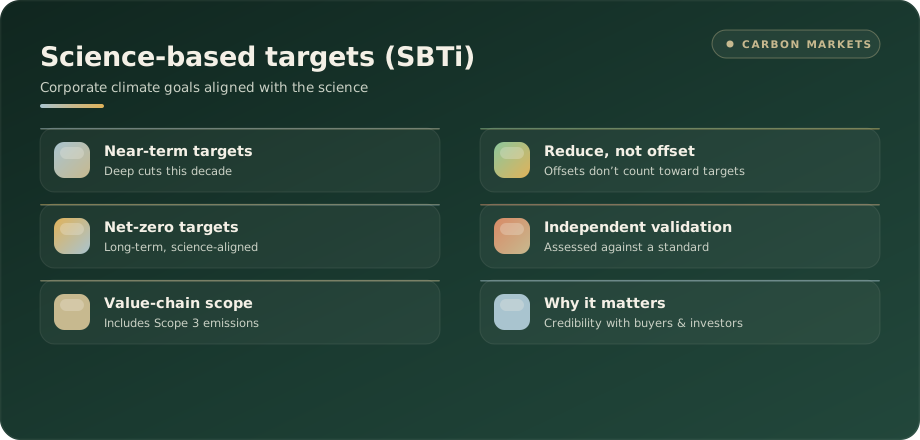
Offsetting can delay real reductions. The "mitigation deterrence" argument: if compensating is cheaper than changing, some organisations will compensate indefinitely. This is precisely why SBTi and most credible frameworks refuse to let credits substitute for required reductions.
Non-CO2 effects are excluded from CORSIA. Aviation's climate impact includes contrails and nitrogen oxides, which several assessments consider to roughly double the warming from CO2 alone. The scheme addresses CO2 only.
None of this makes credits worthless, and none of it removes a legal obligation. What it does mean is that quality varies enormously and due diligence is not optional — which is the practical conclusion this guide keeps returning to.
Mistakes Buyers Actually Make
| Mistake | Consequence |
|---|---|
| Buying before defining the purpose | Compliance-ineligible units bought for a compliance need |
| Letting available supply set the quality bar | You accept whatever is on offer |
| Treating a seller's assurance as evidence | No authorisation document, no eligibility |
| Benchmarking against published averages | Budget wrong by a wide margin |
| Ignoring vintage | Units age out before you retire them |
| Concentrating in one programme or host State | A single regulatory change hits everything |
| Assuming a rating means eligibility | Highly rated and unadjusted is still ineligible |
| Leaving registry accounts until purchase | Own onboarding blocks delivery for weeks |
| Retiring under the wrong purpose | Irreversible; units consumed regardless |
| Netting credits against reported emissions | Misreporting under every major framework |
| Claiming compliance units as a voluntary achievement | Double claim; increasingly scrutinised |
The pattern behind most of them: a decision made on an assumption that was never tested against a document.
Quick Reference
| Term | Meaning |
|---|---|
| CORSIA | Carbon Offsetting and Reduction Scheme for International Aviation |
| EEU | CORSIA Eligible Emissions Unit |
| Corresponding adjustment | Host State adds transferred tonnes back to its own inventory |
| ITMO | Internationally Transferred Mitigation Outcome, under Article 6.2 |
| Vintage | The period in which the reduction physically occurred |
| Retirement | Permanent removal from circulation, voluntary market |
| Cancellation | The equivalent for compliance use, with a stated purpose |
| Additionality | The reduction would not have happened without credit revenue |
| Leakage | Emissions displaced elsewhere rather than reduced |
| Buffer pool | Reserve credits held against reversal risk |
| VVB | Validation and Verification Body |
| DNA | Designated National Authority, which grants authorisation |
| SAF | Sustainable Aviation Fuel |
| CEF | CORSIA Eligible Fuel |
The Indian Context
India participates in CORSIA, with the DGCA as national authority for monitoring plans, reporting, verification oversight and cancellation reports.
For Indian carriers, the obligation steepens: route coverage expands in 2027, and the individual growth factor from 2030 penalises fast growth — which describes much of the Indian market.
For Indian project developers, the binding question is whether India will authorise corresponding adjustments. India is developing its domestic Carbon Credit Trading Scheme under the Energy Conservation Act framework, and the interaction between that scheme, Article 6 authorisation and CORSIA eligibility is still resolving. A developer intending to sell internationally should establish the pathway before committing to a methodology, because retrofitting later is expensive and sometimes impossible.
See CORSIA in India.
Frequently Asked Questions
What is a carbon credit? A tradable instrument representing one tonne of CO2 equivalent avoided or removed, relative to a baseline of what would otherwise have happened.
What does CORSIA stand for? Carbon Offsetting and Reduction Scheme for International Aviation.
Is CORSIA mandatory? Monitoring and reporting are mandatory for in-scope operators from the outset. Offsetting applies on routes between participating States. State participation becomes mandatory from 2027 for those above defined activity thresholds, with exemptions for least developed countries, small island developing States and landlocked developing countries unless they volunteer.
Can I use any carbon credit for CORSIA? No. The unit must come from an ICAO-approved programme, fall in an eligible vintage window, and carry a host-State corresponding adjustment. Most credits do not.
Why are CORSIA-eligible credits more expensive? Because the corresponding adjustment requirement makes them scarce. The premium reflects a sovereign concession and scarcity, not a physical difference in the tonnes.
What is the difference between a carbon tax and a carbon credit? A carbon tax sets a price and is paid to a government. A credit is a tradable instrument bought from a project developer. They are different instruments with different certainty properties — see carbon tax vs carbon credits.
Does buying credits reduce my reported emissions? No. Credits are disclosed outside your scope 1, 2 and 3 inventory and are never netted against it.
What is the difference between avoidance and removal credits? Avoidance means a tonne was not emitted. Removal means a tonne already in the atmosphere was taken out and stored. Removals generally command higher prices and are more defensible for net zero claims.
What is a corresponding adjustment? The accounting entry by which a host State adds authorised transferred tonnes back into its own national inventory, so the same reduction is not counted twice. It is the binding constraint on CORSIA supply.
Is ISCC a carbon credit standard? No. ISCC CORSIA certifies sustainable aviation fuel, not carbon credits. See ISCC CORSIA vs ISCC PLUS.
How long does it take to develop a carbon project? Eighteen months to three years from concept to first issuance, longer where host-State authorisation is required.
Who verifies carbon credits? Accredited independent validation and verification bodies, operating under the rules of the crediting standard. A body that validated a project design generally cannot verify its performance.
Can carbon credits expire? Credits do not expire in themselves, but CORSIA eligibility depends on vintage windows set by ICAO Council decision, and those have been adjusted before. A unit can therefore cease to be usable for a given compliance period.
What happens if a credit I bought turns out to be ineligible? That depends on your contract — which is why the eligibility warranty and its remedy matter more than the price. After cancellation the unit is consumed regardless.
Where do I check whether a programme is currently approved? The ICAO CORSIA emissions units page. Nowhere else is authoritative, and any list in an article is a snapshot.
Where to Go Next
If you are an aircraft operator: CORSIA compliance for Indian airlines · buying CORSIA units · second-phase readiness
If you are a project developer: CORSIA eligible projects in India · corresponding adjustments · becoming a CORSIA supplier
If you are buying voluntarily: credit quality assessment · carbon credit standards · how to buy carbon credits · what credits cost
Understanding project types: cookstove projects · REDD+ and afforestation · renewable energy projects
Measuring and reporting: digital MRV · GHG accounting scopes · ESG reporting and credits
Instruments and markets: voluntary vs compliance markets · carbon tax vs credits · ISCC CORSIA · ISCC CORSIA vs PLUS
Reference: CORSIA knowledge base · CORSIA glossary
Buying carbon credits, or building a project that supplies them? DSTechnoverse provides CORSIA carbon credit services — eligibility screening, pre-transaction due diligence, host-State authorisation support, registry execution and buyer matching. We are based in Indore, Madhya Pradesh and work with operators and developers across India and internationally.
Apply as a CORSIA buyer or seller
Talk to our carbon markets team about your position.