Every serious plan to decarbonise flying runs through one bottleneck: fuel. You cannot electrify a long-haul jet with today's batteries, so the near-term lever that actually cuts aviation's own emissions is sustainable aviation fuel (SAF). What many people miss is that under CORSIA, SAF does more than reduce emissions in the abstract — it directly lowers the number of carbon credits an airline has to buy.
How SAF Fits Into CORSIA
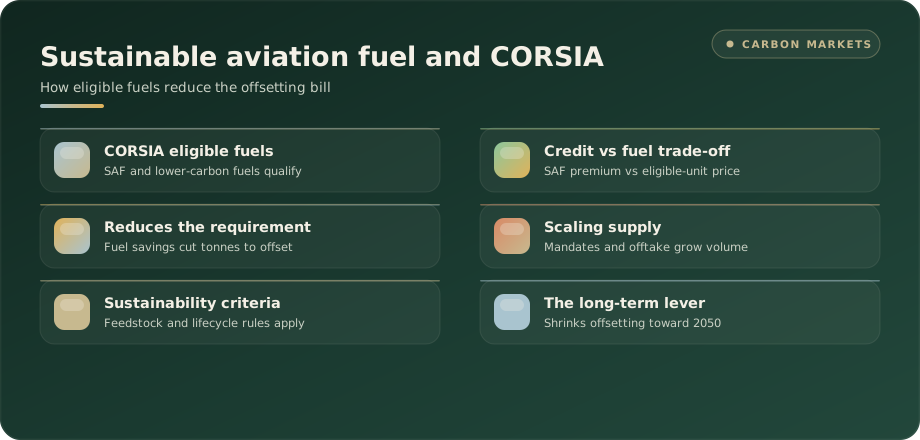
CORSIA gives airlines two ways to meet their obligation: buy and cancel eligible credits, or use CORSIA Eligible Fuels (CEF) — principally SAF, along with certain lower-carbon aviation fuels. When an operator uses eligible fuel, the associated emissions reduction is subtracted from its offsetting requirement. In other words, every tonne of CO2 that SAF avoids is a tonne the airline does not have to offset with a credit. For the mechanics of the obligation itself, see how airlines use carbon credits under CORSIA.
What Makes a Fuel "Eligible"
Not any biofuel counts. To qualify as a CORSIA Eligible Fuel, a fuel must meet sustainability criteria covering, among other things, lifecycle greenhouse-gas savings and safeguards on feedstock — so that a fuel is not "clean" at the wing while causing deforestation or food-supply pressure upstream. The reduction credited is based on the fuel's lifecycle emissions versus conventional jet fuel, not simply on the fact that it is bio-derived.
The Trade-Off Airlines Actually Face
SAF is not free. Today it costs a multiple of conventional jet fuel, so using it trades a higher fuel bill for a lower offsetting bill. Whether that trade makes sense depends on a live comparison:
| Lever | Cost today | What it buys |
|---|---|---|
| Buy eligible credits | Lower per tonne | Compensates emissions elsewhere |
| Use SAF | Higher per tonne | Cuts the airline's own emissions |
The economics shift in SAF's favour as eligible-credit prices rise, as fuel mandates and incentives spread, and as SAF supply scales and its premium narrows. Many carriers therefore run a blend — SAF where it is available and affordable, credits for the remainder — a picture explored in carbon pricing and its impact on airlines.
Why SAF Is the Long Game
CORSIA offsetting is a bridge; SAF is part of the destination. As covered in the future of CORSIA, the scheme is meant to shrink over time as in-sector levers grow — and SAF is the biggest of those levers to 2050. Every unit of SAF used today both reduces this year's offsetting and moves the sector toward a future where credits cover a smaller and smaller residual.
Frequently Asked Questions
What is a CORSIA Eligible Fuel? A fuel — principally sustainable aviation fuel — that meets CORSIA's sustainability criteria and can be used to reduce an airline's offsetting requirement.
Does SAF reduce the number of carbon credits an airline buys? Yes. The emissions reduction from eligible fuel is subtracted from the offsetting requirement, so SAF directly lowers credit demand.
Why is SAF more expensive than jet fuel? Limited production capacity and costlier feedstocks and processing make SAF a multiple of conventional jet-fuel prices today, though the premium is expected to narrow as supply scales.
Is all sustainable aviation fuel CORSIA eligible? No — only fuels meeting the scheme's sustainability and lifecycle criteria qualify, and the credited reduction depends on the fuel's lifecycle emissions.
Will SAF replace carbon offsetting in aviation? Over time it should reduce the offsetting share substantially, but offsetting is expected to cover a shrinking residual for years to come.
Navigating carbon credits and climate claims? DSTechnoverse works on the data and integrity side of carbon — project screening, registry and eligibility verification, MRV and monitoring-data analysis, reconciliation and defensible reporting. See our CORSIA carbon credit services and data analytics. We are based in Indore, Madhya Pradesh and work across India and internationally.
Apply as a carbon credit buyer or seller
Talk to our team, or start with the complete carbon credits guide.