If you learn only one concept in the carbon market, make it additionality. It is the test that decides whether a credit represents a genuine climate benefit or a paper exercise, and almost every carbon-credit scandal is, at root, an additionality failure. The idea is simple; applying it honestly is where projects live or die.
The One-Sentence Definition
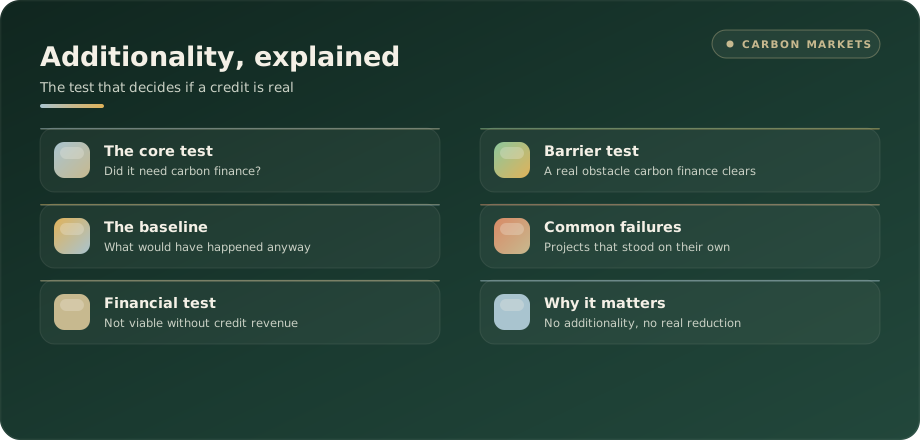
A carbon credit is additional if the emissions reduction it represents would not have happened without the carbon finance. If the reduction was going to occur anyway — because it was already profitable, legally required, or otherwise inevitable — then paying for a credit changes nothing in the atmosphere, and the credit is not real.
That counterfactual — "would it have happened anyway?" — is the whole test.
Why It Is So Central
Think about what you are buying. A credit is a claim that one tonne of CO2 was avoided or removed because you paid for it. If that tonne was never at risk of being emitted, your money bought a certificate, not a reduction. Additionality is therefore not a technicality; it is the difference between funding climate action and funding a spreadsheet. This is why it sits at the heart of every integrity framework, including the ICVCM Core Carbon Principles.
How Additionality Is Tested
Standards use a few complementary tests to judge it.
The baseline
Everything rests on the baseline — a credible picture of what would have happened without the project. Set the baseline honestly and additionality follows; inflate it and you manufacture phantom reductions. Baseline-gaming is the classic route to over-crediting.
The financial test
Would the project have been financially viable without carbon-credit revenue? If it was already the cheapest, most profitable option, it likely would have proceeded anyway — a red flag. Carbon revenue should be what tips a project from unviable to viable.
The barrier test
Is there a real barrier — technological, institutional, informational — that carbon finance helps overcome? A project clearing a genuine obstacle is more plausibly additional than one that faced none.
Examples: Pass and Fail
| Scenario | Additional? | Why |
|---|---|---|
| A cookstove programme reaching households that could not afford efficient stoves | Likely yes | Carbon finance enabled adoption that would not have happened |
| A grid solar farm that was already the cheapest new power | Likely no | It would have been built on its own economics |
| Protecting a forest under genuine, evidenced threat of clearance | Possibly yes | Depends on how real the threat and baseline are |
| A hydro plant that was fully financed and under construction before credits | No | The reduction was already happening |
The pattern is clear: additionality is strongest where carbon finance was decisive, and weakest where the project stood on its own — a tension explored in renewable-energy credit due diligence.
What This Means for Buyers
When you assess a credit, ask the project to make its additionality case explicitly: what was the counterfactual, why was carbon revenue decisive, and how conservative is the baseline? A project that cannot answer clearly is one to avoid — because without additionality, everything else about the credit is beside the point.
Frequently Asked Questions
What is additionality in carbon credits? The requirement that the emissions reduction only happened because of carbon finance — if it would have occurred anyway, the credit is not additional.
Why is additionality important? Because a credit is supposed to represent a reduction caused by your payment; without additionality, no extra reduction occurred and the credit is not real.
What is the financial additionality test? A check of whether the project would have been financially viable without carbon-credit revenue — if it was already profitable, additionality is doubtful.
What is a baseline? The estimate of what emissions would have been without the project; the credit is measured against it, so an inflated baseline creates phantom reductions.
Which carbon credits often fail additionality? Frequently grid renewables that were already the cheapest option, and avoided-deforestation projects with overstated clearance threats.
Working with carbon credits or a climate target? DSTechnoverse works on the data and integrity side of carbon — project screening, registry and eligibility verification, MRV and monitoring-data analysis, reconciliation and defensible reporting. See our CORSIA carbon credit services and data analytics. We are based in Indore, Madhya Pradesh and work across India and internationally.
Apply as a carbon credit buyer or seller
Talk to our team, or start with the complete carbon credits guide.