"High quality" is the most overused phrase in this market and the least defined. Every seller uses it. It means nothing until you can say which tests a credit passes and what evidence establishes that.
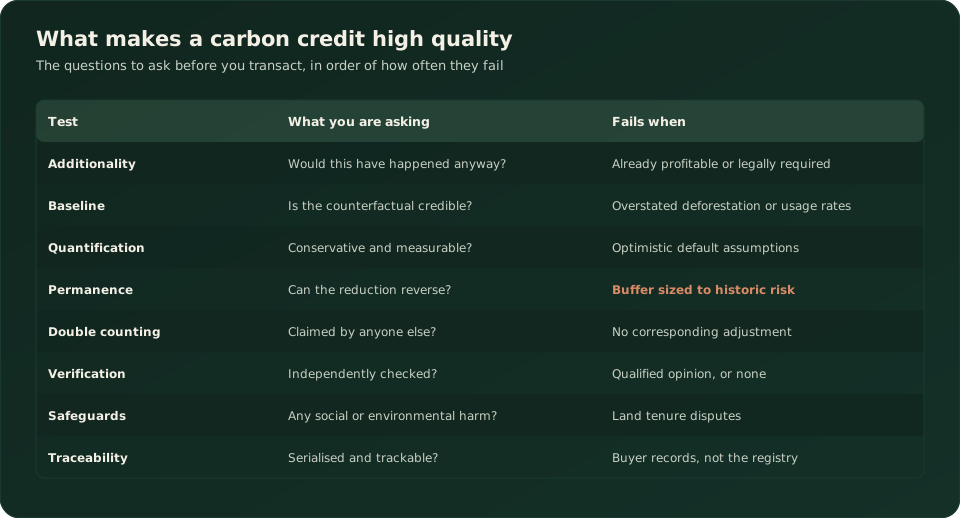
The Eight Tests
| Test | The question | Fails when |
|---|---|---|
| Additionality | Would this have happened anyway? | Already profitable or legally required |
| Baseline | Is the counterfactual credible? | Overstated deforestation or usage rates |
| Quantification | Conservative and measurable? | Optimistic default assumptions |
| Permanence | Can the reduction reverse? | Buffer sized to historic rather than current risk |
| Double counting | Claimed by anyone else? | No corresponding adjustment |
| Verification | Independently checked? | Qualified opinion, or none |
| Safeguards | Any social or environmental harm? | Land tenure disputes |
| Traceability | Serialised and trackable? | Evidence held only by the seller |
They are not equally likely to fail, and they are not equally easy to check. Work them in the order below.
1. Double Counting — Check This First
Not because it is the most important environmentally, but because it eliminates the most supply the fastest, and checking it first saves diligence effort on units that cannot work.
For any compliance use, and increasingly for serious voluntary claims, the question is whether the host State has authorised the transfer and applied a corresponding adjustment.
What counts as evidence: a formal authorisation document from the designated national authority, naming the specific units or a defined volume, plus evidence the adjustment appears in national reporting.
What does not: a seller's assurance, a project webpage claim, a broker's confirmation, or a statement that the country "supports Article 6".
If this fails, stop. Nothing else recovers it.
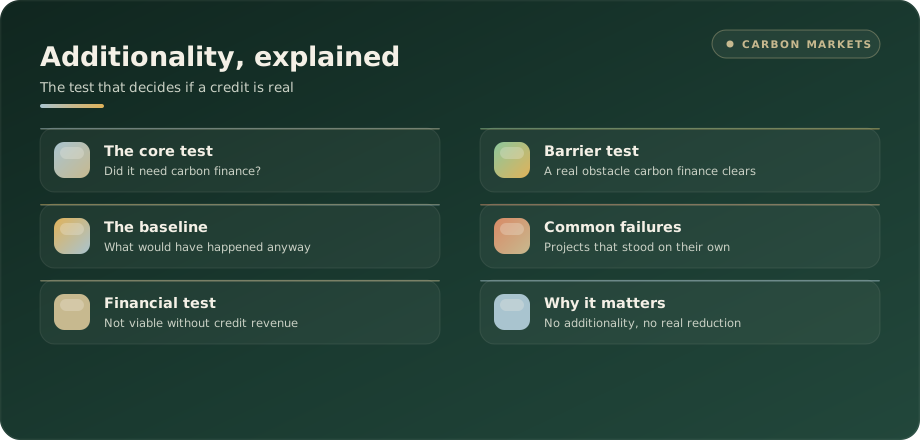
2. Additionality
The reduction must not have happened anyway.
Evidence to request: the baseline scenario, an investment or barrier analysis showing why carbon revenue was necessary, and a common practice test.
Where to be sceptical: grid-connected renewables in markets where they are the least-cost generation option. The argument that a solar farm needed carbon revenue was straightforward in 2012 and is very hard to sustain now. Several standards have narrowed or retired methodologies for exactly this reason.
A useful question: what was the internal rate of return with and without carbon revenue, and who signed off on that analysis?
3. Baseline
The counterfactual against which reductions are measured.
For avoided deforestation, the baseline projects what loss would have occurred. Independent analyses have found some baselines substantially overstated, producing more credits than the intervention justified. Jurisdictional approaches are the structural response.
For cookstoves, the baseline is prior fuel use and the non-renewable biomass fraction. Both have been contested.
For methane capture, the baseline is usually venting — generally the cleanest counterfactual in the market.
What to ask: how was the baseline set, when was it last revised, and does it use a jurisdictional or project-level reference?
4. Quantification
Whether uncertainty was resolved toward fewer credits or more.
Look at the assumptions, particularly default values. A methodology permitting a range, with the project consistently at the generous end, is a pattern worth questioning.
Look at the monitoring plan's realism. Does the project actually produce the data the methodology requires, at the required frequency, over the crediting period? Aspirational monitoring plans produce disputed data.
5. Permanence
Only relevant for storage-based reductions — avoided emissions do not reverse.
Ask about the buffer pool: what percentage is contributed, how was that sizing determined, and when was it last reassessed? A buffer sized against twenty-year-old fire risk may be inadequate against current climate-driven risk.
Ask about the commitment period and what legally secures the carbon stock.
Ask what happens on reversal — who bears it, and does the buffer actually cover the scale of loss now being observed in fire-prone regions?
6. Verification
Check the verification report itself, not a summary.
Is the body accredited under the standard's rules? Does the report cover the monitoring period the units come from? Does it carry qualifications, and if so what do they say? A qualified opinion is not automatically disqualifying and you need to understand what was qualified and why.
Check independence: the body that validated a project design generally cannot verify its performance.
7. Safeguards
Land tenure is the most common failure, particularly in forestry. Agreement from a government or a large landholder is not the same as free, prior and informed consent from the communities actually using the land.
Request: environmental and social impact assessment, stakeholder consultation records, consent documentation where indigenous or local communities are affected, and evidence of a functioning grievance mechanism.
Search for disputes. Projects with contested community relations are frequently documented publicly before they are documented in the registry.
8. Traceability
Get the registry record, not the seller's summary. Confirm unique serialisation, a complete chain of custody from issuance, no prior retirement, and that the seller actually holds the units.
Then capture the evidence into your own files. Evidence held only by an intermediary disappears when the relationship does.
What Ratings Agencies Do and Do Not Tell You
Independent ratings agencies assess project quality and are genuinely useful for triage — they narrow a large market quickly and surface issues you might not find alone.
Three limits worth understanding:
A rating is an opinion on quality, not a statement of eligibility. A highly rated project without a corresponding adjustment is still ineligible for CORSIA. These are different questions.
Methodologies differ between agencies, sometimes producing divergent ratings on the same project. That divergence is informative rather than embarrassing — it usually reflects genuine disagreement about a specific risk.
Ratings are point-in-time. Project circumstances change.
Use ratings to shortlist. Do not use them as a substitute for reading the documents on the units you actually buy.
Red Lines
Circumstances where the correct answer is to walk away rather than to negotiate:
- No host-State authorisation document, and no credible timeline for one, where compliance use is intended
- The issuing programme's approval has lapsed, or is conditional in a way that touches these units
- Vintage falls outside the window for your compliance period
- The seller will not permit registry verification of their holding
- Documentation offered only as summaries, with underlying evidence withheld
- Pressure to transact before diligence completes
That last one deserves emphasis. Genuine scarcity creates real urgency and honest sellers will say so. Urgency is also the standard tool for shortening diligence, and a unit bought under time pressure that later fails is worse than a unit not bought.
Proportionality
Not every purchase warrants the same depth.
Always, regardless of size: double counting, programme approval, vintage. These determine eligibility, are cheap to check, and failure makes the unit worthless for the purpose.
Scale with value: additionality, baseline, permanence, safeguards, counterparty. A large first purchase from an unfamiliar developer deserves real scrutiny; a small repeat tranche from a project already assessed does not need it repeated.
Never scale down: the evidence file. Small purchases produce audit questions exactly as large ones do, and filing properly at the time costs almost nothing.
Building a Written Quality Policy
Buyers who assess each purchase from scratch end up with an inconsistent portfolio and no defensible basis for the decisions. A short written policy fixes both, and it takes an afternoon.
What it should state:
The purpose. Compliance, voluntary claim, or both — because the eligibility requirements differ and a single policy that ignores the distinction will be wrong for one of them.
Minimum standards accepted, and whether ICAO approval is required.
Project types included and excluded. Many buyers exclude categories where the additionality argument is weak, or where the reputational exposure is not worth the price saving.
Vintage limits. How old is too old, and how close to a boundary is acceptable.
Whether corresponding adjustment is mandatory, or only for compliance volumes.
Removal versus avoidance mix, if you have a target.
The evidence required before purchase, listed explicitly so procurement can apply it without judgement calls.
Who may approve an exception, and how it is recorded.
That final point matters more than it looks. Exceptions will arise — a scarce supply situation, a compelling project that fails one test. A policy with no exception route gets ignored; one with a documented route gets followed.
Recording the Assessment
The transaction file is what defends the purchase when someone asks in three years, and it needs the reasoning as well as the outcome.
Record what was considered and rejected and why, the evidence obtained for each test with the documents captured rather than linked, the residual risks identified and accepted, who approved it against what authority, and the price basis with the quotes obtained.
Capturing rather than linking is the point most often skipped. Programme approval status, participation lists and vintage windows all change. A URL in a file is not evidence of what a page said on the day you relied on it — save the page.
Frequently Asked Questions
How do I know if a carbon credit is good quality? Work the eight tests, in the order above, against documents rather than assurances. Start with double counting because it eliminates the most supply.
Are ratings agencies reliable? Useful for triage, not a substitute for document review, and they assess quality rather than eligibility.
What is the most common quality failure? Absence of a corresponding adjustment, by a wide margin. Then additionality for renewables, and baselines for forestry.
Should I pay more for removals than avoidance? Removals are generally more defensible for net zero claims and price accordingly. Whether the premium is worth it depends on what you need to claim.
How long does proper due diligence take? One to three weeks per tranche for a first-time buyer; less once you have a process and are dealing with a known counterparty and programme.
Can I rely on a broker's due diligence? Review their work; do not substitute it for your own. Your regulator or auditor holds you accountable, not your broker.
What if diligence surfaces a problem after purchase? Your contract determines the remedy — which is why the eligibility warranty matters more than the price.
Assessing credits before you buy? DSTechnoverse runs pre-transaction due diligence on carbon credits — programme approval status, vintage, corresponding adjustment evidence, verification and registry chain of custody. See our CORSIA carbon credit services. We are based in Indore, Madhya Pradesh and work across India and internationally.
Apply as a CORSIA buyer or seller
Talk to our carbon markets team, or start with the complete carbon credits guide.