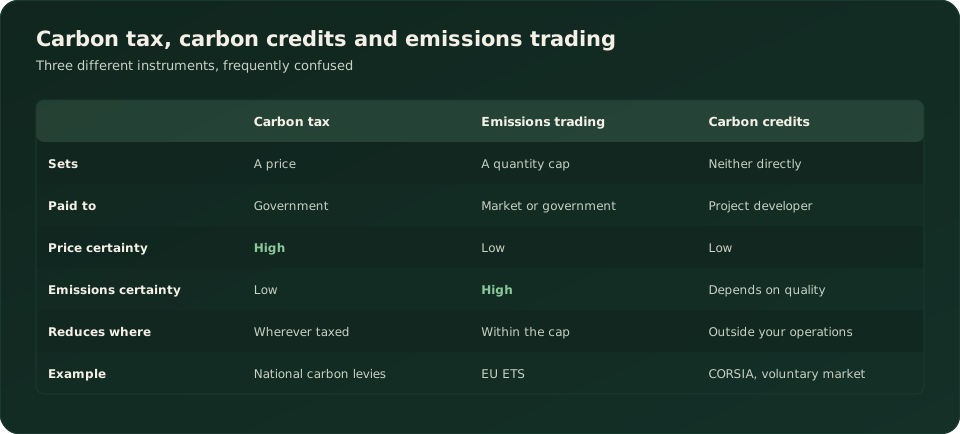
A carbon tax, an emissions trading system and a carbon credit are three different things. They are routinely used interchangeably, including by people selling services in this space, and the confusion produces real errors in planning.
The Three Instruments
| Carbon tax | Emissions trading | Carbon credits | |
|---|---|---|---|
| Sets | A price | A quantity cap | Neither directly |
| Paid to | Government | Market or government | Project developer |
| Price certainty | High | Low | Low |
| Emissions certainty | Low | High | Depends on quality |
| Reduces emissions | Wherever taxed | Within the cap | Outside your operations |
| Instrument held | None | Allowances | Credits |
| Example | National carbon levies | EU ETS, UK ETS | CORSIA, voluntary market |
Carbon Tax
A government sets a price per tonne and charges emitters. Straightforward, administratively simple, and it produces price certainty — you know exactly what a tonne costs.
What it does not produce is emissions certainty. If the price is set below what it costs a company to abate, the company pays and keeps emitting. The government collects revenue; the emissions continue. Whether the tax reduces emissions depends entirely on whether the rate exceeds abatement costs, and setting that rate correctly is genuinely hard.
You hold no instrument. There is nothing to trade, bank or retire — you simply pay.
Emissions Trading
A regulator sets a cap on total emissions and issues allowances up to it. Covered entities must surrender allowances matching their emissions. Allowances are traded, so the market discovers the price.
This inverts the tax's properties. It produces emissions certainty — the cap is the cap — and price uncertainty, because the allowance price moves with demand.
You hold allowances, which are permits to emit, not representations of reductions elsewhere. That distinction matters: an allowance says "you may emit this tonne"; a credit says "a tonne was reduced somewhere else".
Most cap-and-trade systems restrict or exclude offset credits, precisely to preserve the integrity of the cap.
Carbon Credits
A project somewhere reduces or removes emissions and is issued tradable units. A buyer purchases and retires them, claiming the reduction.
Neither price nor emissions certainty is inherent. The price is whatever the market bears; the emissions benefit depends entirely on whether the credit represents a real, additional, permanent, uncounted reduction — which is why quality assessment matters so much.
The money goes to the project developer, not to a government. That is the structural difference from both other instruments, and it is why credits mobilise private finance into mitigation projects in a way taxes and allowances do not.
Which Is Better?
They answer different questions, and the honest comparison is about trade-offs rather than a ranking.
A tax is simplest to administer and gives businesses a predictable planning input. It cannot guarantee an environmental outcome.
Trading guarantees the environmental outcome within its scope but exposes participants to price volatility, and the cap's stringency is politically contested at every review.
Credits direct finance to mitigation that would not otherwise be funded, including in countries with no domestic carbon price. They depend on quality assurance that has proved genuinely difficult, and they can enable delay if used as a substitute for reduction rather than a complement.
Most serious policy analysis concludes that these are complements. A tax or ETS covering domestic emissions, with credits addressing what cannot yet be abated and financing mitigation elsewhere, is the common design.
Where CORSIA Sits
CORSIA is an offsetting mechanism, not a tax and not a cap-and-trade system.
It does not cap aviation emissions — the sector may grow. It does not tax them — no payment goes to a government. It requires operators to buy and cancel credits equal to emissions growth above a 2019 baseline.
This produces a specific set of properties: no emissions certainty for aviation itself, no price certainty for operators, and a flow of finance to mitigation projects outside the sector. Whether that is an adequate policy response is a legitimate debate; that it is a legal obligation for operators in participating States is not.
See the complete carbon credits guide.
Border Adjustments and the Wider Picture
A fourth instrument increasingly enters these conversations and belongs in the comparison, because it changes the calculation for exporters.
Carbon border adjustment mechanisms charge importers based on the embedded emissions of goods entering a market, offset by any carbon price already paid in the country of origin. The EU's CBAM is the furthest developed, initially covering carbon-intensive goods such as iron and steel, cement, aluminium, fertilisers, electricity and hydrogen.
Two consequences worth understanding:
It is not a credit market. CBAM obligations are settled with certificates purchased from the importing jurisdiction, not with carbon credits from projects. Offsetting a CBAM liability with voluntary credits is not available.
It changes the value of a domestic carbon price. Where a domestic price has been paid, it can generally be deducted from the border charge. That inverts the usual framing — a domestic carbon price stops being a pure cost to exporters and becomes partly a way of retaining revenue that would otherwise flow to a foreign treasury.
For Indian exporters in covered sectors, the practical implication is that the domestic compliance position and the export position interact. That interaction sits outside CORSIA entirely, but organisations frequently encounter both, and confusing a CBAM certificate with a carbon credit is a costly category error.
Facing More Than One
Larger organisations increasingly face several instruments simultaneously — an ETS on domestic operations, CORSIA on international flights, and voluntary commitments on top.
Three rules that prevent expensive mistakes:
Do not conflate the instruments. Allowances and credits are different products, in different markets, with different risks. One is hedgeable on a liquid exchange; the other is not. Budgeting them as a single "carbon cost" line obscures that.
Map scope precisely. Which emissions fall under which instrument, route by route or site by site, with the reasoning documented. Assuming either duplication or exemption without checking is how organisations either over-buy or under-comply.
Keep claims separate. Allowances surrendered under an ETS and credits cancelled for CORSIA both discharge legal obligations. Neither is available for a voluntary carbon neutrality claim as well.
India's Position
India operates a baseline-and-credit compliance mechanism — the Carbon Credit Trading Scheme under the Energy Conservation Act framework — rather than a cap-and-trade system or a broad carbon tax. It sets emission intensity targets for notified entities, who trade certificates to meet them.
Alongside it, Indian carriers on international routes face CORSIA, administered domestically by the DGCA.
For an Indian project developer, the significant interaction is between the domestic scheme and international sale. A credit retained domestically supports the CCTS; a credit sold internationally requires host-State authorisation and a corresponding adjustment. Those are different pathways with different requirements, and choosing between them should happen before a methodology is selected rather than after.
Common Confusions Worth Settling
Five conflations that recur, each with a one-line correction.
"Carbon credit" used for an allowance. An allowance is a permit to emit issued under a cap. A credit represents a reduction achieved elsewhere. They are not interchangeable and most cap-and-trade systems do not accept credits.
"Carbon tax" used for any carbon cost. An ETS obligation is not a tax — the price is set by a market, not by government, and the quantity rather than the price is what policy fixes.
"Offset" used for a renewable energy certificate. A REC or Guarantee of Origin certifies the attributes of energy generated. It is not a tonne of reduction and cannot be retired against an emissions obligation.
"Carbon neutral" used to mean net zero. Carbon neutral typically describes balancing emissions with credits. Net zero, as most frameworks define it, requires deep reduction first with only residual emissions addressed by removals. The two make very different claims.
"Compliance credit" used loosely. A credit is compliance-eligible for a specific scheme, not in general. Eligibility for CORSIA says nothing about eligibility under any other regime.
Getting the vocabulary right is not pedantry here. Each of these confusions has led organisations to buy an instrument that does not do what they needed it to do.
Frequently Asked Questions
What is the difference between a carbon tax and a carbon credit? A tax is a price set by government and paid to it. A credit is a tradable instrument bought from a project developer representing a reduction elsewhere.
Which gives more certainty? A tax gives price certainty; trading gives emissions certainty. Credits give neither inherently.
Can carbon credits be used to pay a carbon tax? Generally no. Tax liabilities are settled in currency. Some jurisdictions permit limited offset use against specific levies — check the specific rule rather than assuming.
Does India have a carbon tax? India uses a baseline-and-credit compliance scheme rather than a broad economy-wide carbon tax, alongside various energy and fuel levies.
Is the EU ETS a carbon tax? No. It is a cap-and-trade system — the cap sets the quantity and the market sets the price.
Which is best for reducing emissions? They answer different questions. Most analysis treats them as complements rather than alternatives.
Do I need to worry about more than one? Increasingly yes for larger organisations. Map scope explicitly and budget the instruments separately.
Working out what to buy and what it should cost? DSTechnoverse provides CORSIA carbon credit services — requirement modelling, supply sourcing, pre-transaction due diligence and registry execution. We are based in Indore, Madhya Pradesh and work across India and internationally.
Apply as a CORSIA buyer or seller
Talk to our carbon markets team, or start with the complete carbon credits guide.