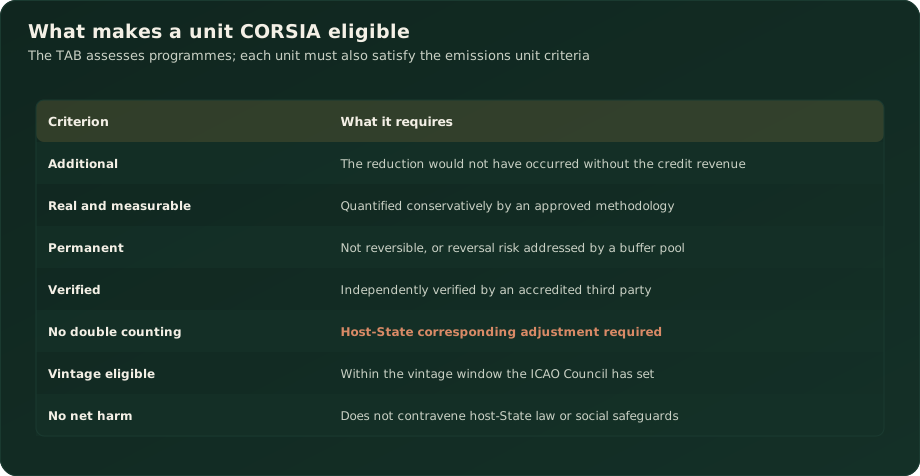
Everyone in this market now knows that a corresponding adjustment is what makes a credit CORSIA eligible. Far fewer know what to do when a seller offers units where the adjustment is pending, or how to write a contract that survives a host State changing its mind.
That is a commercial and legal problem rather than a conceptual one, and this article is about that.
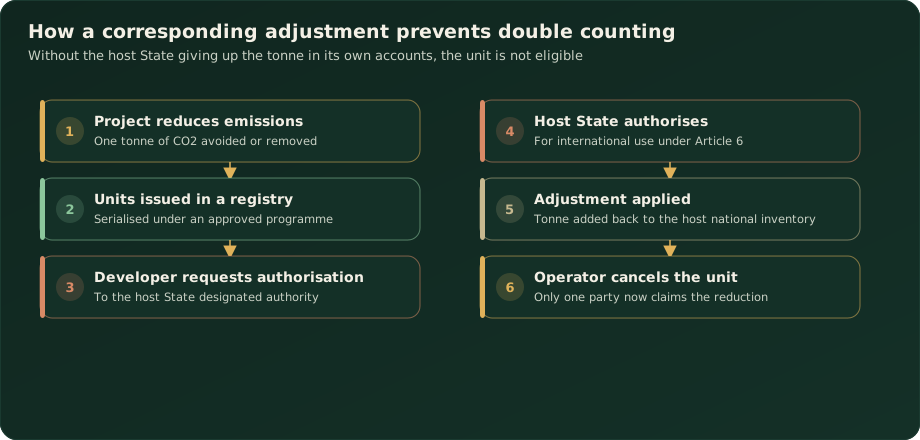
For the mechanics — what an adjustment is, how Article 6 works, why governments resist and what evidence looks like — see corresponding adjustments and Article 6 in the knowledge base. This piece assumes that and goes to the transaction.
The Three States, and What Each Is Worth
Commercially, everything turns on which of three positions a unit is in.
| State | What you actually hold | Commercial treatment |
|---|---|---|
| Authorised, adjustment applied | An eligible unit | Full price; the scarce product |
| Authorised, adjustment pending | A near-certain unit with residual timing risk | Modest discount; manageable |
| Authorisation pending | An option on a sovereign decision | Heavy discount, or walk away |
The third row is where most disputes originate, because sellers describe it in language that sounds like the first. "CORSIA-ready", "CORSIA-aligned" and "eligible pending authorisation" all describe the third state.
A buyer who pays close to full price for the third state has bought a sovereign risk without pricing it.
Pricing Authorisation Risk
If you are considering unauthorised supply — and there are legitimate reasons to, particularly in a forward — the risk has to be priced rather than assumed away.
Four inputs to that judgement:
Does the host State have a designated national authority and a published process? If not, this is not a timing question, it is a question of whether the pathway exists at all.
Has that State authorised anything, ever? Precedent is worth far more than stated intent. A government that has issued authorisations has proved the machinery works.
Does it authorise this project type? Several governments authorise selectively, retaining categories central to their own abatement pathway.
What conditions attach? Fees, revenue sharing and benefit-distribution requirements all affect whether the developer will actually complete the process once they see the cost.
Where all four are favourable, a modest discount may be reasonable. Where the first is unfavourable, the discount required is so large that the transaction usually stops making sense for the seller — which is itself informative.
Contract Terms That Actually Allocate the Risk
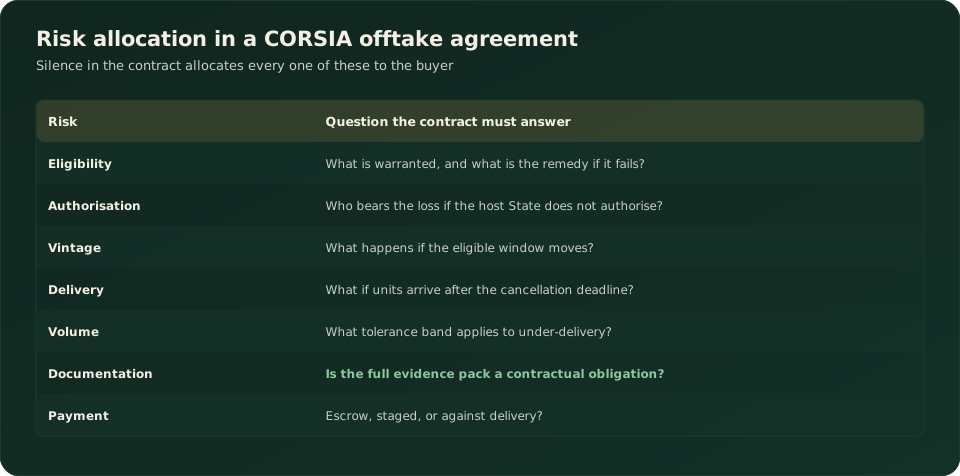
Silence allocates every one of these to the buyer. A forward against pending authorisation needs all five.
A long-stop date. The single most important term. If authorisation has not been granted by a named date, the buyer may terminate and recover payments. "As soon as reasonably practicable" is not a mechanism — it is an invitation to a dispute.
A defined remedy. Termination and refund, price adjustment, substitution with authorised units from elsewhere, or acceptance of non-eligible delivery at a reduced price. Pick one and write it down.
Who bears partial authorisation. Governments frequently authorise a volume smaller than requested. If you contracted for 50,000 tonnes and 30,000 are authorised, what happens to the balance?
Revocation. Authorisations have conditions and durations. What happens if one is withdrawn or lapses before you cancel?
Evidence as an obligation. Delivery of the authorisation document naming your units, not a statement that one exists. Make it a condition of payment rather than a courtesy.
Structuring a Forward Against Pending Authorisation
Where the underlying project is sound and only the sovereign step is outstanding, a structure that works for both sides:
- Small payment on signature, sized so the buyer's exposure is tolerable if nothing else happens.
- A milestone payment on authorisation, which is the event that creates the value.
- Balance on delivery into the buyer's registry account.
- A long-stop date after which the buyer may terminate and recover payments one and two.
- Security over payments made, where the counterparty is small — a parent guarantee, escrow or a standby letter of credit.
- A price step reflecting that an authorised unit is worth materially more than an unauthorised one, so the seller captures the upside of completing the process.
That last point matters for incentives. A flat price paid regardless of authorisation gives the seller no reason to pursue a process that costs them money and time.
Due Diligence on the Authorisation Document Itself
Where authorisation is claimed as already granted, the document is the whole of your protection. Check:
- Issuing body. Is it the designated national authority, or a ministry, agency or official without that mandate?
- Unit identification. Does it name your specific units, serials or a defined volume and vintage — or does it speak generally about the project?
- Scope. Does it authorise for CORSIA specifically, or for international transfer generally? These are not always the same.
- Conditions. Read them. An authorisation conditional on something outstanding is not unconditional.
- Duration. Does it expire, and is your cancellation inside that window?
- Corroboration. Does the programme registry reflect the authorisation status, and does the host State's Article 6 reporting show the adjustment?
Capture the document into your own files. A seller-held document disappears with the relationship, and a URL is not evidence of what a page said on the transaction date.
Red Flags in How Sellers Describe Status
Language is diagnostic here, and a short conversation establishes a lot.
| What you hear | What it usually means |
|---|---|
| "CORSIA-ready" | No authorisation |
| "Eligible pending authorisation" | No authorisation, stated honestly |
| "The country supports Article 6" | No project-specific authorisation |
| "Authorisation is a formality" | The seller has not been through the process |
| "The developer confirms it" | No document has been seen |
| "We can share it after signature" | Do not sign |
That last one is worth being firm about. Eligibility evidence is the substance of what you are buying. A seller withholding it until after commitment is asking you to buy blind.
What to Do When Authorisation Never Comes
It happens, and the scenario is worth having thought through before it does.
If you contracted with a long-stop date, terminate and recover. This is the situation the term exists for, and it is why it is the first thing to negotiate.
If you did not, your position depends on general contract law and on the counterparty's willingness to be reasonable. Neither is a comfortable place to be against a compliance deadline.
Either way, you still need the units. Terminating recovers money and does not discharge your obligation. Building the replacement into your timeline — rather than assuming the original supply will land — is the practical protection.
This is the strongest argument for not concentrating a compliance period's requirement in a single forward against pending authorisation. Splitting across authorised spot supply and a forward means a failure is a shortfall rather than a crisis.
For Sellers: Making Authorisation a Commercial Asset
The same analysis inverted.
Secure authorisation before marketing, where you can. An authorised unit sells faster, at a better price, on shorter negotiation, because most of the risk clauses become moot.
If you are marketing against pending authorisation, say so plainly. Sophisticated buyers will discover it, and discovering it after a misleading description costs you the transaction and the relationship.
Be specific about where you are in the process. "Application submitted on this date, authority has requested this information, expected decision in this quarter" is a far better position than a general assurance, and it supports a smaller discount.
Accept a long-stop date. Refusing one signals that you do not expect to meet it.
Frequently Asked Questions
Can I buy units where authorisation is pending? Yes, deliberately and at a discount, with a long-stop date and a defined remedy. Not by accident, and not at authorised prices.
What discount is appropriate? It depends on the four inputs above — whether a process exists, whether the State has authorised before, whether it authorises this project type, and what conditions attach. Where no process exists, no discount makes the risk sensible.
Who should bear authorisation risk? Whoever is better placed to influence it, which is normally the seller. In practice it is negotiated, and the price should reflect where it lands.
What is a long-stop date? A date after which, if authorisation has not been granted, the buyer may terminate and recover payments. The single most important term in a forward against pending authorisation.
Can an authorisation be revoked? Positions have changed. Assess the specific jurisdiction and address revocation in the contract rather than assuming stability.
How do I verify an authorisation is genuine? Check the issuing body is the designated national authority, that it names your units, and that the programme registry reflects it. See corresponding adjustments and Article 6.
What if the seller will not share the document before signature? Do not sign. The document is the substance of what you are buying.