Corresponding Adjustments and Article 6: The Binding Constraint
The single requirement that removes most carbon credits from CORSIA eligibility. What a corresponding adjustment is, why governments resist granting one, what evidence looks like, and how buyers and sellers should handle it.
If you understand one thing about the CORSIA market, make it this. The corresponding adjustment determines which credits are eligible, why eligible supply is scarce, why it costs what it costs, and why many excellent projects will never sell a tonne into aviation compliance.
The Problem It Solves
A wind farm in Country A displaces coal generation and avoids 100,000 tonnes of CO2.
Country A counts that reduction in its national inventory, where it contributes toward Country A's Nationally Determined Contribution under the Paris Agreement. Meanwhile the project sells 100,000 credits to an airline, which cancels them against its CORSIA obligation.
The same 100,000 tonnes has now been claimed twice — once by a country toward its national target, once by an airline toward its compliance obligation. The world's climate ledger shows 200,000 tonnes of benefit from 100,000 tonnes of actual reduction.
This is double claiming. It is not a technicality: it is a mechanism by which a global accounting system can appear to be working while achieving substantially less than it reports.
How the Adjustment Works
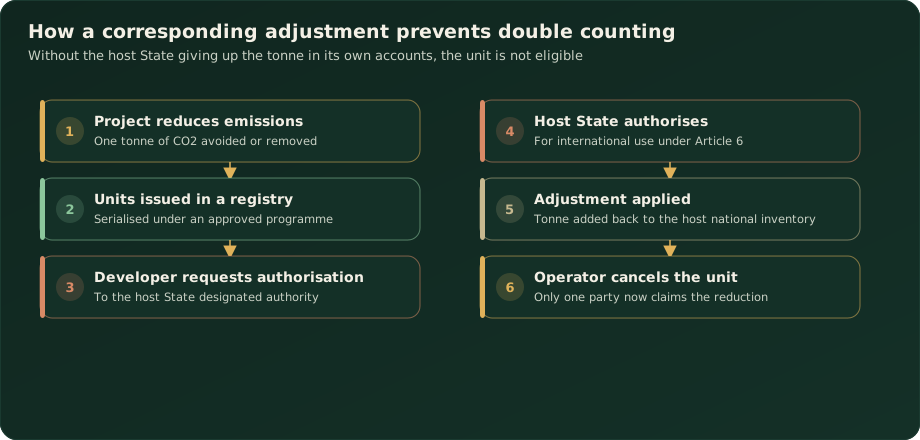
Article 6 of the Paris Agreement provides the remedy. When a host State authorises the transfer of a mitigation outcome for use toward another party's target or an international mitigation purpose such as CORSIA, it must apply a corresponding adjustment — adding those tonnes back into its own accounting.
Country A adds 100,000 tonnes to its reported emissions, or subtracts them from its reported reductions, so its NDC progress reflects that it sold the outcome. The airline claims the reduction; Country A does not.
One tonne, one claim.
The mechanism is conceptually simple. The politics are not.
Why Governments Resist
Authorising means accepting a harder path to your own climate target in exchange for foreign investment and project revenue. Whether that trade is worthwhile varies enormously.
| Government position | Typical driver |
|---|---|
| Reluctant | Ambitious NDC with limited cheap mitigation remaining |
| Selective | Retains project types central to its own abatement pathway |
| Conditional | Authorises with fees, revenue sharing or benefit requirements |
| Unable | No designated authority, no process, no precedent |
| Willing | Mitigation potential comfortably exceeds NDC needs |
Countries with ambitious NDCs and limited cheap mitigation
The most reluctant category. If your remaining abatement options are expensive, selling the cheap ones abroad means buying more expensive domestic reductions later. Several large developing economies have taken exactly this position.
Countries developing domestic carbon markets
May prefer to retain mitigation outcomes inside their own compliance systems, where they support a domestic carbon price and domestic industrial policy. India's Carbon Credit Trading Scheme is a live example of this tension — see CORSIA in India.
Countries with limited administrative capacity
No designated authority, no published process, no precedent. This functionally means no, regardless of stated policy intent. Treating declared intent as an implicit yes is how developers lose validation budgets.
Scale of the Constraint
There is no precise public figure for what proportion of global credit supply carries a corresponding adjustment, but every credible assessment reaches the same qualitative conclusion: a small minority.
The reasons compound. Most credits were issued before Article 6 mechanics existed, from projects designed without authorisation in mind. Many host States have not established processes. Where processes exist, authorisation is often granted for specific volumes rather than as blanket policy. And the administrative work of authorising each tranche is real friction.
For CORSIA this is the binding constraint on supply, and the reason analyses have repeatedly projected shortfalls against demand.
What Evidence Looks Like
Is evidence:
| Item | What it establishes |
|---|---|
| Authorisation document | Issued by the designated national authority |
| Unit-level identification | Names the project, vintage or monitoring period, and volume or serials |
| Registry reflection | Programme registry records authorisation status |
| National reporting | Adjustment appears in the host State's Article 6 reporting |
| Conditions and duration | Any limits or expiry attached to the authorisation |
Is not evidence: a seller's assurance, a project webpage claim, a broker's confirmation, a statement that the country "supports Article 6", or a description of units as "CORSIA-ready".
Authorised, Committed, Pending
Three states, frequently conflated, commercially decisive.
| State | Meaning | Usable for CORSIA |
|---|---|---|
| Authorised and adjusted | Authorisation granted, adjustment applied or firmly scheduled | Yes |
| Authorised, adjustment pending | Government has authorised; accounting not yet flowed through | Usually, with care |
| Pending authorisation | No authorisation exists | No |
The marketing vocabulary obscures this deliberately. "CORSIA-ready", "CORSIA-aligned" and "eligible pending authorisation" all describe the third state.
What Buyers Should Do
- Treat authorisation evidence as a gating check, not a documentation formality
- Demand the document and read it; confirm it names your units
- Verify the issuing body is genuinely the designated national authority
- Establish whether the adjustment is applied or merely committed
- Assess revocation risk in that specific jurisdiction
- Capture the evidence in your own files — a link is not a record
- If authorisation is pending, decide explicitly whether to take that risk, price it, and allocate it in the contract
What Sellers Should Do
- Test the authorisation question before spending anything else
- Engage the designated national authority directly rather than inferring policy from public statements
- Establish fees, conditions and realistic timelines from actual cases, not from what is possible in principle
- Run authorisation in parallel with development where the process permits
- Keep a voluntary market fallback so a negative answer does not sink the project
- Never describe unauthorised units as CORSIA-eligible — sophisticated buyers notice, and it costs credibility on everything else you say
The Voluntary Market Angle
An underappreciated dynamic: corporate voluntary buyers increasingly want corresponding adjustments too.
Corporate claims have faced sustained criticism over double counting, and an adjusted unit is the strongest available answer. Some buyers will pay a premium for exactly that, with no aviation obligation at all.
For sellers this widens the market for adjusted supply and supports pricing. For CORSIA buyers it means competing with corporate demand for the same scarce pool — a factor worth including in any supply forecast.
Where This Is Heading
Article 6 mechanics continue to develop. More governments are establishing designated authorities and processes, and reporting infrastructure under the Paris transparency framework is maturing. Over time the volume of adjusted supply should increase.
Whether it increases fast enough to meet second-phase CORSIA demand is the open question, and the honest answer is that nobody knows. It depends on decisions by dozens of governments, each weighing its own targets against investment inflows.
For planning purposes, that uncertainty is the thing to build around rather than resolve. Diversify, contract with risk explicitly allocated, and avoid strategies that only work if authorisation behaves predictably.
Terms You Will Encounter
| Term | Meaning |
|---|---|
| ITMO | Internationally Transferred Mitigation Outcome — the Article 6.2 term for an authorised, adjusted outcome |
| DNA | Designated National Authority — the body that authorises |
| NDC | Nationally Determined Contribution — the host State's climate target |
| Article 6.2 | Cooperative approaches between parties |
| Article 6.4 | The centralised UN crediting mechanism |
| LoA | Letter of Authorisation |
Where to Go Next
- CORSIA Eligible Emissions Units — where this fits
- The emissions unit criteria — the full criteria set
- Supply and demand outlook — the market consequence
- CORSIA in India — the domestic scheme interaction
- CORSIA glossary — every term defined
Article 6 guidance is published by the UNFCCC.
DSTechnoverse assesses host-State authorisation feasibility for developers before design budget is committed, and verifies adjustment evidence for buyers before transactions. Talk to our team.
Need this applied to your position?
We assess operators’ obligations and developers’ eligibility pathways directly.