If you learn one thing about supplying CORSIA credits from India, learn this: the corresponding adjustment is not paperwork. It is a decision by the Government of India to give up a tonne from its own emissions ledger so that an airline somewhere else can count it.
That framing explains everything about why authorisation is selective, slow and outside a developer's control.
The Double Counting Problem
Every country has a nationally determined contribution — a commitment under the Paris Agreement to reduce emissions by a stated amount. Emission reductions that occur inside India count towards India's NDC by default.
Now suppose an Indian project reduces a tonne, and an airline uses that tonne to discharge a CORSIA obligation. Without an adjustment, the tonne is counted twice: once by India towards its NDC, once by the airline towards its offsetting requirement. The atmosphere gets one tonne of benefit and two claims are made against it.
The corresponding adjustment resolves it. India adds the transferred tonne back to its own reported emissions — effectively removing it from its ledger — so only the airline's claim stands.
The consequence for policy is direct: every authorised export makes India's own target marginally harder to meet, and must be replaced by additional domestic effort. That is why governments authorise selectively.
Our knowledge base covers the underlying mechanism in corresponding adjustments explained, and the UNFCCC Article 6 pages hold the formal framework.
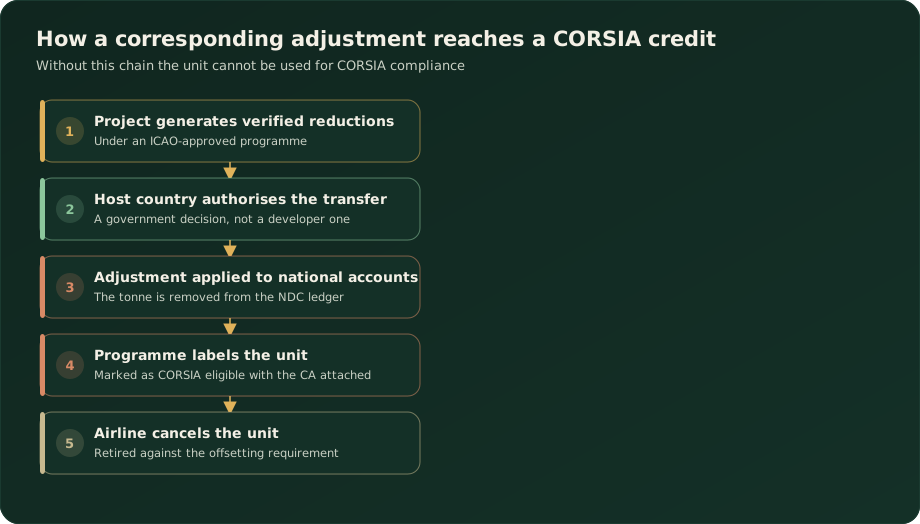
The Chain a Credit Must Travel
| Step | Who acts | What happens |
|---|---|---|
| 1. Project generates verified reductions | Developer and verifier | Under an ICAO-approved programme |
| 2. Host country authorises the transfer | Government | A policy decision, not a developer one |
| 3. Adjustment applied to national accounts | Government | The tonne leaves the NDC ledger |
| 4. Programme labels the unit | Crediting programme | Marked CORSIA eligible with the CA attached |
| 5. Airline cancels the unit | Buyer | Retired against the offsetting requirement |
Steps 1, 4 and 5 are process. Steps 2 and 3 are policy, and they are the reason a technically excellent project can still be unable to supply CORSIA.
What a Developer Can Actually Do
You cannot secure an authorisation by wanting one. You can improve your position:
1. Understand the current policy stance for your activity type before spending. Policy on which activities may be authorised for export evolves, and the honest answer to "will we get a CA?" is sometimes "not for this activity, currently".
2. Choose activities aligned with the policy direction. Where a government prioritises certain sectors or technologies for international transfer, projects in those areas face a shorter path.
3. Engage early through the correct channel. Authorisation requests follow a defined route through the designated national authority. Starting that engagement at the point of sale is far too late.
4. Document impeccably. Where authorisation is discretionary, a project with complete documentation, clean verification and demonstrable safeguards is an easier decision to approve than one with gaps.
5. Be honest with buyers about status. "Authorisation applied for" and "authorisation granted" are different products at different prices. Presenting the first as the second destroys a relationship permanently.
6. Model the timeline as elapsed time you do not control. Build it into the project plan rather than assuming it runs in parallel with everything else.
What Buyers Will Ask
A compliance buyer's diligence on the CA covers:
| Question | What satisfies it |
|---|---|
| Is authorisation granted, or pending? | The authorisation document itself |
| What is its scope? | Project, vintages, quantity specified |
| Is it conditional? | Conditions stated and assessed |
| Is it revocable? | Terms of any revocation right |
| Has the adjustment been applied or committed? | Evidence of the accounting treatment |
| Does the programme reflect it on the unit? | The unit's label in the registry |
"Authorisation is expected" is not a document. Buyers with a compliance deadline cannot take that risk, and units in that position trade — if at all — at a substantial discount to authorised units.
Contracting Around the Risk
Where authorisation is pending, the contract has to allocate the risk explicitly:
- Condition precedent. The sale completes only if authorisation is granted by a stated date. Cleanest, and the buyer may not wait.
- Price adjustment. A lower price now, with an uplift on authorisation. Shares the risk.
- Substitution right. The seller must deliver alternative eligible units if authorisation fails. Only workable for a supplier with a portfolio.
- Termination right. Either party may walk if authorisation does not arrive by a date.
- Revocation allocation. What happens if an authorisation is granted and later withdrawn — a genuine tail risk that most templates handle badly.
Whatever the structure, both sides must be able to state plainly what claim the buyer may make on the day of the transaction. If neither can, the deal has no defined product.
Why It Also Matters to Airlines
Buyer-side, the corresponding adjustment is the first eligibility check, not the last. An airline that cancels units lacking a valid CA has not discharged its obligation — it has spent money and remains non-compliant, with the deadline unchanged.
This is why airline procurement processes weight CA status above every other attribute, including price and co-benefits. See the CORSIA credit due diligence checklist.
Practical Positions to Avoid
Assuming a general policy statement covers your project. Authorisations are specific.
Treating the CA as a step after issuance. It shapes whether the project should proceed at all.
Selling on expectation. It is a reputational and contractual exposure.
Ignoring revocation risk. Long-dated contracts should say what happens if an authorisation changes.
Confusing programme labelling with government authorisation. The programme reflects the CA; it does not create it.
A Worked Comparison: Two Identical Projects
Two Indian biogas projects, same technology, same scale, same programme, both verified with clean opinions. One holds a corresponding adjustment authorisation; the other does not.
| Project A (authorised) | Project B (no CA) | |
|---|---|---|
| Technical quality | Identical | Identical |
| Verification opinion | Clean | Clean |
| Usable for CORSIA compliance | Yes | No |
| Addressable buyers | Airlines with obligations, plus voluntary | Voluntary market only |
| Price achieved | Premium, driven by eligibility scarcity | Voluntary market level |
| Diligence duration | Days, with the pack ready | Days — but fails the first test for airline buyers |
| Contract structure | Straightforward spot or forward sale | Conditional structures if a CA is pursued |
Nothing about the physical project differs. The entire commercial gap comes from a government decision that neither developer influenced directly.
Two lessons for a developer. First, the corresponding adjustment is worth more than almost any technical improvement you could make to the project — which is why it belongs at the front of the development sequence, not the end. Second, if authorisation is not realistically available for your activity type, that is not a failed project; it is a voluntary-market project, and it should be developed, documented and priced as one from the start rather than pursued as a CORSIA project in hope.
Developers who accept that distinction early build viable businesses. Developers who spend two years pursuing an authorisation that policy was never going to grant do not.
A closing practical note for developers already holding unauthorised credits: do not assume they can be retrofitted into CORSIA eligibility later. Authorisation is granted against defined scopes, and vintages that have already passed outside the eligible window cannot be brought back inside it. Units generated without an authorisation pathway in view are voluntary-market units, and the sooner they are marketed as such the better the price they achieve — waiting in hope of a policy change while the vintage ages is the worst of both routes.
Frequently Asked Questions
What is a corresponding adjustment? The host country's accounting step that removes a transferred emission reduction from its own national ledger, preventing the same tonne being counted twice.
Why is it required for CORSIA? Because the airline is claiming the reduction. Without the adjustment, the host country would also claim it towards its NDC.
Who grants it in India? The Government of India through its designated authority. Not the crediting programme, and not the developer.
Can a developer obtain one directly? No. A developer can apply through the correct channel, align the project with policy priorities and document thoroughly — but the decision is governmental.
How long does authorisation take? Elapsed time varies and is outside developer control. Treat it as a project timeline risk rather than a task with a duration.
Can credits be sold without a CA? Into parts of the voluntary market, yes. For CORSIA compliance, no.
What if authorisation is revoked? A genuine tail risk. Contracts should allocate it explicitly; many templates do not.
Does a CA affect price? Substantially. Authorised units command a large premium over units where authorisation is pending or absent.
How should we contract while authorisation is pending? Condition precedent, price adjustment, substitution right or termination right — with revocation addressed separately.
Does India authorise all project types? No. Policy on which activities may be authorised for international transfer evolves, and some activities are prioritised for domestic use. Check the current position before committing capital.
Developing CORSIA-eligible credits in India? DSTechnoverse supports project developers with eligibility screening, methodology selection, monitoring design, documentation packs and buyer due diligence — and advises buyers on whether the units they are offered will actually count. We are based in Indore, Madhya Pradesh and work with clients across India. See our CORSIA carbon credit services, our carbon credit portal at carboncredit.dstechnoverse.com, or talk to our team about your project.
This article is general information, not legal, financial or regulatory advice. CORSIA eligibility criteria, approved programmes and vintage windows change — verify the current position with ICAO and your programme before committing capital.