Most disputes on CORSIA engagements are scope disputes, and almost all of them are preventable at contract stage. "Support with CORSIA compliance" is not a scope. This article sets out what to write instead.
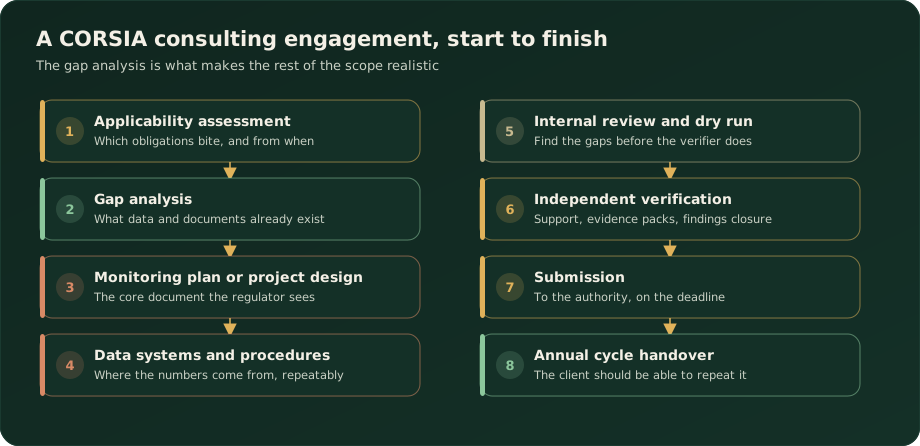
The Eight Stages to Name
| Stage | Deliverable | Acceptance criterion |
|---|---|---|
| 1. Applicability assessment | Written determination of obligations | Signed off by the accountable manager |
| 2. Gap analysis | Report listing gaps against requirements | Every gap has an owner and a date |
| 3. Emissions monitoring plan | The plan document | Submitted and accepted by the authority |
| 4. Data systems and procedures | Data flow, procedures, data gap procedure | Tested against a sample month |
| 5. Internal review / dry run | Findings list and closure evidence | All internal findings closed |
| 6. Verification support | Evidence pack, findings responses | Verification completed |
| 7. Submission | Verified report filed | Filed by the deadline |
| 8. Knowledge transfer | Procedures, templates, training session | Named staff can run the cycle |
Naming acceptance criteria is what converts a stage from an activity into a deliverable. "Prepare the monitoring plan" is an activity; "monitoring plan accepted by the authority" is a deliverable — and the difference determines who carries the risk if the authority asks for changes.
Be careful with stage 3's criterion, though. Acceptance depends partly on the authority's own timetable, so the fair formulation is usually "submitted in the required format, with the consultant responding to authority queries at no additional cost until accepted".
Stage 1: Applicability Assessment
The deliverable is a short written determination covering:
- Which legal entities and AOCs are in scope
- Which aircraft fall within the applicable mass criterion
- Which flights count as international for the purposes of the scheme
- Whether the operator is above the emissions threshold
- Which route pairs currently attract an offsetting requirement, and which do not
- Which exemptions apply — humanitarian, medical and firefighting flights, for example
- What changes on the horizon would alter any of the above
Insist this is written and signed. It is the foundation for everything else, and if it is wrong, every subsequent deliverable inherits the error. It is also the document you will want on file when a verifier or the authority asks why a particular flight category was treated as it was.
See CORSIA scope and thresholds for what the assessment has to work through.
Stage 2: Gap Analysis
The single most valuable stage, and the one most often skipped in a rush to produce a monitoring plan.
The deliverable should list, for each requirement: the current position, the gap, the remediation, the owner and the date. It is the document that makes the rest of the engagement priceable — which is exactly why phased contracts put the fee break here.
A gap analysis that concludes "broadly compliant, minor gaps" without an item-by-item table has not been done properly.
Stage 3: The Emissions Monitoring Plan
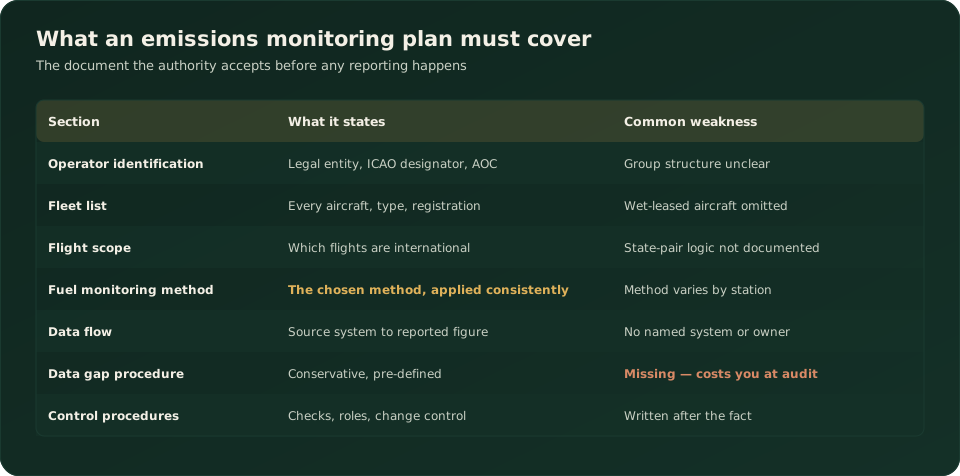
| Section | What it states | Common weakness |
|---|---|---|
| Operator identification | Legal entity, ICAO designator, AOC | Group structure unclear |
| Fleet list | Every aircraft, type, registration | Wet-leased aircraft omitted |
| Flight scope | Which flights are international | State-pair logic not documented |
| Fuel monitoring method | The chosen method, applied consistently | Method varies by station |
| Data flow | Source system to reported figure | No named system or owner |
| Data gap procedure | Conservative and pre-defined | Missing — costs you at audit |
| Control procedures | Checks, roles, change control | Written after the fact |
Two contract points follow. First, the scope must say who updates the plan when the fleet or the operation changes — plans go stale, and a stale plan is a finding. Second, it must say who responds to authority queries on the plan, and at whose cost.
Detail in the CORSIA emissions monitoring plan guide.
Stage 6: Verification Support — Write This Carefully
This is where scope disputes actually happen, because verification produces findings and findings produce work nobody costed.
Put in writing:
- What "support" means — attending fieldwork, preparing evidence packs, drafting responses, or all three
- Who closes findings attributable to the consultant's own work, and at whose cost
- Who closes findings attributable to the operator's data or systems
- How many rounds of findings response are included
- What happens if verification cannot be completed by the deadline, and why
- That the consultant is not the verifier and cannot influence the opinion
The fair default: findings arising from a deliverable the consultant produced are closed at the consultant's cost; findings arising from operator data quality are chargeable, unless the gap analysis should have caught them and did not. Write that sentence into the contract and most of the argument disappears before it starts.
Stage 8: Knowledge Transfer
Name the artefacts:
- A procedures document covering the annual cycle
- A data flow diagram identifying systems and owners
- An evidence pack template and folder structure
- A worked example — one month, end to end
- A training session for named staff, with materials retained
- A calendar with deadlines and internal milestones
Without named artefacts, "knowledge transfer" becomes a conversation at the end of the engagement, and the next cycle starts from the same position as this one.
Exclusions to Interrogate
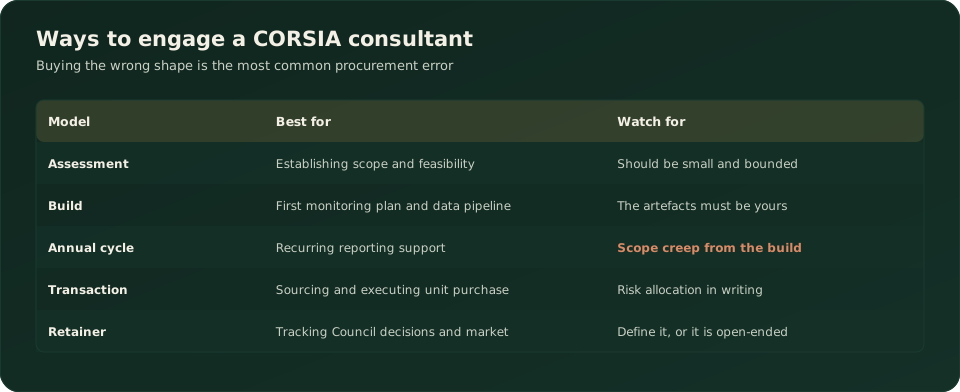
| Exclusion | Question to ask |
|---|---|
| Data remediation | If our data is worse than expected, what happens? |
| System changes | Who specifies and who implements? |
| Additional entities or AOCs | Priced per entity or bundled? |
| Authority queries | Included, or chargeable? |
| Verification findings | Which category is chargeable? |
| Unit procurement advice | In scope? Independent of any sales interest? |
| Regulatory change | If the rules move mid-engagement, who absorbs it? |
| Travel and site visits | Included in the fee or at cost? |
The regulatory change question is not theoretical. CORSIA's parameters — participating states, eligible programmes, vintage windows — do move, and an engagement running across a change needs a clause saying how that is handled rather than an argument about it.
A Workable Contract Skeleton
- Deliverables schedule — the eight stages, each with a description, acceptance criterion and date
- Staffing schedule — named individuals, grades, days, and who may be substituted
- Fee schedule — by deliverable, with the year-two price stated now
- Findings protocol — the attribution rule above
- Change control — how scope changes are priced and approved
- Confidentiality — fuel and route data is commercially sensitive
- Independence declaration — any interest in credit sales, disclosed
- Records and handover — everything produced belongs to the operator, in editable format
- Termination and continuity — what you receive if the engagement ends early
The handover clause matters more than it sounds. A monitoring plan delivered only as a locked PDF, with the working files retained by the consultant, quietly guarantees you come back next year.
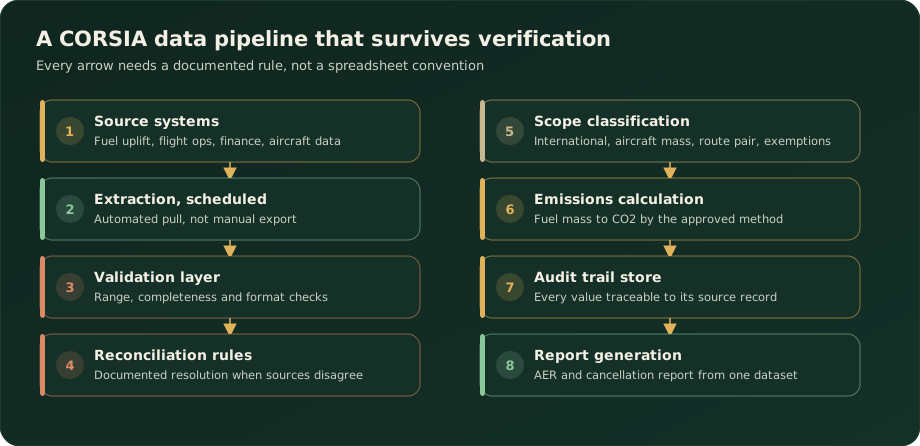
Stage 4: Data Systems and Procedures
The stage most often written as a single line in a proposal, and the one that determines whether the annual cycle is repeatable or a yearly reconstruction.
What the deliverable should actually contain:
| Component | What it specifies |
|---|---|
| Data flow diagram | Every source system, every transformation, to the reported figure |
| System and owner register | Which system holds what, and who is accountable for it |
| Fuel method application | How the chosen method is applied at every station and aircraft type |
| Quality control schedule | What is checked, how often, by whom, with what evidence |
| Data gap procedure | The conservative method, pre-defined, with worked examples |
| Change control | How a fleet, route or system change flows into the plan |
| Retention | Where records live and for how long |
| Reconciliation routine | Reported fuel burn against fuel purchase and finance records |
The reconciliation routine is worth insisting on. It is cheap, it runs monthly, and it catches the class of error — a station's records missing, a duplicated uplift, a unit conversion — that otherwise surfaces at verification when it is expensive.
Acceptance criterion for this stage should be a test, not a document review: take one month at random, follow the data flow end to end, and confirm the reported figure can be reproduced from source records by someone other than the person who built it. If that test passes, the annual cycle will work. If it only passes when the consultant runs it, nothing has been transferred.
Frequently Asked Questions
What should a CORSIA consultant's scope of work include? Applicability assessment, gap analysis, monitoring plan, data systems and procedures, internal dry run, verification support, submission and knowledge transfer — each with a named deliverable and acceptance criterion.
How do I stop scope creep? Name deliverables and acceptance criteria, interrogate the exclusions list, and agree a findings attribution rule before work starts.
Who pays to close verification findings? The fair default is that findings on consultant-produced deliverables are closed at their cost, and operator data findings are chargeable unless the gap analysis should have identified them.
Should verification be in the same contract? No. Verification must be independent of the party preparing the report and should be procured separately.
What is a gap analysis? An item-by-item comparison of current practice against CORSIA requirements, with gaps, remediation, owners and dates. It is what makes the remaining scope priceable.
How do I make sure knowledge is transferred? Name the artefacts — procedures, data flow diagram, evidence template, worked example, training session — and make them deliverables with acceptance criteria.
What if the regulations change mid-engagement? Include a change control clause covering regulatory change specifically. CORSIA parameters do move.
Should the consultant hold our data? They will need access, but the contract should confirm that all working files and documents belong to the operator and are handed over in editable format.
How long should a first engagement run? Typically across a full compliance cycle — plan and systems before or early in the year, then reporting and verification after it closes.
Need a CORSIA consultant in India? DSTechnoverse advises airlines and aircraft operators on CORSIA monitoring, reporting and verification, and works with project developers on eligible credit supply, corresponding adjustments and buyer due diligence. We are based in Indore, Madhya Pradesh and work with clients across India. See our CORSIA carbon credit services, our carbon credit portal at carboncredit.dstechnoverse.com, or talk to our team about your compliance year.
This article is general information, not legal or regulatory advice. CORSIA rules and the list of participating states change — verify the current position with ICAO and the DGCA before acting.