CORSIA lands on an Indian operator in two distinct waves, and treating them as one obligation is the mistake that costs the most time.
The first wave is monitoring, reporting and verification — an annual data and assurance cycle that applies broadly. The second is offsetting — a commercial obligation to cancel eligible emissions units, which applies only under specific conditions and on specific routes.
The Applicability Tests
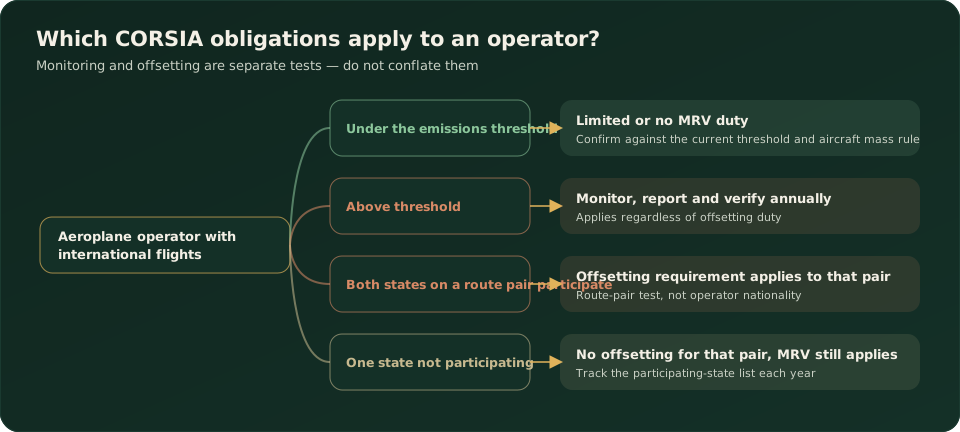
Work through them in order. Each answers a different question, and skipping one produces a wrong scope.
1. Are you an aeroplane operator conducting international flights? CORSIA covers international aviation. Domestic sectors sit outside it entirely, however large they are in your network.
2. Do your aircraft meet the mass criterion? The scheme applies above a defined maximum take-off mass threshold, which excludes smaller aircraft. Confirm the current figure against the ICAO standard rather than from memory.
3. Are your international emissions above the annual threshold? Operators below the defined annual CO₂ threshold from international flights face reduced or no monitoring duties. Above it, the full MRV cycle applies.
4. Which flights are exempt? Humanitarian, medical and firefighting flights are treated differently. Exemptions must be documented, not assumed.
5. Do both states on the route pair participate? This is the offsetting test, and it is entirely separate from the three above.
The route-pair test is what people find counter-intuitive. Offsetting is not determined by where your airline is registered. It is determined by whether both the departure state and the arrival state are participating in the scheme for that year. A single operator can have offsetting obligations on some routes and none on others, and the position changes as states join.
Because the participating-state list is republished, this is a live tracking task rather than a one-off determination. The ICAO CORSIA pages hold the current list.
The India Position
Three practical points for an Indian operator:
The DGCA is your authority. Emissions reports go to the DGCA, which reports onward to ICAO. Civil Aviation Requirements set out the Indian implementation, including formats and timelines, and those are the operative dates for your calendar — not the ICAO documents.
MRV precedes offsetting. Indian operators above the threshold have monitoring and reporting duties independent of whether any offsetting requirement currently arises. Building the data capability now is what makes the offsetting phase manageable later.
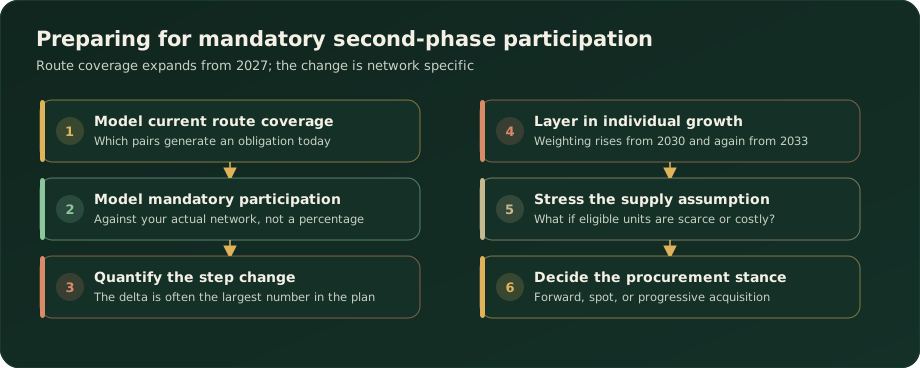
Phase timing matters commercially. CORSIA runs in phases with different participation rules — a voluntary pilot and first phase, followed by a broader mandatory phase. Where your route network sits against that timeline determines when offsetting costs actually begin. See CORSIA phases and timeline.
What the MRV Cycle Involves
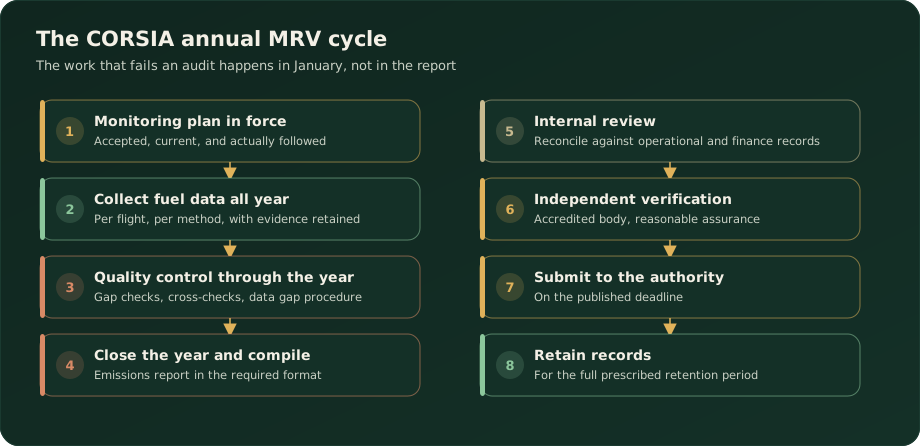
| Stage | What it requires |
|---|---|
| Monitoring plan in force | Accepted by the authority, current, and actually followed |
| Collect fuel data all year | Per flight, by the chosen method, with evidence retained |
| Quality control through the year | Gap checks, cross-checks, documented data gap procedure |
| Close the year and compile | Emissions report in the required format |
| Internal review | Reconcile against operational and finance records |
| Independent verification | Accredited body, reasonable assurance |
| Submit to the authority | On the published deadline |
| Retain records | For the full prescribed retention period |
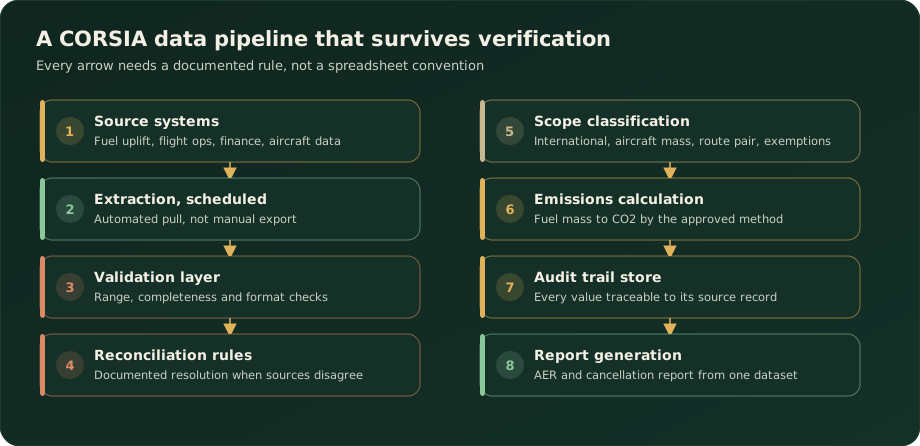
The work that fails an audit happens in January, not in the report. Verification tests whether the data was captured as the plan says it would be, throughout the year. A report assembled well from poorly captured data does not pass; a report assembled plainly from well-captured data does.
Fuel Monitoring Methods
CORSIA permits several fuel monitoring methods, and the choice has practical consequences. Broadly, methods derive fuel burn from tank measurements or from fuel uplift and remaining-fuel data, in different combinations.
What matters when choosing:
| Consideration | Why it decides the answer |
|---|---|
| What data your systems already capture reliably | A method requiring data you do not have is not a method |
| Consistency across stations | Outstations with different handling are the usual weak point |
| Aircraft type differences | Some data is available on newer types and not older ones |
| Auditability | Can each figure be traced to a source document? |
| Wet-leased aircraft | Whose data, whose method, whose report? |
Apply one method consistently. Verifiers press hard on method consistency, and a plan that says one thing while stations do another produces findings quickly. If different fleets genuinely need different methods, say so in the plan and justify it.
Wet leasing deserves specific attention because it is common and commonly mishandled. Establish which operator is responsible for the emissions from wet-leased operations, document it, and make sure the counterparty's data can actually reach your report with evidence attached.
The Offsetting Obligation
Where it applies, the offsetting requirement is calculated from emissions growth relative to a baseline, adjusted by growth factors, and reduced where CORSIA eligible fuels are used. The result is a quantity of CO₂ that must be matched by cancelling eligible emissions units.
Three things determine what you actually pay:
- How much of your traffic falls on participating route pairs — the route-pair test again
- The offsetting requirement calculated for that traffic — see CORSIA offsetting requirement calculation
- The price of eligible units at the time you procure them
Only units meeting the eligibility criteria count — approved programme, permitted vintage, and a corresponding adjustment by the host country. Cancelling an ineligible unit does not discharge the obligation, which is why buyer-side due diligence matters as much as price. See the CORSIA credit due diligence checklist.
What to Have in Place Before the Year Starts
- A written applicability determination, signed off internally
- An accepted emissions monitoring plan — see the emissions monitoring plan guide
- A named compliance lead and a named deputy
- Data owners identified for fuel and flight records
- A documented data flow from source system to reported figure
- A data gap procedure, conservative and pre-defined
- A monthly quality control routine, actually scheduled
- A retention arrangement meeting the prescribed period
- A verification body identified, ideally appointed early
- A compliance calendar with internal milestones ahead of the external deadline
Items 6 and 7 are the ones most often missing, and they are the two that most reliably generate findings. A data gap procedure written after a gap occurs is not a procedure; it is an explanation.
Where First Cycles Go Wrong
Scope defined loosely. Which flights count, which aircraft, which entity. Get it in writing early.
Wet-leased aircraft unaddressed. Discovered at verification, when there is no time to obtain the counterparty's data.
Outstation inconsistency. The method applied differently where local handling differs.
No reconciliation against finance. Fuel purchase records are the obvious cross-check and the one verifiers use.
Data gaps handled ad hoc. Without a pre-defined conservative procedure, the verifier will apply their own conservative assumption, and it will not favour you.
Verifier appointed late. Capacity is finite around deadlines, and a rushed verification costs more and finds more.
Plan not updated after fleet change. New aircraft, new station, new entity — each needs to flow into the plan.
Consequences of Getting It Wrong
Enforcement sits with the national authority rather than with ICAO, so the specific consequences for an Indian operator are set by the DGCA under the applicable Civil Aviation Requirement. In broad terms, three kinds of exposure exist:
| Exposure | Arises from | Practical effect |
|---|---|---|
| Regulatory | Late, missing or unverified reports | Authority action under the applicable CAR |
| Financial | Under-reported emissions corrected later | A larger offsetting requirement than budgeted |
| Commercial | Inability to evidence compliance | Questions from lessors, financiers and code-share partners |
The third is the one operators tend to discover rather than anticipate. Aircraft lessors, lenders and airline partners increasingly ask for evidence of environmental compliance as part of routine diligence, and "our CORSIA reporting is in order, here is the verification report" is a materially easier answer than an explanation.
The financial exposure is worth understanding too. Conservative treatment of data gaps at verification increases reported emissions, and where an offsetting requirement applies, higher reported emissions mean more units to buy. Poor data quality is not only an audit problem; it has a direct price.
Frequently Asked Questions
Does CORSIA apply to Indian airlines? CORSIA MRV obligations apply to operators conducting international flights above the applicable thresholds, regardless of nationality. Offsetting depends on the route-pair participation test and the phase in force.
Does CORSIA cover domestic flights? No. It applies to international aviation only.
Who do we report to in India? The DGCA, which reports onward to ICAO.
What is the route-pair test? Offsetting applies where both the departure state and the arrival state participate in the scheme for that year. It is not determined by the operator's nationality.
What is the emissions threshold? There is a defined annual CO₂ threshold for international flights, below which monitoring duties are reduced. Confirm the current figure against the ICAO standard and the DGCA requirement.
Do we need verification every year? Yes — the annual emissions report must be independently verified by an accredited body before submission.
What happens with wet-leased aircraft? Responsibility must be established and documented, and the data must be able to reach your report with supporting evidence. Address it in the monitoring plan.
Can we change fuel monitoring method? Changes must be justified and reflected in the monitoring plan. Consistency is what verifiers test, so unplanned mid-year changes create findings.
What if data is missing for some flights? Apply your pre-defined, conservative data gap procedure and document it. Without one, the verifier applies their own conservative assumption.
When should we start preparing? Before the compliance year begins. Retrofitting a monitoring plan onto data already collected is the most expensive route through a first cycle.
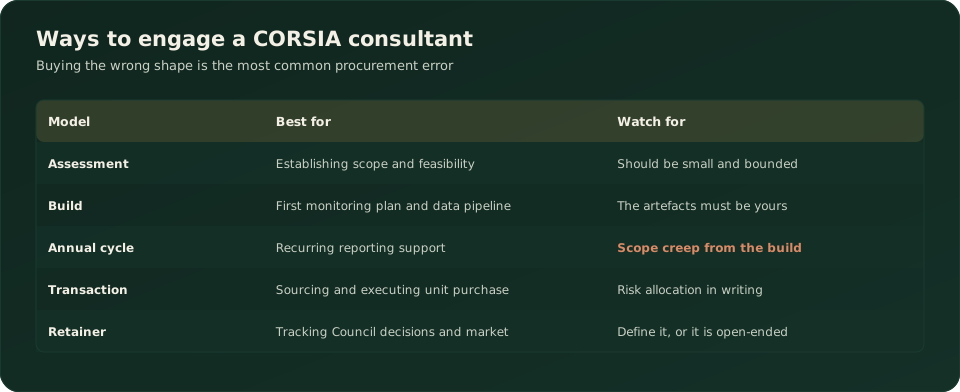
Running your first CORSIA compliance cycle? DSTechnoverse supports Indian aircraft operators with applicability assessment, emissions monitoring plans, fuel data quality management and verification readiness — and hands the annual cycle back to your team. We are based in Indore, Madhya Pradesh and work with clients across India. See our CORSIA carbon credit services, our carbon credit portal at carboncredit.dstechnoverse.com, or talk to our team about your reporting year.
This article is general information, not legal or regulatory advice. CORSIA rules, thresholds and participating-state lists change — verify the current position with ICAO and the DGCA before acting.