The emissions monitoring plan is the document everything else in CORSIA compliance rests on. The authority accepts it before reporting begins, the verifier tests your data against it, and any inconsistency between what it says and what your operation does becomes a finding.
It is also, in most first cycles, written too quickly.
What the Plan Is For
The plan is a commitment. It states how you will identify flights in scope, how you will measure fuel, where the numbers come from, who checks them, and what you will do when data is missing.
Verification then tests one question repeatedly: did you actually do what this document says?
That framing is worth holding onto while writing it. A plan describing an idealised process you will not follow at every outstation is worse than a plan describing a simpler process you will follow everywhere.
Section by Section
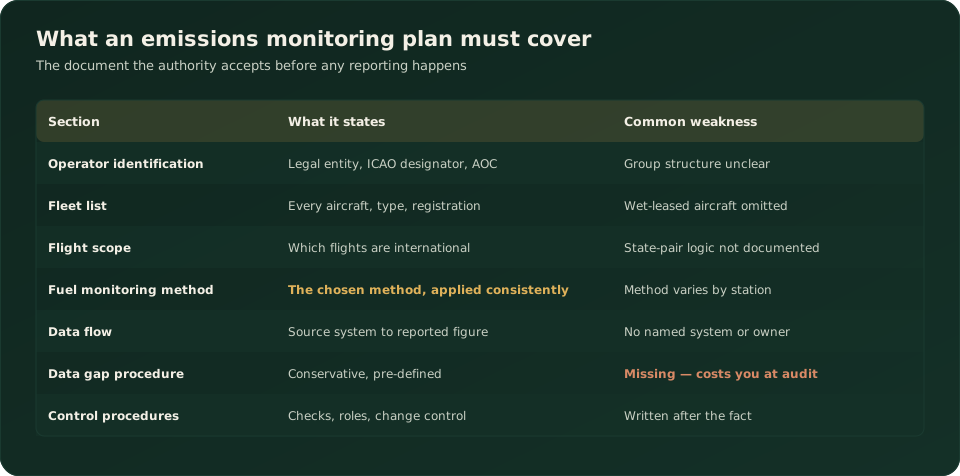
| Section | What it states | Common weakness |
|---|---|---|
| Operator identification | Legal entity, ICAO designator, AOC | Group structure unclear |
| Fleet list | Every aircraft, type, registration | Wet-leased aircraft omitted |
| Flight scope | Which flights are international | State-pair logic not documented |
| Fuel monitoring method | The chosen method, applied consistently | Method varies by station |
| Data flow | Source system to reported figure | No named system or owner |
| Data gap procedure | Conservative and pre-defined | Missing — costs you at audit |
| Control procedures | Checks, roles, change control | Written after the fact |
Operator identification
Name the legal entity that holds the obligation. Where a group has several AOCs or subsidiaries, state clearly which entity reports which operations. Group structures that are obvious internally are not obvious to a verifier, and ambiguity here propagates into every subsequent question.
Fleet list
Every aircraft, by registration, with type and mass data. Then the harder cases: aircraft entering and leaving the fleet mid-year, aircraft on dry lease, and wet-leased aircraft, where responsibility for the emissions must be established and stated. If a wet lease arrangement means the emissions belong to the other operator, say so and explain how that is evidenced.
Flight scope
Which flights are international, and how the system distinguishes them. State the route-pair logic used for the offsetting determination separately from the MRV scope — they are different tests and conflating them in the plan guarantees confusion later.
Fuel monitoring method
State the method, and state that it is applied consistently. Where different fleets or aircraft types genuinely require different treatment, say which, and justify it. Then describe, concretely, what happens at a station: which document records the uplift, which system captures it, who reconciles it.
The gap between the method described and the method practised at outstations is the most reliable source of findings in CORSIA verification. Write what actually happens.
Data flow
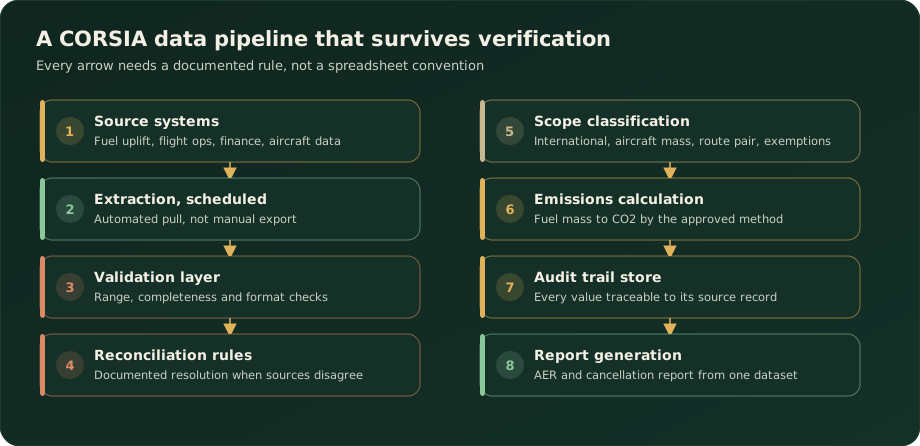
The section that decides whether verification is smooth. It should identify:
- Each source system, by name
- What data each holds, and who owns it
- Every transformation between source and reported figure
- Where data is stored, and for how long
- The reconciliation performed against independent records
A diagram helps here more than prose. A verifier who can see the flow can plan sampling; one who cannot will ask a great many questions to construct it themselves.
Data gap procedure
Write this before you need it. It should state:
- What counts as a data gap
- How gaps are detected — the monthly check that finds them
- The substitution method, which must be conservative (over-estimating rather than under-estimating emissions)
- How the substitution is documented and approved
- What threshold of gaps triggers escalation and investigation
The reason to pre-define it is straightforward: if you have no procedure, the verifier applies a conservative assumption of their own, and it will not be generous. A documented, consistently applied conservative method protects the reported figure.
Consistency is the test. A method chosen after seeing which substitution produces a lower number is not a procedure — and the pattern is visible in the data.
Control procedures
Who checks what, how often, with what evidence. Include change control: how a fleet change, new station, system upgrade or entity restructure flows into an updated plan. Plans go stale, and stale plans generate findings.
The Annual Rhythm the Plan Implies
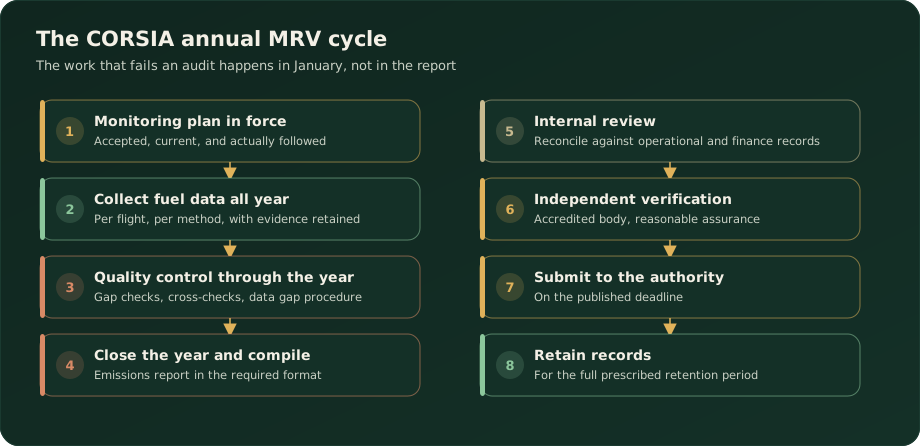
A plan is not a filing exercise. It describes an operational routine that runs all year:
| When | Activity |
|---|---|
| Continuously | Fuel data captured per flight at every station |
| Monthly | Completeness check, gap detection, anomaly review |
| Monthly | Reconciliation against fuel purchase and finance records |
| Quarterly | Review of any plan changes needed |
| Year end | Compilation, internal review, reconciliation |
| Q1 | Verification and submission |
If the monthly rows are not actually happening, the plan is aspirational and verification will show it.
Writing for the Verifier
Three habits that make verification faster and cheaper:
Be specific about systems and people. "Fuel data is recorded in the operations system" is weak. "Uplift figures are entered into [system] by the station handling agent within 24 hours, reconciled by the fuel accounting team against supplier invoices monthly" is testable — which is the point.
Include worked examples. One example flight, showing the source document, the system entry, the calculation and the reported figure, does more to explain your process than several pages of description.
Cross-reference evidence. For each control, say what evidence exists that it was performed. A control with no evidence trail cannot be verified, and an unverifiable control is treated as absent.
Keeping the Plan Current
Triggers for an update:
- Aircraft added or removed
- New route or station, particularly a new outstation
- Change in fuel monitoring method
- Change to a source system
- Corporate restructure, new AOC, merger
- Change in the applicable requirements
- Findings from verification requiring a process change
Assign ownership for this explicitly. In practice a quarterly review with a named owner catches most changes before they become discrepancies.
What Good Looks Like
A strong plan is usually shorter than a weak one. It describes a simple process precisely, names systems and owners, includes a diagram and a worked example, and contains a data gap procedure written in advance. It does not describe every possible scenario — it describes what actually happens, in enough detail that someone else could follow it.
For the wider compliance picture see CORSIA compliance for Indian airlines, and for the data discipline underneath it, CORSIA fuel data quality management.
Submission and Authority Queries
The plan is not finished when you have written it. It has to be submitted to the authority in the required format and accepted, and that process has its own rhythm.
| Step | What to expect |
|---|---|
| Submission | In the authority's format, by the applicable date |
| Completeness check | The authority confirms all required sections are present |
| Technical review | Questions on method, scope, data flow or gap procedure |
| Response | Written, with the plan amended where needed |
| Acceptance | Confirmed by the authority |
| Version control | The accepted version becomes the operative document |
Two practical points. Budget time for queries. A first plan rarely goes through without questions, and each round takes calendar time you do not control. Submitting close to a deadline leaves no room for a second round.
Keep the version history. When a verifier tests practice against the plan, they test against the version in force during the compliance year — not the latest draft. An operator who cannot say which version applied when has a documentation problem before any data is examined.
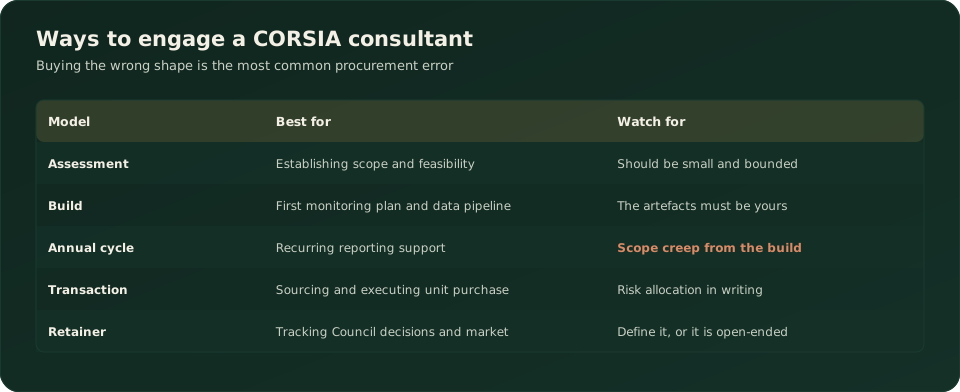
Where an engagement includes plan preparation, make responding to authority queries an explicit part of the consultant's scope rather than a chargeable extra. See CORSIA consultant scope of work.
Frequently Asked Questions
What is a CORSIA emissions monitoring plan? The document setting out how an operator identifies flights in scope, measures fuel burn, controls data quality and handles gaps. The authority accepts it before reporting begins.
Who approves the monitoring plan? The national authority — the DGCA for Indian operators.
What must it contain? Operator identification, fleet list, flight scope, fuel monitoring method, data flow, data gap procedure and control procedures.
How detailed should the data flow section be? Detailed enough that a verifier can trace any reported figure back to a source document without asking you to explain the route.
What is a data gap procedure? A pre-defined, conservative method for substituting missing data, with detection, documentation and escalation. Without one, the verifier applies their own conservative assumption.
How often must the plan be updated? Whenever something material changes — fleet, routes, systems, entity structure, method or requirements. A quarterly review is a practical rhythm.
What happens if practice differs from the plan? It becomes a verification finding. Either change the practice or update the plan; discrepancy is the problem.
Do wet-leased aircraft go in the plan? Yes. Responsibility must be established, stated and evidenced.
Can we use different fuel methods for different fleets? Where genuinely justified, yes — but it must be stated and justified in the plan, not applied informally.
How long should the plan be? As long as it takes to describe the actual process precisely. Strong plans are usually shorter and more specific than weak ones.
Running your first CORSIA compliance cycle? DSTechnoverse supports Indian aircraft operators with applicability assessment, emissions monitoring plans, fuel data quality management and verification readiness — and hands the annual cycle back to your team. We are based in Indore, Madhya Pradesh and work with clients across India. See our CORSIA carbon credit services, our carbon credit portal at carboncredit.dstechnoverse.com, or talk to our team about your reporting year.
This article is general information, not legal or regulatory advice. CORSIA rules, thresholds and participating-state lists change — verify the current position with ICAO and the DGCA before acting.