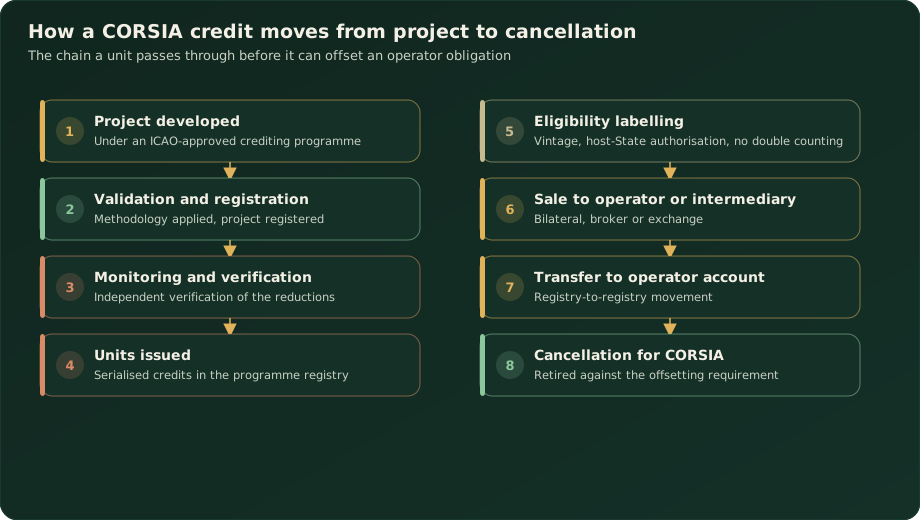
Cancellation is irreversible, sits at the end of a compliance period when everyone is under time pressure, and is executed by whichever person happens to have registry access that week. That combination produces the errors this article exists to prevent.
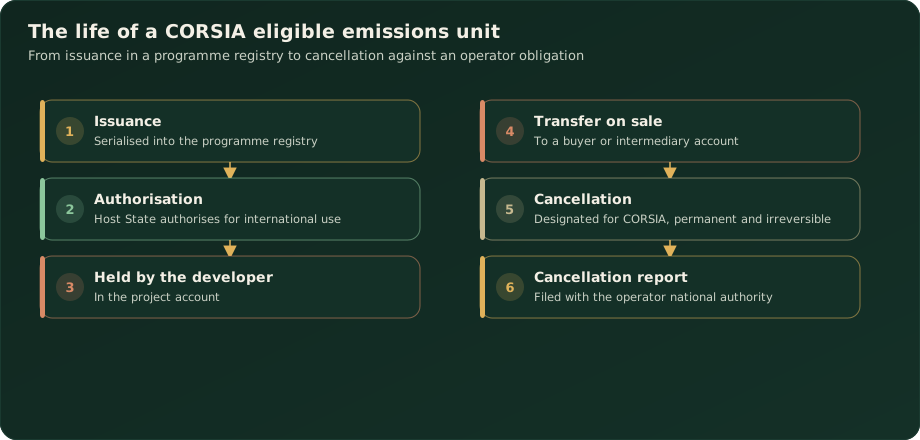
For what registries are, how serialisation works and why there is no single CORSIA registry, see CORSIA registries, serialisation and cancellation. This piece is the operational procedure.
Before the Period Ends
Work backwards from the cancellation deadline, not forwards from today.
| Timing | Action |
|---|---|
| T minus 6 months | Registry accounts open, tested, two representatives nominated |
| T minus 4 months | Obligation figure confirmed against verified emissions |
| T minus 3 months | Supply contracted, diligence complete |
| T minus 6 weeks | Units transferred into your account, serials recorded |
| T minus 4 weeks | Pre-cancellation reconciliation complete |
| T minus 2 weeks | Cancellation executed |
| T minus 1 week | Cancellation report submitted |
| Deadline | Authority acknowledgement received |
The two-week gap before the deadline is deliberate. Registry systems have maintenance windows and load spikes precisely when everyone else is cancelling, and the authority's acknowledgement is not instant.
The Pre-Cancellation Reconciliation
Do this before touching the cancellation screen. It takes an hour and it catches the errors that cannot be undone.
Confirm the obligation figure. From the verified emissions and the published growth factors, with the calculation reproducible. Not from a spreadsheet somebody updated.
Confirm the holding. Log into each registry and confirm the units are present, in your account, unencumbered and not already retired.
Match serials against contracts. Every unit you intend to cancel should trace to a purchase with diligence evidence behind it. A unit you cannot trace is a unit you should not cancel.
Re-verify eligibility. Programme approval status and vintage window, checked today rather than at purchase. If months have passed, this is not a formality — approvals lapse and windows move.
Check the quantity. Cancelling more than you owe is spent money; surplus does not carry forward. Cancelling less leaves an unmet obligation.
Confirm the purpose designation available in each registry, and which one your national authority expects.
Executing the Cancellation
Treat this with the controls you would apply to a payment, because functionally that is what it is.
Two people. One prepares, one reviews and approves. The reviewer independently confirms quantity, serials and purpose designation before execution.
Screenshot before submitting. The confirmation screen showing quantity, serials and purpose. If something is later disputed, this is the contemporaneous record.
Execute during business hours, in your registry's time zone, on a day when support is available. Not on a Friday evening.
One registry at a time. Where units sit across several programmes, complete and record each before starting the next. Parallel execution under time pressure is how quantities get confused.
Record immediately: serials cancelled, quantity, date and time, cancellation reference, purpose designation, registry, and who executed and approved.
The Purpose Designation
The single most consequential field, and the one most easily got wrong.
Programmes provide different cancellation types — voluntary retirement, cancellation for a specific compliance purpose, cancellation for a named scheme. A generic retirement of the kind used for voluntary claims may not satisfy your national authority.
Getting it wrong is difficult or impossible to reverse, and the units are consumed either way. Confirm the correct designation with your authority before the first cancellation rather than during it, and record the confirmation.
The Cancellation Report
Cancellation without reporting does not close the loop. The authority has no visibility of your registry activity unless you tell them.
The report identifies units cancelled with serials, the programme, vintage, cancellation references and the compliance period discharged. For Indian operators this goes to the DGCA.
Build in time for a query. The report is submitted, reviewed and acknowledged. A question at that stage becomes a missed deadline if there is no margin.
Recovering From Errors
Some are recoverable, some are not. Knowing which changes how you respond.
| Error | Recoverable? | Response |
|---|---|---|
| Cancelled too few units | Yes | Cancel the balance; watch the deadline |
| Cancelled too many | No | Surplus is spent; do not repeat next period |
| Wrong purpose designation | Usually not | Contact the registry immediately; expect to replace |
| Cancelled the wrong serials | No | Units are consumed; source replacements |
| Report submitted with wrong serials | Yes | Correct and resubmit promptly |
| Report not submitted | Yes | Submit; explain the delay |
The unrecoverable rows are why the two-person control exists. Every one of them is prevented by a second person checking the screen before execution.
Records to Retain
Per compliance period, retained for at least ten years and surviving a system migration:
- The obligation calculation, with its derivation
- Every purchase contract and diligence file
- Registry records showing chain of custody
- Transfer confirmations
- Cancellation confirmations with serials, references and purpose
- The screenshot taken at execution
- The cancellation report as submitted
- The authority's acknowledgement
- The reconciliation tying obligation to cancellations
Hold these yourself, not only in a registry or with an intermediary. When either relationship ends, your compliance record must not end with it.
A Standing Procedure
Write this down once and it stops being a scramble every period. A workable one-page procedure covers:
Who may execute a cancellation and who must approve it. What the reviewer independently checks. Which registries you hold accounts with, and who the authorised representatives are. Which purpose designation applies, confirmed with the authority. What is recorded at execution. Where records are filed. What happens if something goes wrong and who is told.
Review it when people change roles, and test it before the first cancellation of each period rather than during.
Multi-Registry Cancellation
Where units sit across several programmes, the cancellation becomes several cancellations, and the coordination is where errors creep in.
Allocate before you start. Decide in advance how many units come from each registry, and write it down. Deciding as you go, with a running total in your head, is how quantities drift.
Complete and record one registry fully before opening the next. Partial completion across three systems is the state in which nobody can say what has actually been cancelled.
Reconcile after each. Running total cancelled against obligation, updated as you go, so a discrepancy surfaces at the point it can still be corrected.
Expect different interfaces and terminology. One programme's "retirement" is another's "cancellation", and the purpose designation may be a dropdown in one and a free-text field in another. This is why walking the interface before the first real cancellation matters.
Allow more time than a single-registry cancellation. Three registries is not three times the work, but it is more than one — and each carries its own processing time.
What Changes at Period End
The final cancellation of a compliance period differs from an interim one, and the differences are worth naming.
The quantity must be exact. Interim cancellations can be conservative; the final one settles the obligation. Under-cancelling leaves a shortfall; over-cancelling is spent money with no carry-forward.
The reconciliation is cumulative. It must tie every cancellation across the period to the total obligation, not just the current transaction.
The report covers the period, not the transaction, and the authority is reconciling against what they expect.
Everyone else is doing the same thing. Registry load, verifier availability and authority processing all peak simultaneously. This is the strongest argument for cancelling progressively through the period rather than settling it all at the end.
Frequently Asked Questions
Can we cancel in advance of the deadline? Yes, and progressively through the period is generally better than settling everything at the end, both for supply availability and for spreading the administrative load.
When should we cancel? Two weeks before the reporting deadline at minimum, allowing for registry processing and an authority query.
Can a cancellation be reversed? Generally no. It is designed to be permanent, which is why the pre-execution check matters.
What if we cancel under the wrong purpose? Contact the registry immediately, and expect to have to replace the units. Treat it as unrecoverable when planning.
Who should execute it? Someone with registry access, with a second person approving. Never the same person negotiating the purchase and executing the cancellation.
Do we cancel in one transaction or several? Several is fine and often clearer. Complete and record each before starting the next.
What if the registry is down near the deadline? This is precisely why the two-week margin exists. Contact the registry, document the attempt, and inform your authority if the deadline is genuinely at risk.
How do we prove we cancelled? Registry confirmation with serials and reference, plus your own contemporaneous record and the authority's acknowledgement of the report.