CORSIA Registries, Serialisation and Cancellation
How units actually move — why there is no single CORSIA registry, what serial numbers encode, how transfers work, and why cancellation rather than purchase is the act that discharges an operator obligation.
The transaction gets the attention; the registry mechanics decide whether it counts. Operators have agreed purchases they could not take delivery of, held units they never cancelled, and cancelled units they never reported. Each is a compliance failure produced by administration rather than by anything to do with carbon.
There Is No Single CORSIA Registry
A common and consequential misconception. ICAO does not operate a registry holding CORSIA units.
Units live in the registries of the crediting programmes — the American Carbon Registry, the Climate Action Reserve, Verra, Gold Standard, the Global Carbon Council and others that have held ICAO approval. Each operates its own system, with its own account structure, fee schedule, transfer mechanics and processing times.
A buyer therefore needs accounts wherever their supply sits. There is no consolidated view across programmes, so an operator sourcing from several is maintaining several relationships and several sets of records.
ICAO's role is to approve programmes and define what constitutes an eligible unit. The transactional infrastructure sits with the programmes.
Serialisation
Every unit carries a unique serial identifier, encoding — in a form that varies by programme — the issuing programme, the project, the vintage or monitoring period, and the specific tonne within an issuance batch.
Serials prevent double use and establish chain of custody. They are also what you record: in the contract, the diligence file, transfer confirmations and cancellation records.
A compliance file that references volumes without serials cannot be reconciled against a registry, which is the first thing anyone auditing it will try to do.
Opening an Account
Allow four to eight weeks. Longer for entities in jurisdictions requiring additional documentation.
Requirements typically include entity registration documents, beneficial ownership disclosure, know-your-customer verification for authorised representatives, and sometimes bank references. Programmes apply anti-money-laundering procedures.
The failure mode
An operator agrees a purchase, then begins onboarding. Their own account opening blocks the transfer, and the delay eats into the time available before the cancellation deadline.
Open accounts before you need them. Nominate more than one authorised representative, so one person's absence cannot freeze your ability to transact. Complete a small test transfer if the programme permits, so the first real transfer is not the first time anyone has used the system.
Transfers
| Type | Typical duration | Notes |
|---|---|---|
| Intra-registry | Days | Both parties on the same programme's registry |
| Inter-registry | Longer, sometimes impossible | Not all programmes support it |
Payment sequencing matters. Paying in full before transfer, to a counterparty you have not dealt with, is exposure. Escrow, staged payment, or payment against delivery are standard mitigations, and a legitimate seller will discuss them.
Cross-border considerations. Payment usually involves foreign exchange and cross-border transfer, raising treasury and regulatory questions worth resolving before the transaction rather than during.
Cancellation: The Step That Actually Counts
This is the point most worth emphasising.
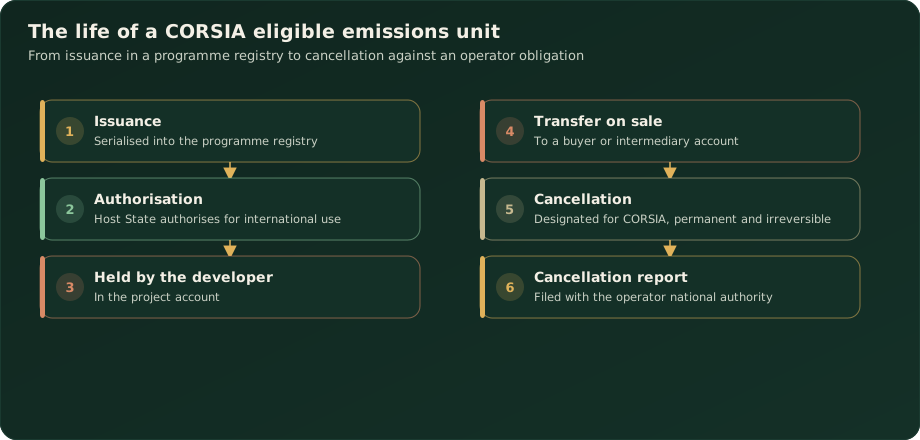
Purchasing units does not discharge your obligation. Holding them does not discharge your obligation. Cancellation does.
Cancellation permanently removes the units from circulation and records the purpose. For CORSIA, the cancellation must be designated for CORSIA compliance — programmes provide a specific cancellation type or purpose field. A generic retirement of the kind used for voluntary claims may not satisfy your authority.
Getting the designation right
Cancelling under the wrong purpose is difficult or impossible to reverse, and the units are consumed either way.
Because it is irreversible, cancellation deserves the control you would apply to a payment: a documented procedure, a second pair of eyes confirming the purpose designation before execution, and a record made at the time rather than reconstructed later.
Record everything: serial numbers, cancellation reference, date, quantity, purpose designation, and the account from which cancellation occurred.
Do not leave it to the last day. Registry processing time is outside your control, and systems have maintenance windows and load spikes near common deadlines — precisely when everyone else is cancelling.
Reporting the Cancellation
The final step: the Emissions Unit Cancellation Report to your national authority — the DGCA for Indian operators.
The report identifies the units cancelled, their serials, the programme, the vintage, cancellation references, and the compliance period discharged.
Cancellation without reporting does not close the loop. The authority has no visibility of your registry activity unless you report it.
Build in processing time: the report is submitted, reviewed and acknowledged, and a query at that stage becomes a missed deadline if there is no margin.
Reconciliation
Your compliance position is the difference between your calculated obligation and your reported cancellations, per compliance period.
Maintain it as a live figure rather than reconstructing it at period end. Two benefits: you always know your remaining exposure, and discrepancies surface while they can still be investigated.
The reconciliation should tie together, per period: the obligation with its derivation, every purchase with serials, every transfer confirmation, every cancellation with references, and every cancellation report with its acknowledgement.
Keep it in a system, not in the head of whoever handled the transactions.
Who Should Hold Registry Access
Registry access is a control point, and treating it casually creates operational and audit exposure.
- More than one authorised representative, always. One resignation or one period of leave should not freeze your ability to transact against deadlines you do not control.
- Separation between agreeing and executing. The person who negotiates a purchase should not be the only one able to execute the transfer and cancellation. Ordinary financial control, applied to an asset that is functionally money.
- Documented procedures. Who is authorised, what approval a cancellation requires, how the purpose designation is confirmed, and what is recorded afterwards.
- Access reviewed on role change. Registry access frequently outlives the job that justified it.
- Records held by you. Where an intermediary executes on your behalf, your files must still contain the serials, confirmations and references. When the relationship ends, your compliance record must not end with it.
For smaller operators where segregation of duties is impractical, the compensating control is documentation produced at the time rather than reconstructed later.
Retention
Retain, per transaction: the contract, the diligence file, the host-State authorisation document, programme approval status captured as at the transaction date, the verification report, registry records showing chain of custody, transfer confirmations, cancellation confirmations with serials and references, the cancellation report, and the authority's acknowledgement.
Capture rather than link. Web pages change, and a URL is not evidence of what a page said on the day you relied on it.
Common Registry Failures
| Failure | Consequence |
|---|---|
| Account opening left too late | Own onboarding blocks delivery |
| Single authorised representative | One absence freezes transactions |
| Wrong cancellation purpose | Irreversible; units consumed regardless |
| Cancelling at the deadline | Processing time is not yours to control |
| Cancellation not reported | Compliance incomplete despite units gone |
| Serials not recorded | Reconciliation impossible, audit painful |
| Evidence held only by an intermediary | Access ends with the relationship |
| No live reconciliation | Discrepancies found with no time to fix |
Where to Go Next
- CORSIA Eligible Emissions Units — what you are moving
- Vintages and eligibility windows — the timing risk
- Compliance periods and deadlines — the administrative tail
- Approved crediting programmes — whose registries these are
DSTechnoverse handles registry setup, transfer execution and cancellation reporting for operators. Talk to our team or apply as a CORSIA buyer or seller.
Need this applied to your position?
We assess operators’ obligations and developers’ eligibility pathways directly.