An airline with European routes, an international network and a public sustainability commitment is subject to three different carbon regimes at once. They use different instruments, they are administered by different authorities, and almost none of the work is shared.
This article is about operating under several at the same time.
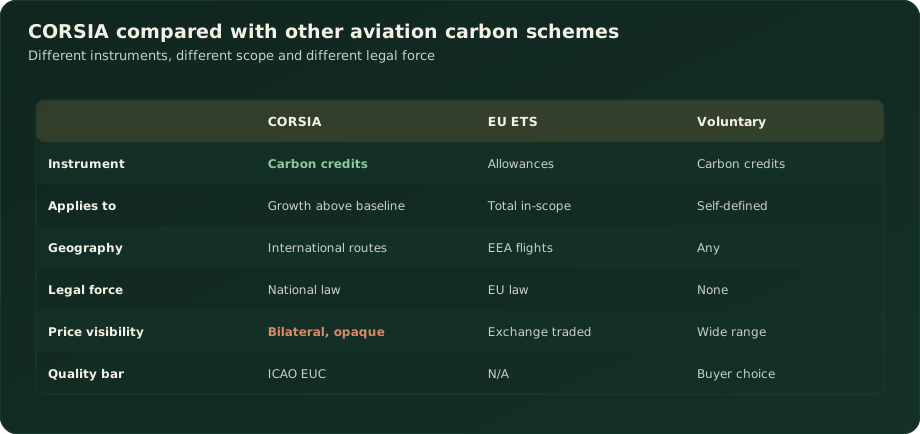
For how the schemes differ in instrument, scope, legal force and price visibility, see CORSIA vs EU ETS, UK ETS and the voluntary market. This piece is the operating problem.
Three Parallel Reporting Streams
The costliest misconception is that one emissions dataset satisfies everything. It does not, and the differences are structural rather than cosmetic.
| CORSIA | EU ETS | Voluntary | |
|---|---|---|---|
| Monitoring plan | Emissions Monitoring Plan | Separate EU ETS plan | None required |
| Approved by | National authority (DGCA in India) | Administering member State | — |
| Standard | ICAO Annex 16 Volume IV | EU MRV Regulation | GHG Protocol |
| Verifier accreditation | CORSIA framework | EU accreditation framework | Assurance standards |
| Scope | International, covered route pairs | EEA flights | Usually all operations |
| Settlement | Cancel EEUs, file cancellation report | Surrender allowances | Retire credits, disclose |
Different documents, different authorities, different verifier accreditation — drawing on substantially the same underlying fuel and flight data.
Build One Data Layer, Filter Downstream
The efficient architecture is a single authoritative emissions dataset, with scheme-specific boundary rules and calculations applied on top.
The inefficient and common alternative is three separate exercises, each reconciling the source data independently. Beyond the wasted effort, it produces figures that occasionally disagree — and a discrepancy between your own reports is the first thing a verifier or auditor will ask about.
Building the shared layer once is usually the highest-return work available to a multi-scheme operator. It is also the work that tends to go unowned, because it sits between flight operations, finance and sustainability rather than inside any one of them.
Mapping Scope Without Assuming
A flight falls under one scheme, both, or neither, and the answer is not intuitive.
| Flight | CORSIA | EU ETS |
|---|---|---|
| Paris to Frankfurt | No | Yes |
| Delhi to Mumbai | No | No |
| Delhi to Frankfurt | If both States participate | Narrowed scope |
| Delhi to Singapore | If both States participate | No |
Do not assume duplication, and do not assume exemption. Scope arrangements between the schemes have been designed to limit duplicate obligation on the same emissions, and they have changed as the relationship evolved.
Map your actual network route by route, document the reasoning, and revisit it when either scheme's scope changes. This is precisely the kind of determination a verifier will want to see reasoning for, and "we assumed" is not reasoning.
Budget Them Separately
The instruments behave differently as financial exposures, and combining them into one carbon cost line obscures that.
EU ETS allowances trade on a liquid exchange with continuous public pricing and a forward curve. The cost can be hedged with ordinary treasury instruments.
CORSIA units trade bilaterally with no reliable public reference, and supply is constrained by government authorisation decisions. It cannot be hedged the same way.
Two very different risk profiles. An organisation reporting a single "carbon cost" to its board is concealing that one half is manageable with familiar tools and the other is not.
Keep Claims Separate
The compliance error with the most reputational exposure.
Allowances surrendered under an ETS and units cancelled for CORSIA both discharge legal obligations. Neither is additionally available as a voluntary carbon neutrality claim.
An operator that surrenders allowances, cancels CORSIA units, and then reports carbon neutrality on the strength of those same instruments is double claiming. Disclosure regulators are increasingly alert to exactly this, and it is a straightforward finding to make.
The clean position: report compliance obligations as compliance, and any voluntary claim separately with its own retired credits.
SAF Serves All Three
The one lever that works everywhere, which changes its economics considerably.
Under CORSIA, qualifying CORSIA Eligible Fuels reduce the offsetting requirement directly. Under the EU ETS, SAF reduces the emissions requiring allowances. For voluntary commitments, it is the most defensible decarbonisation claim available to an airline, because it addresses the emission rather than compensating for it.
Documentation requirements differ between schemes and satisfying one does not automatically satisfy another — and the same fuel cannot be claimed twice. But the underlying purchase serves all three, which means assessed against any one scheme in isolation, SAF looks more expensive than it is.
Run the comparison across your full exposure, not scheme by scheme.
A Practical Operating Checklist
- Map scope route by route, per scheme, with the reasoning documented
- Build one authoritative emissions dataset; apply scheme rules downstream
- Maintain separate monitoring plans, approved by their respective authorities
- Engage separate verifiers, accredited under the right frameworks
- Budget the instruments separately, with different risk treatments
- Track scheme scope changes — the interface has moved before
- Keep compliance and voluntary claims strictly separate
- Model SAF against total exposure rather than one scheme
Resourcing Across Schemes
The staffing question follows from the instrument differences and is usually got wrong in one of two directions.
Under-resourcing treats CORSIA as an extension of an existing EU ETS process. It is not — different plan, different authority, different verifier accreditation, and a procurement exercise rather than a screen-price purchase.
Over-resourcing builds parallel teams, duplicating the data work that should be shared.
The arrangement that works: one team owning the shared data layer, with scheme-specific compliance owners drawing from it. The data engineering is common; the regulatory interpretation is not.
For the purchasing side, the split is sharper. Allowance management is a treasury function operating against a liquid market. Credit purchasing is a procurement exercise with a due diligence workstream, closer to buying a service than a commodity. Giving both to the same person because both are "carbon" produces someone doing one of them badly.
Watching the Interface
The relationship between schemes has changed before and is under periodic review. Three things to track:
EU ETS aviation scope. It has been narrowed, extended and reviewed repeatedly as CORSIA developed. A change moves flights between regimes.
CORSIA participation. A State joining or leaving alters covered route pairs, which changes which flights fall where.
Exemption arrangements. The mechanisms preventing duplicate obligation on the same emissions are policy instruments, not physical laws, and they have been adjusted.
Assign this to someone as a standing responsibility rather than discovering a change through a compliance surprise. A quarterly check of both regimes' published positions is sufficient, and it is the kind of task that never happens unless it is owned.
Where the Effort Actually Goes
For an operator running both schemes for the first time, the effort splits differently from expectation.
Data reconciliation dominates, and it is shared. Getting fuel and flight records into one defensible dataset is the same work whichever scheme consumes it, and it is the largest single line.
Scope mapping is scheme-specific and one-off, then maintained. Route-by-route classification takes real effort once and light maintenance thereafter, punctuated by a scope change.
Monitoring plans are separate documents with meaningful drafting effort each, because the approving authorities have different emphases.
Verification is doubled, with no shared preparation beyond the underlying data.
Settlement is entirely different — surrendering allowances is administrative; buying and cancelling credits is a procurement exercise with diligence attached.
The planning implication: budget the data layer once and generously, and budget everything downstream twice.
Frequently Asked Questions
Do the two schemes use the same emission factors? The underlying conversion from fuel mass to CO2 is consistent, but the scope rules, monitoring methods and reporting boundaries differ, so the same flight can produce different reported figures under each. That is expected rather than an error, and it needs explaining in your own documentation.
Which verification happens first? They run on separate calendars set by different authorities. Sequence them deliberately rather than discovering a clash — verifier availability is constrained in both regimes and the windows overlap.
Can the same team run both? The data work should be shared; the regulatory interpretation should not. In practice one owner per scheme, drawing on a common data layer, is the arrangement that works.
What happens if scope arrangements change? Flights move between regimes, which changes your obligation under both without any change to your operation. This is why the interface needs a standing owner rather than an occasional check.
Can EU ETS allowances be used for CORSIA? No. Different instruments serving different systems.
Are we double regulated on some flights? Scope arrangements are designed to prevent duplicate obligation on the same emissions. Map your network explicitly rather than assuming either way.
Can one monitoring plan cover both schemes? No. Different standards, different approving authorities. The underlying data can and should be shared.
Can one verifier do both? They must be accredited under the applicable framework for each. Confirm before engaging.
Which costs more? Depends entirely on network shape. CORSIA is proportional to growth; the ETSs are proportional to total in-scope emissions.
Can we claim carbon neutrality using compliance instruments? No. They discharge legal obligations and are not additionally available for a voluntary claim.
What is the highest-return thing to fix? The shared data layer. It removes duplicated effort and prevents your own reports contradicting each other.