CORSIA vs EU ETS, UK ETS and the Voluntary Market
An airline can face several carbon schemes at once. How they differ in instrument, scope, legal force and price visibility, where they overlap, and why the reporting burden is three parallel streams rather than one.
An airline operating into Europe with a public net zero commitment can be simultaneously subject to CORSIA, the EU Emissions Trading System, the UK ETS and its own voluntary pledges. These are different systems with different instruments and different consequences, and conflating them produces both over-purchasing and under-compliance.
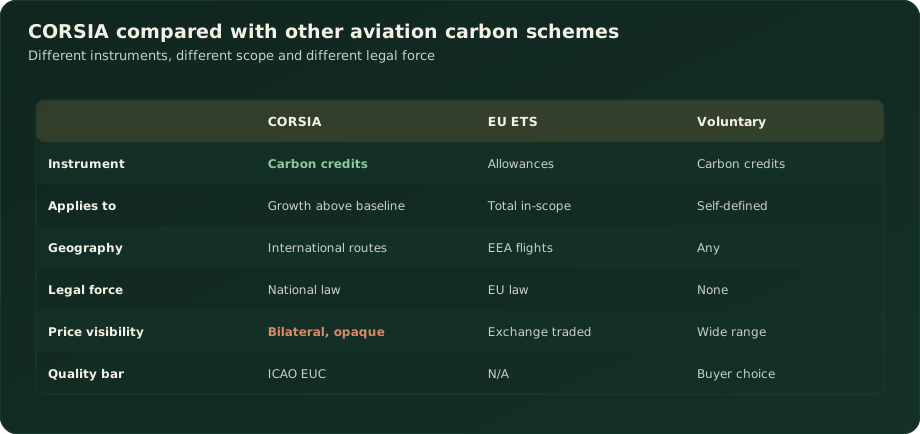
The Instrument Is the Core Difference
| Scheme | Instrument | Applies to |
|---|---|---|
| CORSIA | Carbon credits (EEUs) | Growth above the 2019 baseline |
| EU ETS | Allowances within a declining cap | Total in-scope emissions |
| UK ETS | Allowances within a declining cap | Total in-scope emissions |
| Voluntary | Carbon credits, buyer's choice | Self-defined boundary |
Credits against growth. Allowances against total. Credits by choice. That distinction drives almost everything else.
Scope
CORSIA covers international flights between participating States. Domestic flights are entirely outside it.
EU ETS covers flights within the European Economic Area, including domestic flights within member States. Its scope for flights to and from third countries has been narrowed repeatedly — the original full-scope design provoked sufficient objection that the EU limited application while ICAO developed CORSIA, and scope has been reviewed periodically since.
UK ETS covers UK domestic flights and flights from the UK to the EEA, following the UK's departure from the EU ETS.
Voluntary commitments are whatever the organisation defines, usually total operations.
Worked through:
| Flight | CORSIA | EU ETS |
|---|---|---|
| Paris to Frankfurt | No | Yes |
| Delhi to Mumbai | No | No |
| Delhi to Frankfurt | Yes, if both States participate | Narrowed scope |
| Delhi to Singapore | Yes, if both States participate | No |
Legal Force
| Scheme | Enforced by | Maturity |
|---|---|---|
| CORSIA | National law of the operator's State | Newer; penalties vary by State |
| EU ETS | EU law | Mature; financial penalties and operating restrictions |
| UK ETS | UK law | Established |
| Voluntary | None directly | Reputational and disclosure exposure |
Voluntary commitments carry no direct legal enforcement but increasing regulatory exposure through greenwashing rules and sustainability disclosure requirements. A public commitment can also become a contractual obligation to a corporate customer.
Price Visibility
EU ETS and UK ETS allowances trade on liquid exchanges with continuous public pricing and a visible forward curve. The cost can be hedged.
CORSIA units trade bilaterally with no reliable public reference. Pricing depends on programme, vintage, project type, volume and above all authorisation status. It cannot be hedged the same way, because the underlying is not liquid and supply is constrained by government decisions.
Voluntary credits span an enormous range across incompatible products.
This difference matters for budgeting: combining CORSIA and EU ETS into a single carbon cost line obscures two very different risk profiles.
Integrity Requirements
CORSIA applies the ICAO Emissions Unit Criteria — additionality, conservative quantification, permanence, independent verification, no double counting via corresponding adjustment, eligible vintage, no net harm, registry traceability. The corresponding adjustment requirement is the strictest single element in any operating scheme.
EU ETS and UK ETS do not currently permit international credits for aviation compliance. Allowances are the instrument, so credit integrity questions do not arise in the same form.
The voluntary market applies whatever standard the buyer chooses — flexibility that is a strength for buyers with specific priorities and a weakness under scrutiny.
Overlap and Double Regulation
Can a flight be regulated twice?
The mechanisms have been designed to limit this, principally through scope. EU ETS applies to intra-EEA flights; CORSIA applies to international flights between participating States. Where overlap could arise, exemption and offsetting arrangements have been used to avoid duplicate obligation on the same emissions.
The relationship remains under review, and the EU has periodically reassessed its own scheme's scope against CORSIA's development.
Do not assume duplication, and do not assume exemption. Map your network against both schemes explicitly and document the analysis. This is exactly the kind of determination a verifier will want to see reasoning for.
Which Costs More
No general answer — it depends on network shape and market conditions.
The structural difference: CORSIA is proportional to growth; the ETSs are proportional to total in-scope emissions.
- A carrier with stable intra-European operations and no growth faces a substantial EU ETS bill and possibly a small CORSIA one.
- A fast-growing carrier on international routes outside Europe faces the reverse.
Both are rising, for different reasons. The EU ETS cap declines and free allocation for aviation has been phasing out. CORSIA obligations rise as coverage expands in 2027 and the individual growth factor gains weight from 2030.
Reporting and Verification: Three Parallel Streams
The administrative burden differs as much as the financial one, and operators subject to several schemes routinely underestimate how little of the work is shared.
| CORSIA | EU ETS | |
|---|---|---|
| Monitoring plan | Emissions Monitoring Plan | Separate EU ETS monitoring plan |
| Approved by | National authority (DGCA in India) | Administering member State competent authority |
| Standard | ICAO Annex 16 Volume IV | EU MRV Regulation |
| Verifier accreditation | Accredited under the CORSIA framework | EU accreditation framework |
| Settlement | Cancel EEUs, file cancellation report | Surrender allowances |
Different documents, different authorities, different verifier accreditation — drawing on substantially the same underlying fuel and flight data.
The efficient answer, and the common inefficient one
The efficient approach is a single authoritative dataset feeding all schemes, with scheme-specific filtering, boundary rules and calculations applied downstream.
The common approach is three separate exercises, each reconciling the source data independently, producing figures that occasionally disagree. Disagreement between your own reports is exactly what a verifier will ask about.
Building the shared data layer once is the highest-return work available to a multi-scheme operator, and it is usually the piece nobody owns because it sits between functions.
SAF Works Across All of Them
Sustainable aviation fuel is the one lever that serves every scheme:
- CORSIA — qualifying CORSIA Eligible Fuels reduce the offsetting requirement directly
- EU ETS and UK ETS — SAF reduces the emissions requiring allowances
- Voluntary — the most defensible decarbonisation claim available to an airline, because it addresses the emission rather than compensating for it
Documentation requirements differ between schemes, and satisfying one does not automatically satisfy another. But the underlying fuel purchase serves all of them, which improves the economics relative to assessing any one in isolation.
Practical Guidance for Multi-Scheme Operators
- Map scope precisely — route by route, scheme by scheme, with the reasoning documented.
- Do not conflate instruments — allowances and credits are different products with different markets and risks.
- Budget them separately — one is hedgeable, one is not.
- Watch the interface — scope arrangements between schemes have changed and may change again.
- Keep voluntary claims consistent with compliance activity — claiming carbon neutrality on units cancelled for CORSIA compliance is a double claim, and disclosure regulators are increasingly alert to it.
- Model SAF against all schemes simultaneously — in isolation it looks more expensive than it is.
Where to Go Next
- What is CORSIA — the scheme in isolation
- CORSIA Eligible Fuels — the shared lever
- CORSIA MRV explained — one of the three streams
- CORSIA credit pricing — why it cannot be hedged like allowances
References: ICAO CORSIA and the EU ETS aviation pages.
DSTechnoverse maps multi-scheme exposure and builds the shared data layer that serves all of them. Talk to our team.
Need this applied to your position?
We assess operators’ obligations and developers’ eligibility pathways directly.