Most disputes about carbon credit integrity come down to one question: did the thing being credited actually happen, at the scale claimed? Traditional monitoring answers that with periodic surveys and sampling. Digital MRV answers it with continuous measurement, and that difference is reshaping which projects are considered credible.
What dMRV Actually Means
MRV is Monitoring, Reporting and Verification — the process by which a project demonstrates that its claimed reductions occurred.
Digital MRV replaces or supplements manual data collection with automated measurement: sensors, remote sensing, connected meters and automated data pipelines, with an audit trail a verifier can inspect directly rather than reconstructing from field reports.
The distinction is not merely technological. It changes what a verifier can check. Under survey-based monitoring, the verifier reviews a sampling methodology and a set of results. Under dMRV, the verifier can examine the underlying measurement record itself.
The Architecture
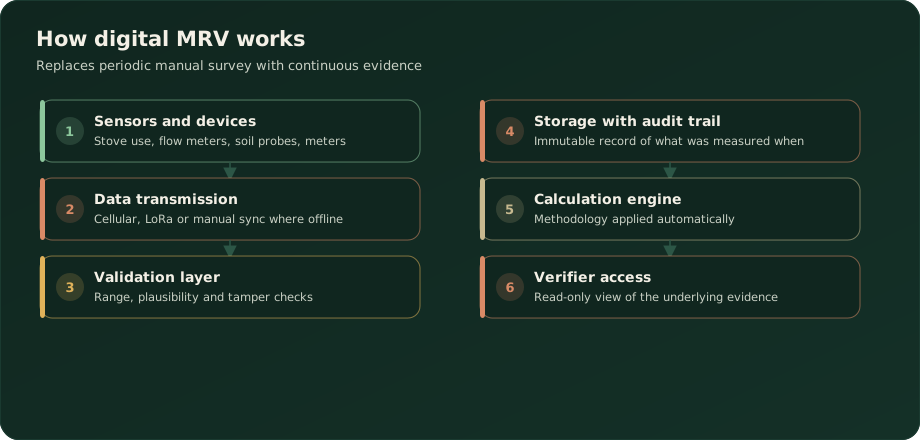
Sensors and devices. Stove use monitors recording cooking events, flow meters on biogas systems, soil probes, electricity meters, water treatment usage counters. What is measured depends entirely on the project type.
Transmission. Cellular where coverage exists, low-power wide-area networks such as LoRa where it does not, and periodic manual sync for genuinely remote deployments.
Validation. Range checks, plausibility checks and tamper detection applied on ingestion, producing an exception list rather than silently accepting whatever arrives.
Storage with an audit trail. An immutable record of what was measured, when, by which device. This is the part that changes the verification conversation.
Calculation. The methodology applied automatically to the measured data, rather than assembled manually each cycle.
Verifier access. Read-only visibility of the underlying evidence rather than a summary report.
Where It Helps Most
Not every project type benefits equally. The gain is largest where the contested variable is usage or operation over time.
| Project type | dMRV value | Why |
|---|---|---|
| Cookstoves | Very high | Usage rate is the most contested assumption in the category |
| Solar lamps and home systems | Very high | Distribution is not usage; sensors close that gap |
| Water treatment | High | Same problem — device provided is not device used |
| Biogas digesters | High | Operation over time is measurable directly |
| Landfill and methane capture | High | Flow and concentration monitoring is already instrumented |
| Forestry | Moderate | Remote sensing helps; ground carbon stock still needs plots |
| Engineered removals | Moderate | Already heavily instrumented by nature |
| Grid renewables | Low | Generation is already metered; the contested issue is additionality, which no sensor resolves |
That final row is important. dMRV improves measurement, not additionality. A project whose weakness is that it would have happened anyway does not become credible by measuring its output more precisely.
What It Costs
Honest accounting, because dMRV is frequently presented as free improvement.
Hardware per monitored unit, plus spares and replacement over the crediting period.
Connectivity — recurring data costs, which in rural deployments can exceed the hardware cost over time.
Platform — storage, processing and verifier access.
Field operations — installation, maintenance, battery replacement and recovering devices that fail.
Sampling design — determining how many units must be monitored to support a statistically valid inference across the population.
That last point is where cost is controlled. Universal monitoring is rarely necessary or affordable. A statistically valid sample, properly designed, supports the same inference at a fraction of the cost — and a project that monitors a well-designed sample thoroughly is more credible than one that monitors everything badly.
The Tension Nobody Mentions
There is a genuine trade-off that project developers face and marketing material tends to omit.
Money spent on monitoring is money not spent on the intervention. A cookstove programme that instruments every household reaches fewer households. One that instruments none produces credits nobody should buy.
The resolution is proportionality: monitor a valid sample well, use conservative assumptions where measurement is impractical, and be explicit about which is which. A project claiming universal sensor monitoring at scale should be asked what it cost and what it displaced.
What It Does Not Fix
Additionality. No measurement resolves whether the project needed carbon revenue.
Baseline credibility. Sensors measure what is happening now, not what would have happened otherwise. The counterfactual remains modelled.
Permanence. Measuring a forest precisely does not stop it burning.
Double counting. Whether another party claims the same reduction is an accounting and authorisation question, not a measurement one.
Data quality by itself. A sensor measuring the wrong thing, calibrated badly or installed incorrectly produces precise wrong numbers. Precision is not accuracy.
What a Verifier Looks For
If you are designing a dMRV system, design it against these questions:
- Can every reported figure be traced to specific device readings?
- Is the raw data retained, unmodified, alongside the processed result?
- How are gaps handled, and was the method defined in advance?
- How is tampering detected, and what happened when it was?
- How were devices calibrated, and how often?
- Is the sample statistically defensible, and how were units selected?
- Can the verifier access the underlying data directly rather than a report?
That last question is the one that most distinguishes a real dMRV implementation from a conventional system with a dashboard on top.
Designing the Sample
Because universal monitoring is rarely affordable, the sampling design carries most of the credibility — and it is the part most often handled loosely.
Size it against the variability, not against a percentage. "We monitor 5% of units" is not a statistical statement. The question is how variable usage is across the population and how precise an estimate the methodology requires. A homogeneous population needs a smaller sample than a heterogeneous one.
Select randomly, and be able to show it. Convenience sampling — the households nearest the road, the units easiest to service — biases the result in a predictable direction, because accessible units are usually better supported.
Stratify where the population genuinely differs. Rural and peri-urban households, different stove models, different climatic zones. Stratification improves precision for the same sample size.
Plan for attrition. Devices fail, households move, units are resold. A sample sized exactly to requirement at installation will be below requirement within a year. Over-sample deliberately rather than discovering the shortfall at verification.
Handle non-response honestly. Units that stop reporting are not units with zero usage, and they are not units with average usage either. The treatment must be defined in advance and should be conservative — assuming a silent device is performing at the sample average is the assumption most likely to inflate the result.
A verifier assessing dMRV will probe the sampling design before probing the sensors. Devices that work are easy to demonstrate; a sample that supports the inference claimed is the harder thing to establish.
The Direction of Travel
Two developments worth tracking.
Standards are increasingly requiring or rewarding digital monitoring in categories where measurement uncertainty has driven criticism. For cookstoves in particular, sensor-based usage evidence is moving from differentiator toward expectation.
Buyers are asking. Sophisticated purchasers now ask how usage is measured before asking the price, because the answer predicts the risk they are taking on.
For a developer, the practical implication is that dMRV capability is becoming a market access question rather than a quality upgrade — and retrofitting monitoring to a project designed without it is considerably harder than designing it in.
Choosing a dMRV Provider
The market has filled with platforms, and the claims are more uniform than the capabilities.
Ask what they measure, not what they display. A dashboard is presentation. The substantive question is which physical quantity is sensed, at what frequency, with what accuracy and how it is calibrated.
Ask about the audit trail specifically. Can a verifier see raw device readings, or only processed output? If the platform can silently adjust a value between ingestion and report, the audit trail is decorative.
Ask about failure handling. What happens when a device stops reporting, when a reading is implausible, when connectivity drops for a month. A provider without a clear answer has not run a deployment at scale.
Ask who owns the data. If the project's monitoring record lives only in a vendor platform, an exit from that vendor is an exit from your evidence base.
Ask for a reference deployment in your project type and geography. Cookstove monitoring in dispersed rural households is a different operational problem from metering biogas digesters, and experience does not transfer as readily as vendors suggest.
Check whether the methodology accepts it. A technically excellent monitoring approach that the applicable methodology does not recognise produces data you cannot credit against. Confirm before procuring.
The pattern to avoid is buying a platform before establishing what the methodology requires you to demonstrate. The requirement comes first; the tooling implements it.
Frequently Asked Questions
What does dMRV stand for? Digital Monitoring, Reporting and Verification.
Does dMRV make credits higher quality? It improves measurement confidence, which addresses one of several quality dimensions. It does not address additionality, baselines or permanence.
Which projects benefit most? Those where usage or operation over time is the contested variable — cookstoves, solar lamps, water treatment and biogas.
Is it expensive? Hardware, connectivity, platform and field operations all cost. Sampling design is what keeps it proportionate.
Do standards require it? Increasingly encouraged and in some categories effectively expected. Requirements vary by methodology.
Can a verifier rely on sensor data alone? Generally it supplements rather than replaces other evidence, and calibration and tamper detection become part of what is verified.
Does blockchain matter here? Some platforms use distributed ledgers for the audit trail. The substantive requirement is an immutable, inspectable record — how that is achieved matters less than that it exists.
Measuring, reporting or disclosing emissions and credits? DSTechnoverse works on the data side of carbon and environmental compliance — monitoring design, reconciliation, verification support and defensible reporting. See our CORSIA carbon credit services and data analytics. We are based in Indore, Madhya Pradesh and work across India and internationally.
Apply as a CORSIA buyer or seller
Talk to our team, or start with the complete carbon credits guide.